
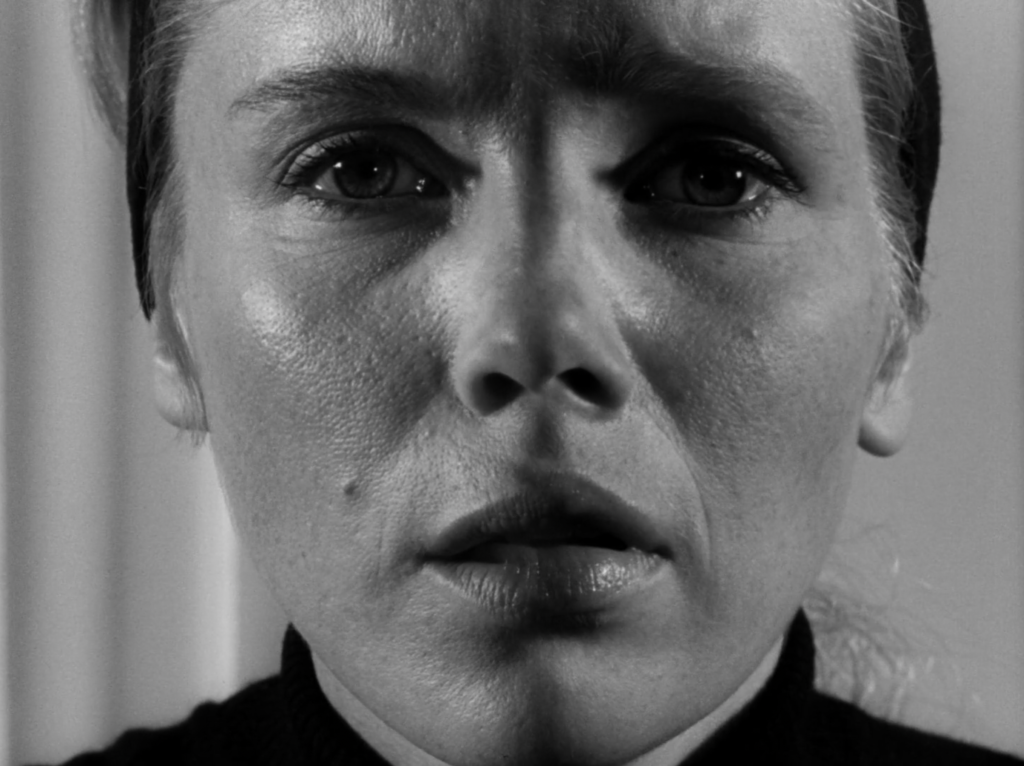
Nearly 60 years after its original release, Ingmar Bergman’s psychological masterpiece Persona remains an astonishingly elusive work: both intellectually provocative and deeply unsettling. Its return to cinemas in a new BFI re-release is a welcome opportunity to experience a film whose power has scarcely diminished with time. Indeed, despite its original release in 1966, Persona feels like a work that continues to anticipate the possibilities of cinema yet to come.
The premise is simple. Elisabet Vogler (Liv Ullmann), a celebrated stage actress, inexplicably stops speaking during a performance of Electra. Having been placed in the care of nurse Alma (Bibi Andersson), she retreats to a remote seaside cottage, where the two women gradually develop an intimate and psychologically volatile relationship. Alma, initially eager to fill the silence, begins to disclose her most private experiences and insecurities. Elisabet listens and watches but offers almost nothing in return. Yet as the film progresses, the apparent imbalance between them becomes progressively harder to define, as their identities, desires, and emotional boundaries begin to dissolve.
Bergman builds this relationship around the premise that silence can communicate more than speech. Elisabet’s refusal to speak appears at first to be an act of withdrawal but gradually transforms into resistance and borderline apparent cruelty. Alma, meanwhile, talks with an openness that exposes her vulnerabilities, leaving her increasingly susceptible to Elisabet’s scrutiny. Their relationship becomes a battleground for psychological control, although the distinction between aggressor and victim is never entirely clear.
At the same time, there is an unmistakable sapphic energy running through their relationship, which makes the intimacy between the two women all the more difficult to disentangle. Bergman does not define the nature of their attraction. He allows desire, admiration, jealousy and resentment to coexist in a relationship that shifts imperceptibly and constantly between affection and hostility. Their closeness carries an erotic charge, but it is never quite clear whether this is reciprocated, imagined, or simply another means through which one woman exerts influence over the other.
Beneath the film’s abstract explorations of identity lies something painfully recognisable about the dynamics of unequal relationships. There is a particular intimacy to watching someone gradually unravel in the presence of a person to whom they have entrusted their most private thoughts, only to receive almost nothing in return. Alma’s disclosures initially seem to bring the women closer, but as her confessions become increasingly personal, Elisabet’s silence begins to like a deliberate means of withholding of affection. The imbalance is agonisingly familiar to anyone who has experienced the vulnerability of caring more, revealing more, or needing more from another person than they are willing to give. Alma’s growing desperation is heartbreaking precisely because it is so recognisable: the painful realisation that having made yourself entirely available to someone does not mean they will meet you with the same openness. Bergman captures the particular cruelty of this emotional dependency in a way that allows us viewers to witness not just a psychological breakdown, but the devastation of someone who has made themselves vulnerable and found no corresponding affection on the other side.
In addition to the emotional complexity and devastation laid out in Persona, Bergman’s command of the cinematic image makes it an enduring achievement. Sven Nykvist’s monochrome cinematography transforms the stark coastal landscape into an environment of almost oppressive isolation. Faces become landscapes in their own right, captured in extreme close-up and scrutinised with a borderline uncomfortable intensity. The film’s most recognisable image, in which the faces of its two protagonists merge into one, distils the film’s central theme of the instability of identity: where does one woman end and the other begin?

The film’s opening montage, with its disjointed images, flickering film strips and abrupt transitions, announces an approach to storytelling that is clearly going to challenge conventional boundaries. At various points, the image fractures, the film itself seems to break apart before the audience. These interventions are not simply artistic flourishes. They draw attention to cinema as an act of construction, performance and projection, complicating our relationship with what we are watching and how much we can trust it.
It is an extraordinarily modern approach. The film’s exploration of fractured identities and the relationship between performance and selfhood would go on to influence generations of filmmakers. Its echoes can be felt in the work of David Lynch, among others, but Persona still feels distinctive. Bergman provides no definitive explanation for the women’s relationship, nor does he resolve the ambiguities that mount throughout the film. This is what makes Persona such a rewarding film to revisit. Its treatment of womanhood, sexuality, motherhood and emotional dependency is uncomfortable and confronting, but can’t be explained in a single watch. Beneath its psychological complexity is an acute understanding of the ways people perform versions of themselves for others, the vulnerability that comes with allowing those performances to fall away, and the emotional turmoil that can occur when the two combine.
The BFI’s re-release offers a timely reminder that cinema mustn’t be confined to the era in which it was made. Persona is a work of radical imagination, and one that continues to challenge our perceptions. Its mysteries may never be entirely resolved, but that is the point. Almost six decades on, Bergman’s masterpiece is as mesmerising, unsettling, and essential as ever.






Leave a Reply