
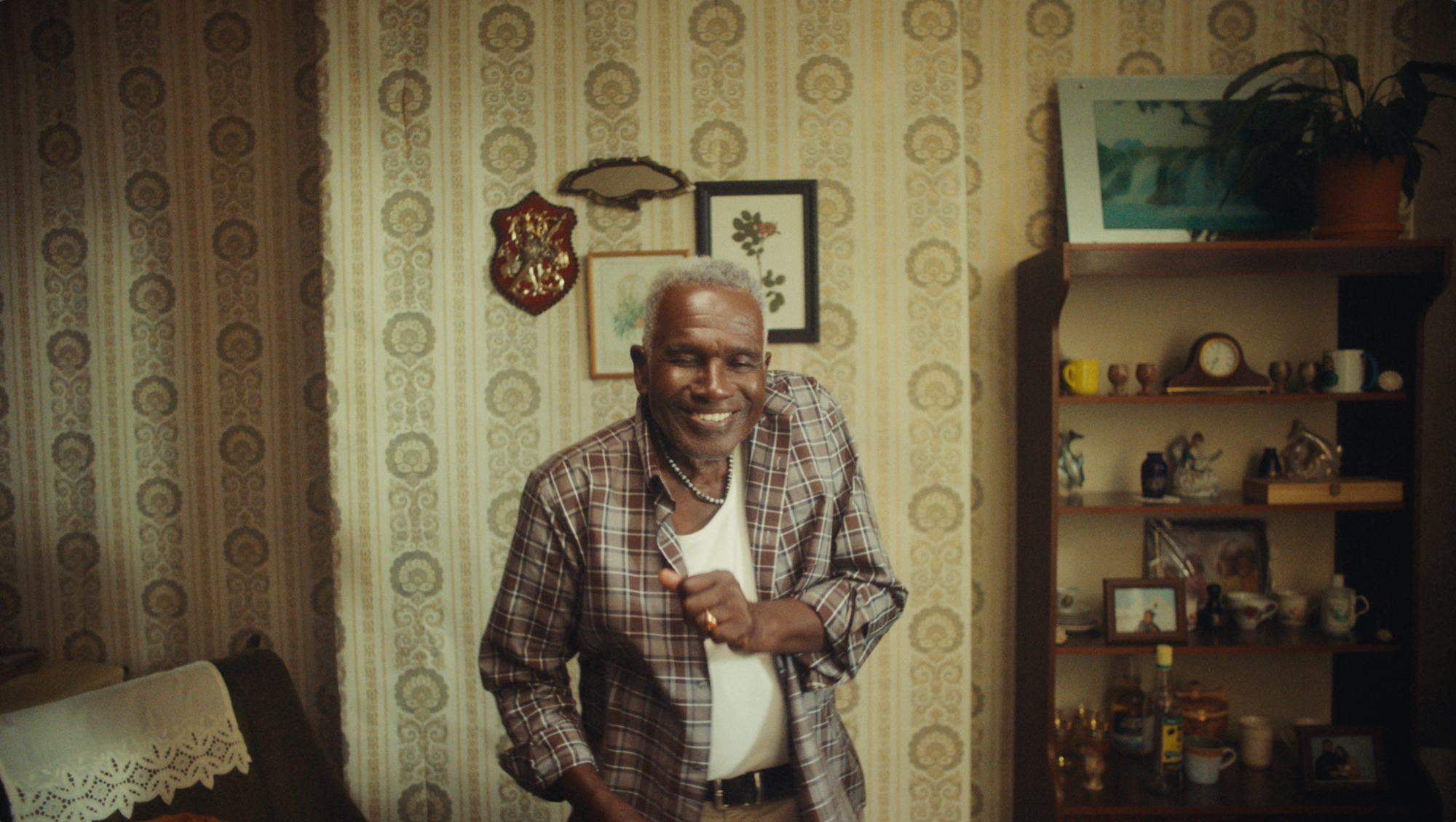
Grief rarely announces itself in grand gestures. More often, it settles into the quieter corners of everyday life: an untouched place at the dinner table, a familiar routine that suddenly feels incomplete, or the instinct to share something with someone who is no longer there. In An Ode to Joy, writer and director Ashleigh Ashley finds tenderness in these ordinary manifestations of loss, offering a moving portrait of love that persists long after death.
Starring the incomparable Rudolph Walker, the short film centres on Hezekiah, an older widower navigating life following the death of his beloved wife, Joy. Hezekiah continues to tend to the garden, maintains familiar domestic rituals and finds ways to remain connected to the woman with whom he has shared so much of his life. Joy may no longer be physically present, but her presence is unmistakable.
There is something deeply moving about the film’s attention to the small details of a shared life. Ashley understands that the loss of a partner is not simply the loss of a person, but of an entire world built together: its private jokes, familiar rhythms, and unspoken understandings. In allowing Hezekiah to hold on to these things, the film resists the expectation that grief must eventually be overcome. Instead, it suggests that love and loss can coexist, and that remembering someone can be an active and joyful part of continuing to live.
Walker’s performance is wonderfully understated, with a lived-in quality to his portrayal that makes the character feel immediately recognisable. Importantly, there is humour and a mischievous streak beneath his sadness, giving the character a fullness that is too often denied older men on screen. His relationship with his grandson also introduces a welcome intergenerational dimension, exploring how grief is experienced, communicated and understood across different stages of life.
That balance between melancholy and humour is among the film’s greatest strengths. Moments of lightness emerge naturally from the characters and their relationships, making the more poignant passages all the more moving. There is a subtle touch of magical realism that adds another dimension to the film’s exploration of memory and continuing connection, without undermining its otherwise grounded nature.

The personal origins of An Ode to Joy are particularly meaningful. Drawing inspiration from her late grandfather and her own family history, Ashley approaches the material with an obvious affection for the people and experiences that informed it. That sense of familiarity extends to the film’s production design, with elements of Ashley’s grandmother’s home finding their way into the setting.
In her narrative-directing debut, Ashley, whose experience includes producing and working across acclaimed television productions, demonstrates a clear understanding of how to create emotional resonance without relying on excessive sentimentality. Her filmmaking is attentive, and most importantly, she gives an older protagonist the space to be vulnerable, funny, complicated and wholly human.
There is a broader significance to this, too. Stories about ageing, bereavement and Black British family life remain underrepresented on screen, particularly those that allow older characters to exist beyond familiar stereotypes. An Ode to Joy makes a valuable contribution to that landscape, approaching its subject with specificity while finding something universal in the experience of loving and losing another person.
The film’s most moving proposition is also its simplest: grief is not the opposite of love, but one of its enduring expressions. In Hezekiah’s continued devotion to Joy, Ashley finds a beautiful reminder that the people who shape our lives do not simply disappear when they are gone. Warm, thoughtful, and uplifting, An Ode to Joy marks an exciting arrival for a filmmaker with a genuine sensitivity for human stories.




Leave a Reply