
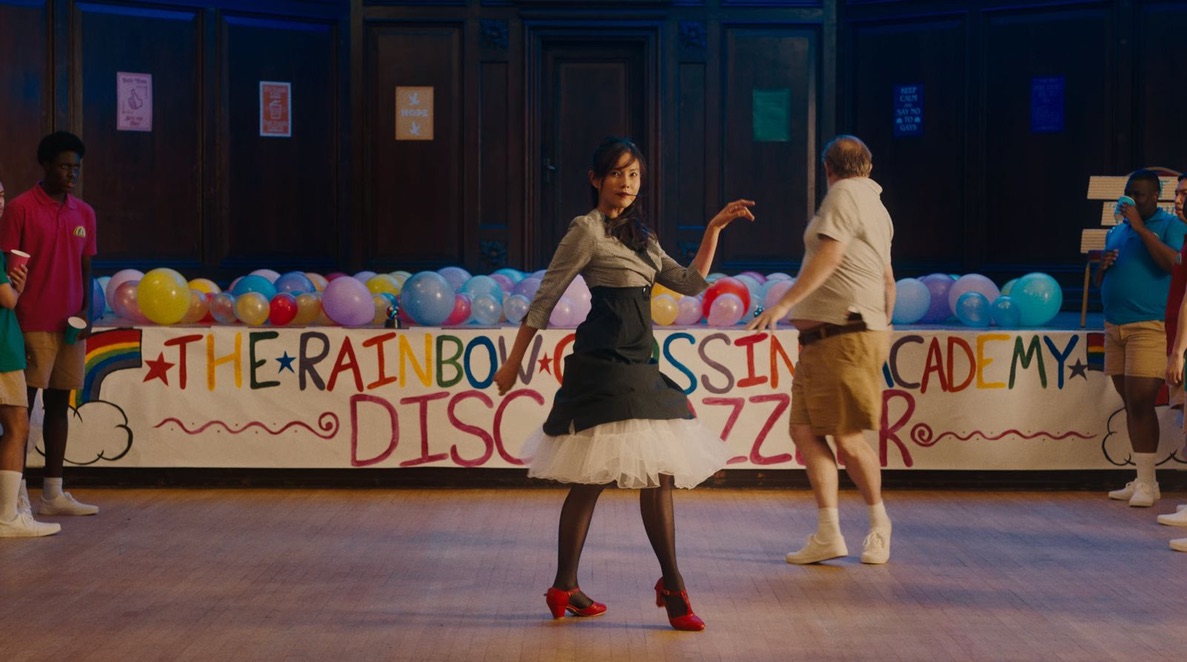
Jacob Sarkisian’s The Rainbow Crossing Academy is a riotously entertaining and refreshingly joyful take on a subject that cinema has so often approached through the lens of trauma. Centred on Sebastian, a young man who voluntarily enrols in a gay conversion camp in the hope of becoming straight, the short film finds plenty of absurdity in an institution whose very premise is as misguided as it is ridiculous. Yet beneath its comedic exterior lies a tender story about self-acceptance, internalised homophobia, and the journey towards embracing who you are.
As Sarkisian explains to Close-Up Culture, Sebastian’s struggle is inspired by his own experiences of growing up gay and wishing he could be someone else. This emotional authenticity gives the character’s journey an added poignancy. Some of the film’s most meaningful moments occur when it briefly steps away from its more outrageous humour to explore the fear and confusion beneath Sebastian’s desire to change. There is something wonderfully ironic about the rainbow-coloured uniforms worn by the camp’s residents, an accidental celebration of the very identity its leaders are attempting to suppress. The Rainbow Crossing Academy is funny, heartfelt, and wonderfully unapologetic, with a message that feels all the more powerful for being delivered with such infectious optimism. It is a thoroughly delightful piece of filmmaking, and one that leaves you wanting to spend more time in Sarkisian’s world.
A young man voluntarily enrolling in conversion therapy in the hope of becoming straight is a hilariously unusual premise. Where did the initial idea come from, and what drew you to Sebastian’s particular journey?
The idea was kind of a response to Jordan Peele’s Get Out. I loved that film and it got me thinking about approaching social issue stories in a creative way, which led to me coming up with a horror story set in a gay conversion camp. After multiple re-writes, however, it just wasn’t working. But I liked the concept and characters and so approached it with something that for some reason comes easier to me – comedy. And, having done so much research into gay conversion camps, I realised how easily gay conversion camps and “their science” lend themselves to comedy. They are naturally hilarious. Sebastian’s journey, meanwhile, is essentially my own. I never attended a conversion camp thankfully (although I did try to!) but I went through the same internalised homophobia Sebastian does.
When I realised I was gay, I was terrified. I tried everything I could to not be gay – I prayed the gay away, self harmed, hated myself for being gay and would have done anything to not be. I then got a girlfriend (my second girlfriend, to be transparent) and she was wonderful. I truly loved her in my own way and she was perfect. And I was devastated that I was still having these feelings that something wasn’t right, and eventually just had to accept that I was gay. So Sebastian’s journey of not wanting to be gay and desperately wishing he could be straight because he genuinely loves his girlfriend is inspired completely by my own journey as a young man.
Conversion therapy can be a really traumatic subject. What made you feel that comedy was the right genre through which to explore it?
I’ve always felt that comedy is the best genre to approach serious subjects, inspired by Mel Brooks and also Taika Waititi’s Jojo Rabbit. It enables audiences to engage with the subject matter in a much more approachable way. Comedy makes serious subjects easier to digest, and it takes the sting out of them. We have seen lots of conversion camp stories where they show the pain of conversion camps but I wanted to show how utterly stupid and ridiculous they are, and comedy was just the right way to do that. It wasn’t a hardship to make these camps seem ridiculous, because they are. I wanted to give queer audiences the chance to laugh at our oppressors rather than fear them.
Sebastian’s journey is as much about internalised homophobia as it is about the external pressures placed upon him. How important was it to explore the ways in which LGBTQ+ people can internalise the very prejudices they are subjected to?
Absolutely, it is about internalised homophobia. A lot of young people discovering they are gay or queer come to that realisation with horror – we are taught from a very very young age that being gay is wrong. It is almost embedded into us. Before we even know what being gay really means, we know that society thinks it’s something bad. So we have all of this hard-wired into our brains before we even get to our formative years, so trying to come to terms with who you are as a teen (tough years for anyone, anyway!) when who you are is seen as something to be abhorred, is genuinely scarring. You are taught to dislike gay people, so when you realise you are gay, you therefore dislike yourself. It takes years to unlearn. And I wanted to focus on that inner journey to again make it about us – queer people – rather than about the idiocy and bigotry of others.
We should be the main characters and the absolute focus in our story, so it just made sense to make this an internal story about Sebastian’s internal homophobia. Lots of conversion camp stories have their lead characters forced into the camp – I thought it would be really interesting to have our character choose to enrol himself out of desperation to be different, which is something many queer people will relate to, and the journey of unlearning that and learning to like yourself with the help of others is a huge part of the queer experience for many and is ultimately what this film is about.

Something that immediately stands out is the film’s vibrant colour palette and cinematography. How did you arrive at this aesthetic?
Thank you! I really wanted this film to be a joyful experience despite the subject matter so I wanted it to be visually engaging. I love marrying the visuals with the tone of the film, so the cinematography style I developed with my excellent DP Neal Parsons was crucial to that. We gave the camera bags of energy, using lots of whip pans, crash zooms, double dolly zooms, and other playful techniques to ensure that our filmmaking style matched the playful, comedic tone of the story, inspired by how Edgar Wright did the same with his films.
The image of these boys lined up in different coloured t-shirts that makeup the colours of the rainbow was the first image I had and became the cornerstone of the film. Not only does it make the film incredibly vibrant and puts the rainbow into The Rainbow Crossing Academy but it is also very ironic. The leaders of the camp, Eve and Keith, have inadvertently dressed these boys in the colours of the gay pride flag – a rainbow. And I just thought that was a very funny irony that sums up the spirit of the film and the idiocy of these camp leaders.
How did you approach casting and working with the actors to ensure that the comedy never undermined the emotional vulnerability of the characters?
Sydney Aldridge was our casting director and she helped us cast a fantastic crew of varied actors. The key to never letting comedy undermine the emotional vulnerability of the characters was to give the characters genuine emotion and journeys. Keith, Eve’s second in command wonderfully played by Steevan Glover, is funny because he is tragic. Jordan (Louis Serkis) has a real vulnerability to him. I told my actors not to try and play the comedy, just let the world and the conversion camp itself kind of do the work and provide the funny. All of the actors therefore approached these characters as very real genuine people, and that’s what makes it funny – the combination of comedy and tragedy. The actors know they’re in a comedy, but the characters don’t. They’re just living their lives trying to get what they want, and that’s how we approached it with my actors.
This is your first short film as a director. What did the experience teach you about your own filmmaking instincts, and was there anything about the finished film that surprised you?
I could write essays about how much it taught. It wasn’t just my first time as a director but my first time on a film set, and it was a joyous experience. It taught me that adaptability and flexibility is the ultimate weapon on a film set. We prepared so much but inevitably something will go wrong that makes you have to adapt – I actually had to rewrite an entire scene (the salt water scene) the night before we shot it due to a location issue. And I was surprised how flexible I was and how readily I could change something so big and make it even better than the original plan. But I think if you have done your prep and really make sure you know the story and characters inside and out, you’ll reach a stage where you know exactly how to change and where to go when you need to change. I also think the editing process was the biggest learn. My editor Billy Morley was fantastic and I learnt how much you could really re-shape the film and the film’s tones or certain scenes or character beats, as long as you approach it with creativity and an open mind. This was certainly a film made in the edit. I think the surprise to me was how much leaning into different tones worked.
Originally, the phone call scene with Seb’s girlfriend was just a call between him and Daisy and it was much more comedic. But I realised in the edit that the scene did not work coming off the back of that very silly and funny boyband dance scene. It just felt flat. So, in a late stage idea, I decided to go completely the other way and embrace the earnestness and emotion of the character – and so the home video footage sequence was born. And it just worked so much better, and helped me get to the heart of Seb’s character and what I wanted to say with the film much more – this is all starts when we’re kids. We’re all just scared kids hoping to be liked, hoping to be happy, and it is so sad that society and these places and people beat that out of us as we get older. The kid in those home video footage clips is actually me, too.

With LGBTQ+ representation becoming more visible on screen, do you think there is still a tendency for queer stories to be told through narratives of trauma and suffering? Was making something as irreverent and playful as The Rainbow Crossing Academy partly a response to that?
Making The Rainbow Crossing Academy playful and fun was 100% a response to how many queer stories are about trauma and suffering. I grew up watching those stories and it terrified me! There’s still room for those stories, of course, and some of those stories are genuinely amazingly made films, but personally why would I as a queer person want to watch queer people suffer? Particularly when we do in real life anyway. So I wanted RCA to be the opposite of that – I wanted it to be escapism and a joy, where queer audiences can have fun and we can laugh at the world together.
What do you hope audiences take away from the film? Is there a particular conversation or reaction you’d like it to provoke?
Conversion camps are still legal in the UK where I’m from and in lots of other countries. There’s a bill being debated now in the UK about trying to outlaw gay conversion camps and there is somehow some push back. If RCA could play any part in helping to outlaw camps in the UK, that would be amazing. But we are a short film, we probably won’t have that reach, so ultimately I’d just love for audiences to have a good time and enjoy the film and hopefully want to watch it again as I do believe there’s lots in there that a second viewing would be worthwhile! Plus, we’d love to make the feature film!
Ultimately, if audiences come away from this having had a fun time and laughing out loud, I’d consider that a job well done from my amazing team.




Leave a Reply