
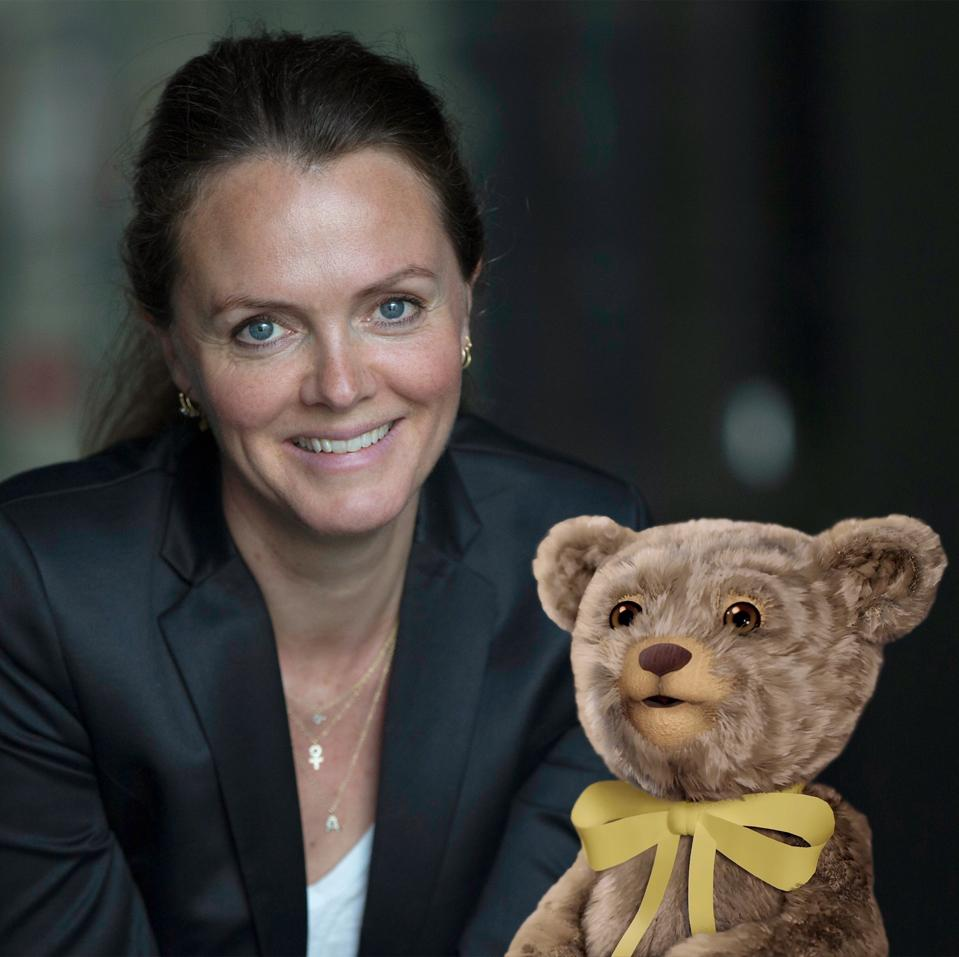
Set during the rescue of Danish Jews in October 1943, the Oscar-qualified animated short Remember My Name tells a deeply moving story of wartime separation through the eyes of a young girl’s teddy bear.
Directed by Sascha Kempinski and Kirsten Skytte and adapted from Kempinski’s own graphic novel, the film transforms a personal family history into an intimate portrait of loss, courage and human kindness.
In this interview with Close-Up Culture, producer Rebecca Pruzan discusses translating the book’s distinctive visual world to the screen and approaching difficult history for young audiences.
Having previously produced IVALU, which went on to receive an Academy Award nomination, you’re now producing another Oscar-qualified short, Remember My Name. What attracted you to this project, and what made you want to become involved in bringing Sascha’s family history to the screen?
I was immediately drawn to Sascha Kempinski’s family story and her graphic novel. It carries a deeply personal history, but also speaks to something universal: displacement, separation, family, love and the longing to belong.
I was particularly captivated by the idea of telling this chapter of history through the eyes of a little teddy bear. It offers a different and very intimate perspective on events that can otherwise be difficult to approach, especially for younger audiences.
I also fell in love with the graphic novel’s bold, artistic and distinctly Scandinavian visual language, created by Sascha’s mother, Jeanne Kempinski. I felt there was something very special here – a story that could touch audiences beyond its historical context and remind us of our shared humanity, and of the importance of helping one another, regardless of religion, culture or background.
As a producer, how did you approach translating such a deeply personal and historically significant story into an animated short film? Were there particular challenges in handling its emotional and historical subject matter?
For me, one of the most important things was to preserve the emotional truth of Sascha’s family story while finding a cinematic language that could communicate it to a broad audience, including children.
The story is about a very young child being separated from her parents during the rescue of Danish Jews in October 1943. It is an intimate family tragedy set against an enormous historical event. We had to find the right balance between those two perspectives without making the film either too illustrative or too emotionally overwhelming.
I have spent many years working with storytelling for children, both as a producer and previously as a Commissioning Editor at DR. That experience made me particularly aware of the importance of respecting young audiences : not shielding them from difficult realities, but finding ways to approach them with sensitivity and honesty.

The film brings together two female directors and a female producer. How important was that creative collaboration, and what did each of you bring to the project?
The collaboration was central to bringing the film to life, with each of us contributing different strengths.
Sascha brought her deeply personal family history, the original graphic novel and its distinctive visual universe which helped shape the story and its artistic vision. Kirsten Skytte brought her extensive animation experience, technical knowledge and creative ingenuity, helping translate that vision into an animated film. I brought my experience as a producer, my background in storytelling for children and my commitment to developing the project from the moment I discovered the book through to the film’s distribution.
It was a collaboration built on different perspectives and complementary skills. I believe that combination made the film stronger and helped us bring Sascha’s very personal story to the screen.
You previously experienced the Oscar campaign journey with IVALU. Has that experience influenced how you’re approaching the campaign for Remember My Name, and what have you learned from taking a short film to an international audience?
Absolutely. Having experienced the Oscar journey with IVALU, I know how demanding and resource-intensive a campaign can be, and how important it is to build relationships, create visibility and make sure the right people actually get to see your film.
But every film is different, and this is my first time campaigning for an animated short. We are learning a lot along the way. With Remember My Name, we are trying to build a campaign that goes beyond the traditional festival circuit, with screenings and events in different territories and outreach to animation professionals, cultural institutions and educational organisations.
One thing I learned from IVALU is that you cannot do this alone. It takes a dedicated team, a strong network and a lot of persistence. And perhaps most importantly, you have to believe in the film and keep finding new ways to bring it to audiences.
With Holocaust survivors and eyewitnesses becoming fewer, how important do you think films like Remember My Name are in preserving personal histories and introducing younger generations to the events of the Holocaust?
I think it is becoming increasingly important. We are reaching a point where the responsibility for remembering and passing on these stories rests more and more with the next generations. We cannot rely on eyewitnesses being there to tell their stories forever.
For Sascha, the film is also deeply personal. She made a promise to her elderly father that their family’s story would never be forgotten. Making this film was her way of honouring that promise and ensuring that their history would reach generations who may never have the opportunity to hear it directly from those who lived through it.
But I also believe we need to find new ways of approaching history. Remember My Name is based on one family’s experience, but it is not only a film about the Holocaust. It is also about what happens when families are torn apart, about the pain of separation, and about the people who choose to help others, often at great personal risk.
These are themes that remain deeply relevant today. I hope the film can encourage younger audiences to engage with history, but also to reflect on their own responsibility towards other people. History is not only shaped by political leaders and major events; it is also shaped by ordinary people making extraordinary choices.
Animation can make difficult historical subjects more accessible without diminishing their seriousness. What do you think the medium offers filmmakers when telling stories about trauma, memory and historical injustice?
Animation offers a unique freedom to tell stories that might be difficult to approach through live action. It can create a certain emotional distance, allowing audiences to enter a painful subject through imagery, metaphor and imagination, without losing its emotional weight.
In Remember My Name, the teddy bear becomes our emotional companion and our way into the story. We experience the events through his perspective, which allows the film to communicate something very profound without relying on dialogue or explicit depictions of violence.
I also think animation can reach audiences across generations and cultures. It allows us to approach difficult subjects in a way that is both accessible and artistically expressive. But accessibility should never mean simplifying the subject or underestimating the audience.
What has been the most rewarding aspect of producing Remember My Name, and what do you hope the film achieves as it continues its journey through festivals and the Oscar campaign?
The most rewarding aspect has been seeing a very personal family story grow into something that can touch people who have no connection to the family or even to the historical events themselves.
I am proud of what we have created together, and particularly proud that we have found a way to bring this story to younger audiences without losing its emotional depth.
Of course, we are working hard on the Oscar campaign and hope to take the film as far as possible. But beyond the awards, I would love to see it reach schools, museums and educational institutions, where it can open up conversations about history, displacement, separation and the importance of compassion.
Ultimately, I hope audiences leave the film with a reminder that, even in the darkest times, we have a choice in how we treat one another. And that helping someone, regardless of their background, can make all the difference.




Leave a Reply