
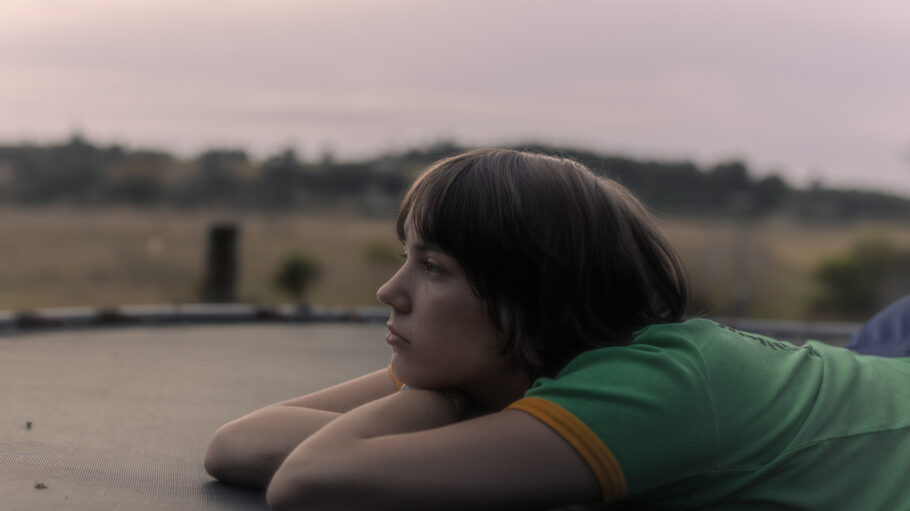

Fourteen is an age defined by contradictions: wanting desperately to be seen while simultaneously wishing to disappear, performing confidence while privately wrestling with insecurity. In her feature debut, Big Girls Don’t Cry, writer-director Paloma Schneideman perfectly captures these contradictions through an intimate portrait of adolescence, queer identity and the painful business of growing up.
Set in a small coastal town in rural New Zealand during the summer of 2006, the film follows fourteen-year-old Sid (Ani Palmer) as she attempts to navigate the social world around her. Spending her school holidays with her childhood best friend Tia (Ngātaitangirua Hita), Sid finds herself drawn towards a group of older, more sophisticated girls, particularly the effortlessly charismatic Lana (Beatrix Rain Wolfe). When her older sister Adele’s (Tara Canton) American friend from university, Freya, (Rain Spencer) arrives for the summer, Sid becomes preoccupied with the possibilities of a different kind of adolescence. Keen to reinvent herself, she begins experimenting with new identities, relationships and behaviours, often finding herself out of her depth.
Schneideman perfectly captures the social hierarchies of teenage girlhood. Sid’s attempts to ingratiate herself with the older girls can be excruciating to watch, not because they are particularly unusual, but because they are so recognisable. The exaggerated stories borrowed mannerisms and desperate attempts to appear more experienced than she really is all speak to the insecurity of someone who has yet to establish a sense of self.
Yet Big Girls Don’t Cry is never condescending towards Sid. Though she can be selfish, dishonest, and even cruel to those closest to her, these shortcomings are not shown as moral failings. Instead, Schneideman frames them as part of the messy process of self-discovery. Sid’s fascination with the older girls, and particularly her relationship with Freya, occupies an uncertain space between admiration, identification, and attraction which is common to the queer coming of age experience. Schneideman captures the vulnerability of discovering one’s sexuality without an obvious framework through which to understand it, especially in a small rural community where the possibilities for self-expression are limited.

The 2006 setting is particularly effective for the narrative. The early internet, MSN conversations and online chatrooms offer Sid an alternative space in which to experiment with her identity. Her online behaviour is often reckless, and the consequences of her attempts at reinvention are not always apparent. Nevertheless, the internet becomes an important extension of the film’s wider exploration of performance: the different versions of ourselves we construct in the hope of being accepted, and the precariousness of maintaining them.
Palmer is exceptional as Sid. There is an immediacy to her portrayal that makes even the character’s smallest reactions feel significant. She captures the restless energy of adolescence alongside its more uncomfortable moments of vulnerability, often communicating far more through a look or a shift in expression than through dialogue. It is an especially impressive debut, and one that gives the film much of its authenticity. Spencer brings an appealing self-assurance to Freya, while Hita gives Tia a tenderness that makes the deterioration of their friendship particularly moving. Noah Taylor is also excellent as Sid’s father, Leo, whose emotional distance provides another source of frustration and loneliness for his daughter. Their relationship is characterised by the familiar irritations of family life, but beneath the bickering is a more complicated longing for attention and understanding.
Visually, the film is beautifully attuned to its setting. Cinematographer María Inés Manchego captures the sun-drenched coastline and languid rhythms of a New Zealand summer. There is an intimacy to the camerawork that keeps the audience close to her perspective, observing the people and situations around her with the same curiosity, apprehension, and occasional embarrassment that define her experience.
There is a generosity in the way the film regards its young protagonist. It neither romanticises adolescence nor treats its discomforts as something to be overcome. There is a recognition that awkwardness, confusion, and occasional cruelty are all part of becoming a person. With a wonderful central performance from Palmer and a confident, perceptive directorial voice, Big Girls Don’t Cry is a beautiful and moving debut. Schneideman has made a film that understands just how enormous the world can feel at fourteen, and how difficult it can be to find your place within it.






Leave a Reply