
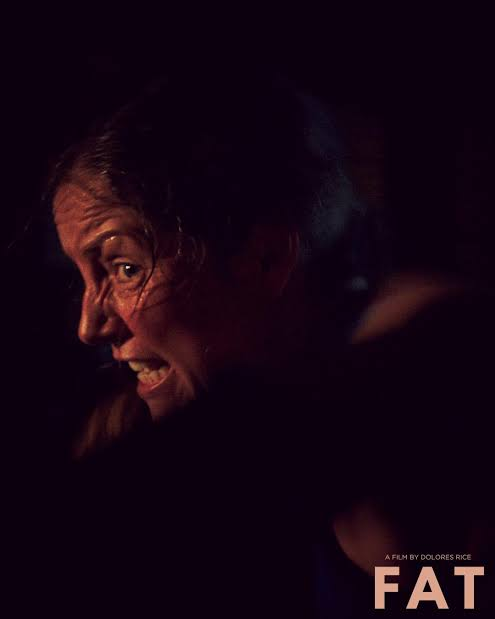
Tackling the lasting psychological and physical impact of childhood sexual abuse, Fat subverts expectations by framing a deeply personal journey of survival through the lens of a psychological thriller.
Following its protagonist, Maeve, across childhood, adolescence, and adulthood, the film examines how unresolved trauma manifests in the body -and how movement, community, and self-belief can interrupt the cycle.
Director Dolores Rice speaks to us about the research that sparked the project, casting three actors to share one soul, and the quiet power of “private heroism.”
Fat tackles the deeply sensitive subject of childhood sexual abuse and its lasting impact on survivors. What initially inspired you to tell this story, and why did you feel it was important to explore the subject through the psychological thriller genre?
I knew how prevalent this issue was. I also realized how difficult an experience it is to speak about. Then I came across this research paper highlighting the high correlation with eating disorders and CSA. In this specific poll 46% of women struggling with excess weight had been assaulted as children. This felt like urgent and fertile ground to explore through film. Psychological Thriller felt like the appropriate genre as many people who experience CSA are left with a feeling of perpetual terror in their bodies which they often try to mask and bury through food. So Fat is an attempt to uproot the terror and hand it back to its source, namely the perpetrator.
The film follows Maeve across three different stages of her life, showing how childhood trauma can continue to shape someone’s identity and relationship with their body into adulthood. How did you approach portraying this journey, and what did you want audiences to understand about the long-term effects of trauma?
In the first instance, with the child, I really wanted the audience to experience viscerally the heinousness of the crime. Sometimes we can talk about these things and remain somewhat removed from the actuality of what we are describing. I wonder if this removal means that less effective steps are taken to protect children from this happening again or to help people who have already experienced this. In the second instance, with teen Maeve, I wanted to show the nobility, the strength and the exuberance of the indomitable human spirit to keep on growing defiantly in spite of such experiences but how these experiences, if left undealt with, can take us down again and again and again.
Then finally with Adult Maeve, I wanted to show how this experience wove itself into Maeve’s psyche in a way that completely derailed her life. I wanted to show the culmination of trying to suppress the terror with food as a sedative almost. But then with the reminders in her psyche of the child and the young woman’s strength which they found through dance, I wanted to illustrate that both that child and teen were still inside of her, and that the body that could find beauty and strength then could do the same now. That no one is destined to succumb to the devastating effects of this trauma, but that there is a way through.
One of the film’s central themes is the relationship between trauma and the body, particularly the role that food can play as a coping mechanism. Your research into this connection helped inform the story. What did you discover during that process that particularly stayed with you?
The idea of sedation. We often think of alcohol and drugs, or even media as a way to sedate us from experiencing uncomfortable feelings in our body, and we are certainly as a society very aware now of emotional eating. But what stayed with me most was the physical manifestation of eating to quiet the noise of trauma. Because it also helps give the illusion that you are disappearing your self. That by adding weight to your body you are hiding, and protecting it. You are building up an armor of what is not you to defend what is you from the world. There is also the dopamine component. As a person who lives with active trauma in your body you are also circumnavigating uncomfortable feelings. Hits of food pleasure are something you can ensure make you feel better for a moment.

You use dance and kickboxing as powerful physical elements within the film, presenting the body not simply as a place where trauma is carried but also as a source of resistance and empowerment. What inspired these creative choices, and how did they help communicate Maeve’s journey towards reclaiming herself?
Like horses shaking off shock, I think there is something to people dancing off trauma. It seems as though it is important to move your body in the face of difficult life events to shake up the molecules so you don’t stagnate in the residue of shock or fear or shame. But the result is not permanent so you have to keep moving. I really wanted to show how the body has extraordinary resilience. The body seeks out strength and momentum when it is put into motion. Trauma is all about being stuck in loops of past realities, movement can interrupt these loops and perceiving your body as strong and with agency allows you to experience the world from a vantage point of active participant rather than passive receiver. I wanted to show a Maeve who was not forced to succumb to her trauma but instead found a way to retaliate against its directive.
The film moves between childhood, adolescence and adulthood through distinct visual styles, reflecting the fragmented and sometimes intrusive nature of traumatic memories. How did you work with your cinematographer and wider creative team to establish these different visual worlds?
It was very important to me that even though we captured time through a different palette that there was very little technique given over to transitioning between the three timelines. I hoped to communicate that these memories live actively in the present-day protagonist’s psyche and body. They may have a different texture, which we captured with the marvelous design team through costume, location dressing, make-up and hair and again with great grading in post-production as well as sound-design, but the fluidity of the edit as we move through time is there to demonstrate that trauma and memory are actively living in a present-day body, that CSA is a harm that is not fleeting but can be everlasting.
The performances of Liz Fitzgibbon, Willow McCarthy and Emmy Nolan are central to bringing Maeve’s different stages of life to the screen. How did you approach casting three actors to portray the same character, and how did you ensure their performances felt emotionally connected?
Willow was cast first as she is my daughter and an actress in her own right and dancer. Then, for the other roles, I had a wonderful casting director, Amy Rowan. She suggested both Liz Fitzgibbon and Emmy Nolan. There was a great physical symmetry between the three characters and a similar energy also in that they all have this deep inner life going on, old soul-energy. We also chose shots that would align perfectly in the different time-frames to make the connection, the ballet connecting Teen and Child Maeve, the chips-eating connecting Teen and Adult Maeve.
Although Fat confronts an incredibly difficult subject, you have described it as a story of hope, courage and what you call ‘private heroism’. What does that idea mean to you, and how important was it that the film offered something beyond simply depicting trauma?
I suppose because that is why I made the film. We often see these stories as a plot point, or a crisis, or a moment of drama where a victim is created, but actually, CSA is so pervasive in society, I truly believe we need to move beyond the shame and repulsion that keep such stories shrouded in silence and hushed tones because that does not help people who have experienced this. Women, and men, everywhere are walking around with this particular trauma feeling isolated and hopeless. There are ways to live with this and move beyond it that are empowering and practical. I wanted to show a story where real steps were taken by Maeve to find agency again. Part of this is through social systems but mostly through friendship (community support), and self-belief. I hope that Fat gives other people the will to believe in themselves to learn to navigate this trauma in an empowered way, even if that simply means sharing a story they hadn’t dared to share before.

You have spoken about audiences responding to the film with a sense of relief, particularly because it addresses a subject that is so often kept private. Why do you think storytelling and shared cinematic experiences can help break the silence surrounding childhood sexual abuse?
I have been sitting with this idea a lot. I think that being in a room, the cinema, where the collective is metabolizing this story of shame alongside you, lifts the heavy burden of carrying this story alone. The act of watching Fat unfold and being able to feel the person next to you not running away, not feeling too ashamed to be in the room, yearning for Maeve to get to the other side of it and celebrating her small victories along the way, I think that is a relief to everyone. I also believe that perpetrators are weak men (primarily) who try to take strength away from girls and women (primarily – up to 1 in 3 women have been assaulted as children, and up to 1 in 6 men) and the trick is to remember that these perpetrators are only further weakened by the act, that in fact, the girls (and boys) and women (and men) have their strength intact, they just need to remember that. It’s all about purging the delusion that any permanent diminishment took place in your body. The only person diminished is the predator. What better place to purge delusion together than through storytelling in a cinema alongside your fellow humans – the public sharing of difficult stories relieves the weight of carrying these stories alone.




Leave a Reply