
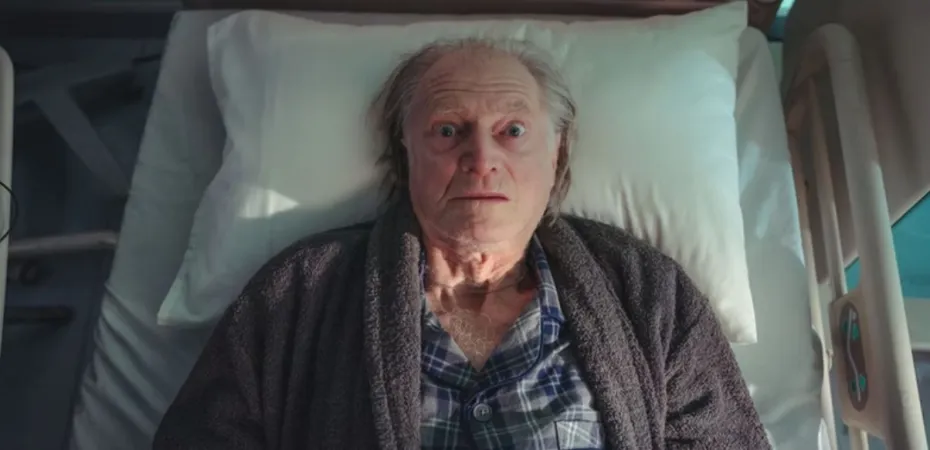
Writer-directors Daniel Audritt and Kat Butterfield sat down with Close-Up Culture’s Senior Writer Genevieve Dammery about their short film Life Goes On, a comedy that brings an unexpected twist to the familiar time-loop narrative.
Set in a hospice and led by remarkable performances from David Bradley and Maggie Steed, the film finds humour, tenderness and poignancy in its exploration of mortality, family and the importance of making the most of the time we have.
We caught up with Audritt and Butterfield to discuss the film’s origins, the challenges of bringing its ambitious premise to life, and their aspirations for the future.
The film has a rather unusual premise. There’s something unexpected about taking the time-loop narrative and placing it within a hospice setting, with a character who is already at the end of his life. What made you decide to take the story in that direction?
Kat: The idea took quite a few years to percolate and develop into what it eventually became. It was never a single moment of inspiration; different elements came together over the course of about 15 years. It’s difficult to describe exactly how it came about because there were so many contributing circumstances. It was partly inspired by my experience working in a hospice about 13 years ago, which shaped me quite significantly.
Daniel: We often see hospices portrayed on television and in films, and Kat will always say, “They’re not actually like that. They’re not dark, depressing and gloomy. They’re joyful and full of heart.” Years ago, Kat wrote a sitcom based on a hospice. She was told by someone quite senior in television that she had a better chance of finding a winning lottery ticket than getting a comedy set in a hospice commissioned. I think that helped shape her determination to prove them wrong.
Kat: I do think it’s a brilliant setting for comedy. It has all the ingredients I find interesting: bittersweetness, tragicomedy, warmth, family and pathos. Having worked in a hospice and observed what they are actually like gave me a foundation to draw from. Initially, though, I had a comedic idea: wouldn’t it be funny if a man were on his deathbed, being visited by people he really didn’t want to see? I called Dan, and he thought it was funny, but pointed out that it wasn’t really a story yet. It was just a funny scene.
Daniel: That idea was sitting in the background for a while. Around the same time, we’d rewatched Palm Springs and had been discussing what our own version of a time-loop story might look like. We realised that territory had already been explored by films like Groundhog Day and Palm Springs, so we abandoned those ideas. Then, one day, Kat went out for a run and all these different elements seemed to come together: the hospice experience, David Bradley as an actor, the idea of time loops, family and our own experiences of bereavement. She came back with the idea, and I immediately thought, “That’s a story. That’s great.”
Kat: I said, “What if he can’t die?” The man in the hospital can’t die, so he has to relive the same day over and over again. It’s his final day, but he can’t actually reach the end of it. It felt quite inappropriate and outrageous, and we weren’t entirely sure whether we could get away with it. But we liked that feeling. We decided to lean into it and explore the idea, even if it seemed a little risky.

I think what’s particularly clever about the film is that, although the time-loop premise is familiar, you’ve found a really different way of approaching it.
Daniel: What we loved about Kat’s idea was that most time-loop stories follow someone who feels stuck in life. They experience the loop, learn to appreciate what they have and eventually emerge as a better person, ready to approach life differently. We liked the idea that our character has no future in that sense. There is no tomorrow in which he can become a better man or start living differently. The time loop therefore becomes less about how you make someone a better person or teach them to appreciate life, and more about how you have a good death, resolve your unfinished business and appreciate the time you have left.
I’d love to say that was the intellectual thinking behind the idea from the beginning, but, as you’ve just heard, Kat initially just thought the idea of someone being unable to die was funny!
David Bradley is phenomenal in the role and Maggie Steed is equally wonderful. Maggie at the screening I attended, where she was watching the film for the first time. What was it like seeing her reaction, and have you spoken to her much since?
Kat: We’ve exchanged a few messages. We were quite nervous because Maggie is the sort of person who will tell you if she’s unhappy with something.
Daniel: She’s delightful and incredibly funny, but she’s also tough. You don’t sustain a career for 50 or 60 years without being tough. That doesn’t mean she’s not lovely to work with, because she absolutely is.
Kat: She was so funny on set. She’s hilarious. I became less nervous when she laughed for the first time. She had this wonderful habit of saying, “Oh, stop it!” whenever she found something particularly funny. I loved how often she said it. She also started crying quite early on, during David’s final bed bath with the nurse. At that point, I thought, “Okay, I know she likes it!” We could see her reaction afterwards and knew we had to get her up on stage. We weren’t planning to do that, but we wanted to capture the moment, and thankfully someone filmed it. It was such a lovely response.
Daniel: There were two particularly special things about that moment. Firstly, it was Maggie’s first time seeing the film. Secondly, she and David have been friends for 40 or 50 years. When David signed on to the project, he actually suggested Maggie for the role. He knew she was a brilliant actor, but I think there was also something special about the opportunity to work alongside her again. They’d always wanted to work together, and when they were younger, they’d even joked that by the time they finally managed it, they’d probably be old people. When they first saw each other on set, they were laughing about the fact that it had finally happened. I think Maggie’s reaction was partly about seeing the film itself, but also about watching a very dear friend deliver such a wonderful performance. She’s one of David’s biggest fans, and she knows just how brilliant he is.
Kat: She actually said that, when she first read the script and filmed her scenes, she hadn’t quite realised the range of emotions the story contained. It wasn’t until she watched the finished film that she saw David move through so many different emotional states, from grumpiness and sadness to happiness and everything in between. Maggie has been in touch with us since the screening, and apparently she was on the phone to David the following day in floods of tears, telling him how amazing he was. She also said how lovely it was that we’d been able to use the full range of his talent. We already felt that David had been somewhat underused in certain respects. He’s had an extraordinary career, of course, but he often plays brilliant, scene-stealing supporting characters rather than getting the opportunity to carry an entire character arc. We really wanted to demonstrate everything he could do, so it meant a lot to hear that from Maggie. She has known him for so long and seen so much of his work. For her to feel that we’d managed to showcase such a wide range of his abilities was incredibly rewarding.
That’s so lovely. You can really see the affection between them in the film, and how much they enjoyed working together. Their relationship feels so natural, and it genuinely doesn’t feel like acting. The film relies on a lot of repetition, with each iteration of the day slightly different from the last. When you’re shooting those scenes, how do you make sure you capture all the significant moments in each performance, while retaining the emotional and narrative differences between each version?
Kat: It was really tough.
Daniel: We were essentially filming the same material four or five times. We worked closely with our director of photography, Hamish Anderson, who we’ve known for many years, and established a rule that we would shoot each day differently. That at least gave the crew a visual reference for where we were in the story, because the filming style changed as the narrative progressed. In terms of the actors, some scenes required everyone to do exactly the same thing while we changed the camera approach. Others were more interactive with David, particularly the scenes involving Jane, who plays the nurse.
We had to be very specific about which version of the scene we were shooting. Fortunately, we’d worked with our crew, particularly the heads of department, for many years, and some of the actors had worked with us before. David also trusted us enormously. That was the key thing: everyone trusted that Kat and I knew what we were doing. And if we didn’t, it was our money on the line!
I can imagine! And it was shot incredibly quickly, wasn’t it?
Daniel: Three and a half days! I don’t think any member of the crew knew exactly what was happening 100 per cent of the time. There was always someone who would essentially say, “Okay, if you know what you’re doing, just tell me and I’ll do it.” When we got into the edit, I was convinced I’d dropped a shot somewhere, or that there was some problem with a take that I hadn’t noticed. I was convinced there would be something in the background, or some issue that we wouldn’t be able to work around.
Kat: We did a lot of planning, particularly for the more complicated camera movements. We knew what we wanted to do with those beforehand, although some took longer than expected. The freeze-frame sequence, for example, took nine takes.
Daniel: And it was never the actors’ fault! It was always something moving in the background. There was also a particular pressure that came with having such an incredible cast. David Bradley, Maggie Steed, Amanda Root and Matt Berry had all agreed to give us their time. They loved the script, and we were confident in what we’d written. What we didn’t want was to let them down in the production itself. When you’ve got such a strong script and such a fantastic cast, you don’t want to be the people who somehow mess it up. That was a lot of the pressure we felt.
Kat: We were also producing the film ourselves, which was probably a mistake! We didn’t bring in another producer, so we took on all of that work as well. We were effectively the production managers, too, largely because we were trying to save money, as you do with a short film.
It sounds chaotic, but clearly very rewarding. This is your first narrative short film, although you’ve both done a lot of work in comedy writing. What has the experience of making a narrative film taught you about filmmaking that your previous work might not have prepared you for?
Kat: I think the biggest difference is the length and complexity of the narrative. We’ve done a lot of sketches, which tend to be around three to five minutes long. You don’t necessarily have to worry about continuity in the same way, and there’s considerably less for your actors to learn.
Daniel: With a sketch, you’re essentially setting up a joke, getting as many punchlines out of that premise as possible, landing the payoff and then getting out. That’s a sketch in a nutshell. One of the biggest lessons for us was understanding pacing. Coming from comedy, we had to develop the confidence to recognise when a scene didn’t need to be funny. Sometimes you need to let a moment exist in its own reality, allow the characters to be fully realised people rather than simply devices for generating jokes, and trust the audience to sit with that. You also need to understand when to bring the comedy back in, and when to exercise restraint. You have to be able to turn the comedy on and off, rather than feeling that every scene needs to deliver a joke.
We initially had some edits of Life Goes On where we’d taken out far too much of the breathing room. Everything was moving too quickly. We worked with a fantastic editor, Hettie Griffiths, who helped us find that balance. Sometimes we’d let a moment breathe and realise we’d lost too much pace; other times we’d cut too aggressively. Learning how to balance those two things was probably the biggest lesson. The other thing the experience has taught us is that we can make narrative films. Our ambition is to write feature films and television projects that have more room to develop, and before making this film, we could say that was what we wanted to do, but we didn’t necessarily know whether we could. Now, I feel much more confident that we can.
The film finds humour in a setting that film often approaches with solemnity. How did you navigate that tonal balance, and was there ever a concern that the comedy might undermine the weight of the subject matter?
Daniel and Kat: I think this was one of the trickiest elements to be honest. Sometimes, both at script stage and in the edit, we’d go too far one way or the other and have to re-adjust, but I think we found the balance. Trying to get it so when we shifted from comedy to drama and back again, it didn’t feel like a massive, unearned gear-shift was key for us. It’s definitely really risky to broach such a sensitive topic with humour but it was a challenge we wanted to undertake (pardon the expression!) To us, having a tightrope walk of light and shade is the best way to tell a story like this because life is all about light and dark co-existing. Our favourite comedies do exactly this – so we wanted to give it a go and see if we could too. As comedy writers, we felt very comfortable in the comedic scenes but having the restraint to maybe lose a joke or two in service of the bigger picture was a learning experience for us.
There’s a real skill involved in crafting a short film. You have to keep people engaged, give them a complete narrative and leave them satisfied. I think Life Goes On achieves that beautifully. You come away feeling that you’ve watched a complete story, with an ending that feels entirely right. I imagine achieving that in less than 20 minutes is quite a challenge.
Kat: It needed to be on the longer side of a short film. We always knew we wanted to tell what was essentially a whole movie in 19 minutes. We wanted to tell an entire narrative, and part of the motivation was also to prove to ourselves that we could make a feature film. We wanted a story that felt complete, with a proper conclusion.
Daniel: There are some brilliant short films that are more like slices of life. They might show you 12 minutes in someone’s life, leave a lot of questions unanswered and offer something quite artistic and beautiful. That’s not necessarily our style. We wanted to make a film that happened to be 19 minutes long, rather than taking a story that should be two hours and trying to squeeze 19 minutes of it into a short film because that’s all the money available allows.
Daniel: We wanted audiences to come away with that feeling of hope and joy at the end, even though the film is about death. We kept describing it as a life-affirming comedy about death.

I think that’s a wonderful description of it. Finally, what’s next for you both and for Life Goes On?
Kat: We’ve now been longlisted for the Oscars, so we’re very much in the middle of that process.
Daniel: We’ve also got quite a few festivals left to attend. We’re only about six months into our festival run, and we’ve got around 10 festivals this month alone, with more still to hear from. Beyond that, we’re trying to get some feature films off the ground. We’ve written a few, and we’re hoping to use this short film to demonstrate to actors that we can make something we’re proud of and that they can trust us to deliver on a larger project. Hopefully, that will encourage them to come on board with some of the feature films we’ve been developing.
What do you think the film ultimately says about the way we spend our lives and the things we choose to leave unsaid?
I think what we wanted it to be about was being intentional with the time you have on this earth because whether you’re on your deathbed or not, you don’t have infinite time. We wanted it to show the importance of vulnerability too, because often these walls we build to protect ourselves from being open or getting hurt, are often the things that are limiting our enjoyment on this planet and standing in the way of connection – which after all, is what life is all about.
David Bradley leads the film with a performance that requires him to communicate a great deal through subtle changes in behaviour and expression. What was it about him that made him the right person to play Bill?
It was only ever him. If he’d said no, Life Goes On, would be a PDF in a folder and nothing more. When we were discussing the idea, we just knew it had to be him. Firstly, you have a shorthand with the audience with David because he’s known for playing evil or grumpy characters – so having him as a curmudgeonly bloke who doesn’t want to be bothered was pretty easy. But what David also has that audiences aren’t as aware of, is this incredible warmth as a person and a great sense of humour and fun. What we wanted to do was reel the audience in with what they know him for, and then shock them with everything else he has to offer.
Also, with David, he has this ability to think a different thought and his whole face changes. He can soften his entire expression with a thought. It’s amazing to see. We knew he was a fantastic actor, but when we first saw him on camera, there was a collective moment between us and the whole crew where we looked at each other and went “wow”.
The film has received some fantastic recognition on the festival circuit. Has the response from audiences, particularly those who might have personal experiences of bereavement or end-of-life care, differed from what you initially anticipated?
Dan & Kat: I think we’ve received the response we dreamed of receiving but didn’t necessarily think we’d get. Obviously as a filmmaker getting into amazing festivals and picking up awards is something you always want, but to be honest, we’ve been blown away by the messages we’ve received from audiences around the world telling us how much the film has meant to them. We’ve even had the film described as ‘profound’ which we still can’t get over as we really don’t know if we were meaning to be, and if we did, we perhaps did it accidentally?! Having a re-do of life whilst on your deathbed ended up being such a good metaphor for life’s big questions, which is funny as it honestly started as purely a comedic idea that grew a heart by adding elements that just felt grounded and true.
We also wanted to make something that felt very ‘us’ so we made something really specific to our experiences and observations and the kind of characters we’ve seen in our life – Bill even speaks in a very northern working class British dialect, which is where Kat is from. We definitely worried at multiple points that it was too niche, too personal to travel – but I think its specificity has really allowed people to resonate with it no matter where they are in the world – that response has been a big shock to us and very hard to wrap our heads around.
Having spent so much time with Bill and the world of Life Goes On, has making the film changed either of your own perspectives on mortality, family relationships or the importance of expressing how you feel?
I think it was a really nice way to reaffirm our core belief, which is that we don’t have much time in this life, enjoy it, laugh, be open with the ones you love and things maybe won’t be as scary. It’s reaffirmed something we think we needed to learn ourselves which is that expressing your feelings can be an incredibly brave thing to do, especially if you’re used to keeping it all to yourself. The experience of sharing the film with the world has meant that people have, in various ways, analysed the film on our behalf, and it’s made us realise some of the deeper reasons we had for writing it – sometimes a story comes out of you without you knowing why it came out, and this whole process has been like holding up a mirror to ourselves – a very vulnerable experience, which is rather apt for a film about vulnerability!



Leave a Reply