
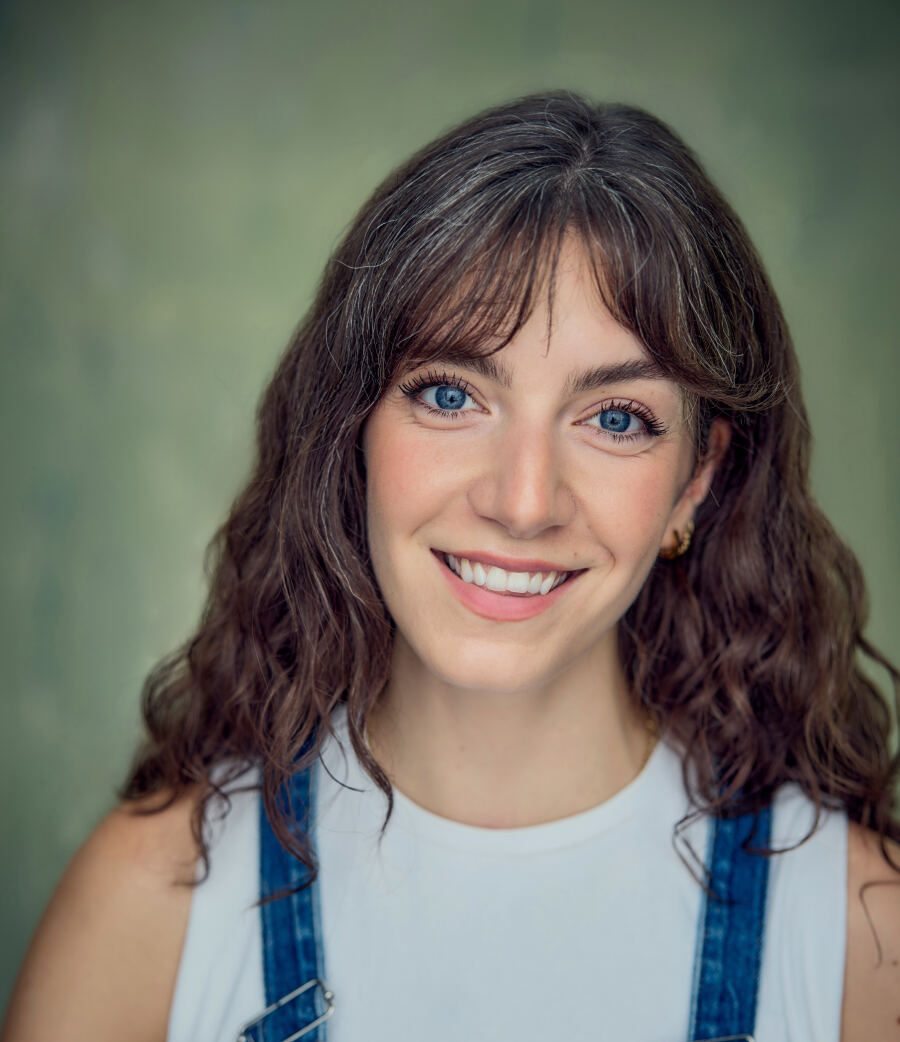
Tired of waiting for gatekeepers to say yes, actress, writer, and producer Frankie Minnock decided to take her creative destiny into her own hands. While acting remains her lifelong passion, stepping behind the camera has reshaped how she approaches storytelling, collaboration, and vulnerability on set.
In this interview with Close-Up Culture’s James Prestridge, Frankie opens up about championing female-led projects, playing Alison in The Beth Complex, and why having a little audacity is the key to making things happen.
James: You’ve worked across acting, writing and producing. How has being involved in different parts of the creative process shaped the stories you want to tell?
Frankie: As an actor, I was frustrated by the fact that I was always relying on other people to say yes to me. They were always the final barrier between me and getting a job.
Eventually, I reached a point where I thought I should start creating something myself and explore some of the other areas of the industry.
I really enjoyed it, had fun and learned a lot. But it also made me realise how important collaboration is and that you don’t need to do everything yourself. There are always other creatives looking to work on something fun and new, and people with different strengths who can bring something valuable to a project.
That’s something I’ve really learned to appreciate.
In terms of the stories I want to tell, I’m particularly drawn to female-led stories, and projects that excite me.
I have a little rule: a project either needs to be something really fun that brings me a lot of joy, or something more poignant that has a deeper meaning and makes you feel something. If it ticks one of those boxes, I’m usually excited about it and want to get involved.
James: I can relate to that. Even with this website, I want to do everything, but I’m not necessarily good at everything!
Frankie: Honestly, that’s so relatable! That’s exactly what I’ve learned. I enjoy exploring those other areas, but acting is my main passion. I’ll always do other things to get projects moving and express my creativity, but working with people whose strengths lie in those other areas is much more important.
James: Is there a particular type of character or story you’re drawn to? What makes a script stand out to you when you’re deciding whether to take on a project?
Frankie: I’m drawn to complex, well-written characters – say’s every actor ever haha! I’m sure other actors can relate to receiving a script and thinking, “What is this even trying to say?” Then you get something that’s really well written, and you immediately get excited.
Last year, I worked on a short film called The Beth Complex, written and directed by Maggie Dickinson. The story focused on four sisters and was partly inspired by Little Women.
I loved it because every character was so different, well thought out and beautifully written. It was an amazing project to work on, and I honestly had the best time.
In terms of the projects I’m drawn to, it could be almost any genre. I don’t like limiting myself to one particular type of story because there are so many things I want to explore.
Ultimately, the baseline is that it’s well written, the characters have depth and it makes me excited then I want to be involved.
James: Having experience behind the camera as well as in front of it, has writing and producing changed the way you approach acting or collaborating with directors?
Frankie: It’s made me realise even more that creating a film, television show or any kind of project is a team process.
As an actor, my job is to bring the director’s vision to life, and I think communication is incredibly important in making that happen.
Having worked on both sides, I’ve realised just how important it is to make sure everyone understands the vision, feels excited about it and, importantly, feels comfortable.
I know how scary and embarrassing the job (acting) can feel. Let’s be honest, what you’re doing is quite ridiculous sometimes! You’re putting yourself in an incredibly vulnerable position in front of people you might not know very well or have only just met.
Having experienced things from both perspectives, I understand how important it is to create an environment where everyone feels comfortable. When actors feel comfortable, that’s when you get their best work.
James: When you’re developing a character, how do you find the balance between bringing your own interpretation to the role and staying true to the writer’s intentions?
Frankie: Developing a character is probably one of my favourite parts of acting. I really enjoy figuring out who a character is, why they behave in certain ways and what has led them to make particular decisions.
I love understanding people and working out why they do the things they do.
I also find that when a script is well written, the character is already there on the page. A lot of the hard work has been done for you. You don’t necessarily have to spend as much time figuring out who they are because you can already see it in the writing.
Of course, you can explore their backstory, create memories and build a world around them if those things aren’t already established. But when something is well written, so much of that information is already there.
James: Is there a particular role you’ve played so far that you’ve found especially interesting or exciting to approach?
Frankie: I’d say The Beth Complex, which I mentioned earlier. The character I played was called Alison, and you meet her in a really vulnerable state.
She goes through a lot throughout the short film but there are so many things happening beneath the surface. I enjoyed finding ways to keep all of that bubbling away without necessarily showing it all the time, as well as establishing her relationships with each of her sisters and how they differ.
In terms of staying true to the writer’s intentions, I’ve learned to trust my instincts when I first read something. I can usually get a feeling for how I think a character should behave or how a particular scene should work, and I’ve learned to trust that.
At the same time, it’s really important to remain open and adaptable. That’s such a big part of acting: being able to change something and try it a different way.
Sometimes a director will introduce a new idea, and you suddenly think, “Actually, that’s really interesting. How can we explore that?” I think that’s one of the most exciting parts of creating a character.
James: Was there a particular moment in your life when you realised acting was what you wanted to do, or has it always been something you’ve been drawn to?
Frankie: It’s been what I’ve wanted to do since I was tiny. I can’t tell you exactly how old I was, but I’ve always been incredibly drawn to it.
I loved films, tv shows and going to the cinema. It’s where I’ve always felt most at home, and I still do. I love going to the cinema by myself. It’s probably my favourite hobby.
When I was younger, I would watch films, and as I got older, I started to realise that acting was something people could actually do as a job.
I’ve always loved creating stories, playing pretend and using my imagination, so it felt like a natural progression.
I’ve never really had any other career options in mind. I’ve always been so drawn to acting.
My boyfriend often tells me how lucky I am because I’ve always known what I wanted to do. There are so many people who struggle to find that one thing they’re passionate about.
He reminds me that, although it’s not an easy career and there are plenty of ups and downs, I should appreciate having such a clear vision of what I want to achieve.
I always try to hold on to that.
James: Has there been a particular moment or experience in your career that has taught you the biggest lesson?
Frankie: I don’t know if there’s one particular moment that stands out as the biggest learning curve, but over time I’ve learned to trust myself more.
I’ve also realised how important it is to put yourself out there. Nobody is coming to find you. You have to be a little bit delusional, believe in yourself and keep going.
I’ve always had that mindset to some extent, but over the last couple of years, it’s really clicked for me. I’ve started going all in, having a bit more audacity and genuinely going for the things I want.
I’m trying all the different things I can to make it happen.
James: Social media is a great place to do that.
Frankie: Absolutely. I started posting to share my work and explore different creative opportunities, and it’s already brought me some amazing experiences.
I also find it really fun. It’s a creative outlet, and I’ve met some great people through it.
There are also opportunities for short films, casting calls and other projects being shared on social media. It’s become a really useful hub for creatives.
Of course, there are plenty of negatives to social media, but there are positives too, and I try to focus on those.
James: Do you feel there’s a line between being an actor and being a content creator on social media, or do the two roles naturally overlap?
Frankie: I think there is a line, but it’s interesting because it’s still relatively new territory. Things are constantly changing and evolving, so I think we’re all learning as we go.
For me, I’m an actor first. One hundred per cent.
But if I can use social media to support my acting career, share my work and help younger actors by passing on information I’ve learned, then of course I’m going to do that. It’s another avenue for those things.
James: If you could drop yourself into any film or television universe for a day, which would you choose? And would you be the hero, the villain or the character causing all the trouble?
Frankie: I’d absolutely love to be in The Hunger Games. I think it’s an incredible franchise, and it’s a dream of mine to be involved in something like that.
I’d definitely want to play someone who causes a bit of trouble. That would be much more fun!
James: If you could write a role specifically for yourself and cast any actor in the world as your scene partner, who would you choose and what kind of story would you put them in?
Frankie: This could change depending on what day you ask me, but at the moment I’m really fascinated by the witch trials.
I find the whole subject fascinating, although incredibly sad, and I’d love to be involved in a project exploring that period of history.
I also think it would be interesting to explore how those events reflect aspects of modern-day society. There’s so much you could do with that subject.
In terms of who I’d want to work with, right now I’d say Anya Taylor-Joy. I think she’s phenomenal, and she’d be incredible in that kind of story. It would be a dream come true to work with her on something like that.
Having said that, you could ask me the same question tomorrow and I’d probably tell you I want to do a sitcom about people in their late twenties and thirties navigating life!
There are so many different genres and stories I’d love to explore, and I get excited about all of them. But right now, something centred around the witch trials is definitely top of my list.
James: It’s funny because as soon as you mentioned the witch trials, Anya Taylor-Joy immediately came into my head.
Frankie: Yes! I think she’s already established that image in people’s minds because of the work she’s done in that genre.
I most recently watched her in Lucky on Apple TV, and she was incredible. I’d love to opportunity to work with her.


Leave a Reply