
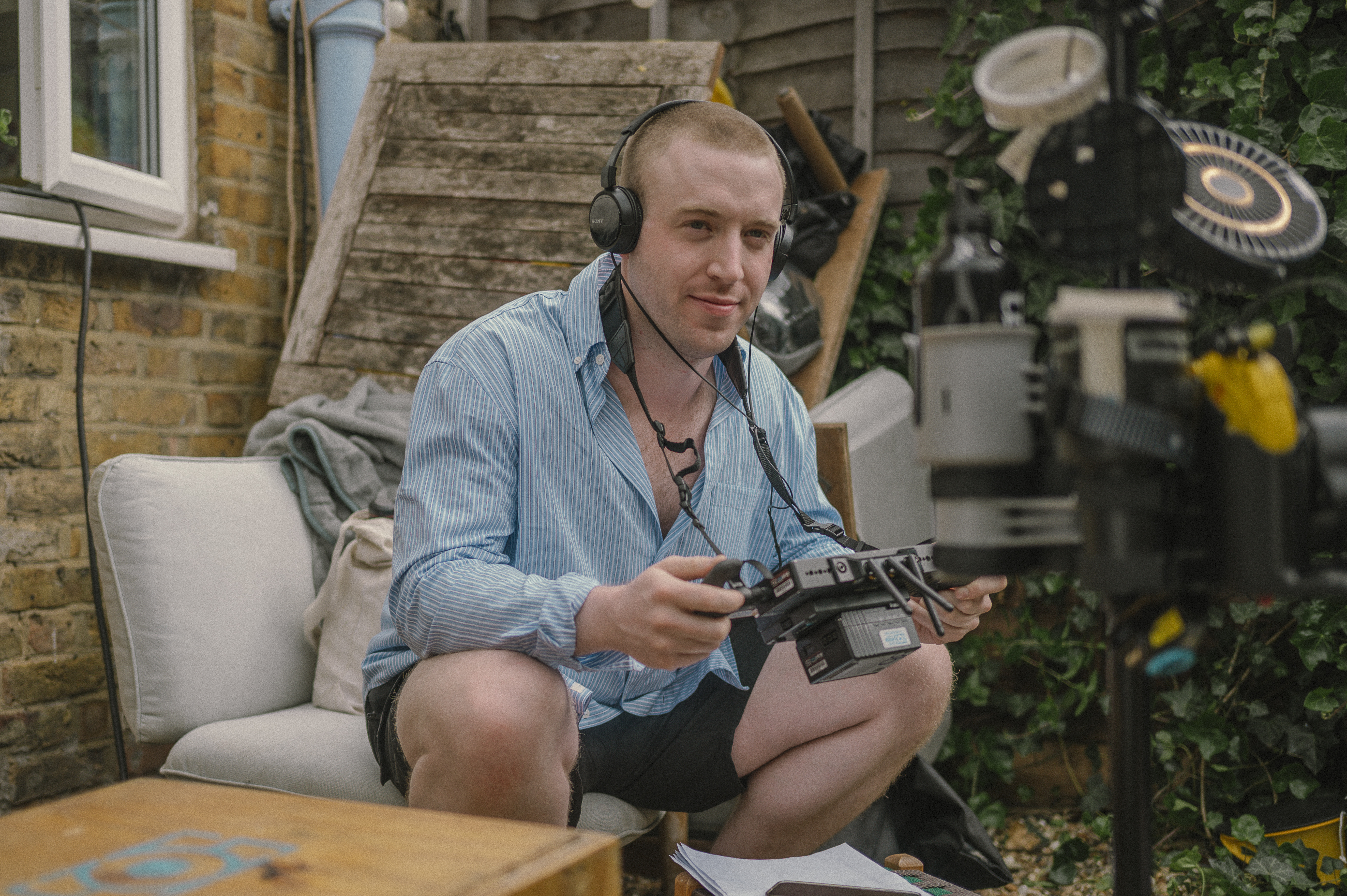
In his directorial debut, Bedcrumbs, writer-director Ross O’Donnellan explores the quiet, deterioration of a relationship that has seemingly run its course. Shot on 16mm, the film pairs a dreamlike aesthetic with an intimate examination of queer relationships.
Close-Up Culture’s Genevieve Dammery sat down with O’Donnellan to discuss the importance of authentic queer representation, his transition from writer and actor to director, and the creative decisions that brought Bedcrumbs to life.
The film is interested in the quieter, less spectacular ways that relationships come apart. Why did you want to explore this particular kind of relationship breakdown in the film?
I’ve had my share of explosive break-ups and as we all well know – they’re hard. But in my experience, it’s just as difficult when things end for reasons we can’t quite put our finger on. When we’re almost hoping for some big argument or betrayal to punctuate the relationship, so that we can at least feel justified in ending it. That’s the territory I wanted to explore with this story, because it’s a challenging situation to be in and a challenging one to navigate as a filmmaker.
I love big stories, but this demanded a focus on the small and the quiet – which felt quite vulnerable and weirdly risky. Any attempts to make it bigger or more heightened in the writing as well as the performing, filming and editing of it ultimately just felt wrong.
There’s an interesting tension between physical intimacy and emotional distance. The characters are sharing such an intimate space, but that doesn’t necessarily translate into genuine closeness. How did you approach communicating that disconnect visually?
I think having spent so much of my adult life living and loving in tiny London flats, that juxtaposition between physical closeness and emotional distance is something I’ve been very familiar with. For Michael and Billy, played so beautifully by John Bell and Thomas Flynn, we experimented a lot with body language – eye contact, turned shoulders – and how that shifted in different contexts. For example, when they’ve been drinking they might let their guards down and be more tactile. Or when one is jealous, a territorial quality might emerge. We played with the furniture and objects a lot, as the characters try their best to create distance in a confined space.
But it was also interesting to see how their physicality could speak to their love and shared history, even when they’re at odds. Like when they’re ignoring one another while making the bed with the practiced precision of a couple that have done so countless times before.
The bedroom becomes such an important setting, almost functioning as a character in its own right. What interested you about confining so much of the story to this particular space, and did you ever consider taking the characters outside of it more frequently?
I always wanted this to feel intimate and borderline claustrophobic, and the bedroom obviously sees so much of a relationship over its life cycle. Sex, of course. Arguments. Laughter. But also those more mundane moments – domestic tasks. Sleep! The bedroom offers us the best glimpse at this couple in various states over a short period of time. We actually cut a scene in the bathroom that originally appeared early on in the film as it removed us from the confines of the bedroom too soon.
The film was shot on 16mm, which gives it a particularly tactile, almost feverish quality. What made you choose that format, and how did the texture and limitations of shooting on film influence the atmosphere you wanted to create?
Our DP Ebba Hult is an absolute talent at shooting on film, so that’s something we were always aiming for here. Pedro Almodóvar’s ‘Law of Desire’ was a big reference point for us aesthetically, and we felt 16mm could best help us create that colourful, dreamlike atmosphere that our colourist Karol Cybulski subsequently emphasised. There’s obviously a pressure with shooting on film – particularly on a budget – as every take counts. But ultimately it facilitated an approach I would strive for regardless – be well-prepared and don’t overdo it!
This is your directorial debut, but you’ve also worked as an actor and writer. Did you find that your experience on the other side of the camera fundamentally changed the way you approached directing, particularly when working with actors on emotionally vulnerable material?
I’ve worked with a variety of very different actors across stage and screen. Now, while a cardinal rule of acting is never to give another actor notes – you do learn how to navigate different personalities and so you can bring out the best in each other. That’s certainly an advantage now that I’ve moved to the other side of the camera. Acting is very exposing – as are many roles on set by the way, especially when navigating sensitive material – so I do strive to create a safe space in which we can all do our best work.

There’s something quite uncomfortable about watching people negotiate the boundaries of a relationship when those boundaries are constantly shifting. How did you work with the cast to establish the emotional dynamics between the characters, particularly when so much of what is happening isn’t necessarily expressed through dialogue?
Yes, a lot of this film is definitely concerned with the unsaid! Honestly, I was incredibly lucky to be able to work with a cast who cared so much about their respective characters. We had a lot of conversations about how each character was the protagonist in their version of the story – I certainly didn’t want there to be a clear antagonist as I don’t think Michael and Billy’s relationship is that simple. That ultimately helped to create a certain spark as one character or another feels wronged, even when they’re in the wrong!
Do you think there is a distinct identity to queer filmmaking, either in the stories being told or the way they are told? As a queer filmmaker, do you feel a particular responsibility to challenge established conventions of cinema, or is it more important to have the freedom to tell stories that aren’t necessarily defined by queerness?
I think there’s a plethora of queer stories to tell and countless ways of telling them. I love that we’re seeing more and more queer films that aren’t concerned solely with coming out or struggles with sexuality. Those stories are dear to me and absolutely deserve to be told, but it’s so important to explore the lives of queer characters that aren’t centred purely on their queerness. Queer characters are often centred in my work, and if I feel a responsibility it’s to allow them to navigate as broad a range of conflict as their hetero counterparts!
The title, Bedcrumbs, is wonderfully suggestive. There’s an idea of intimacy, domesticity and perhaps the little remnants of something that has already disappeared. What does the title mean to you, and did it come before or after the story itself?
Thank you! That name emerged at the end of a long list on my Notes app… The film was originally titled ‘Random Facts About the Sky’ – a name that’s forever emblazoned on the cast and crew caps we made as a wrap gift! In the edit, we cut a scene that included a monologue about the sky, and without it the title didn’t make much sense. But while I still love the original, I think ‘Bedcrumbs’ is the perfect fit for the film. I’m glad you like it!
Bedcrumbs is premiering at Cork International Film Festival on Friday 13th November, and will be screening at HollyShorts UK in London on Saturday 14th November.
Title image by Kinvara Hubbard



Leave a Reply