
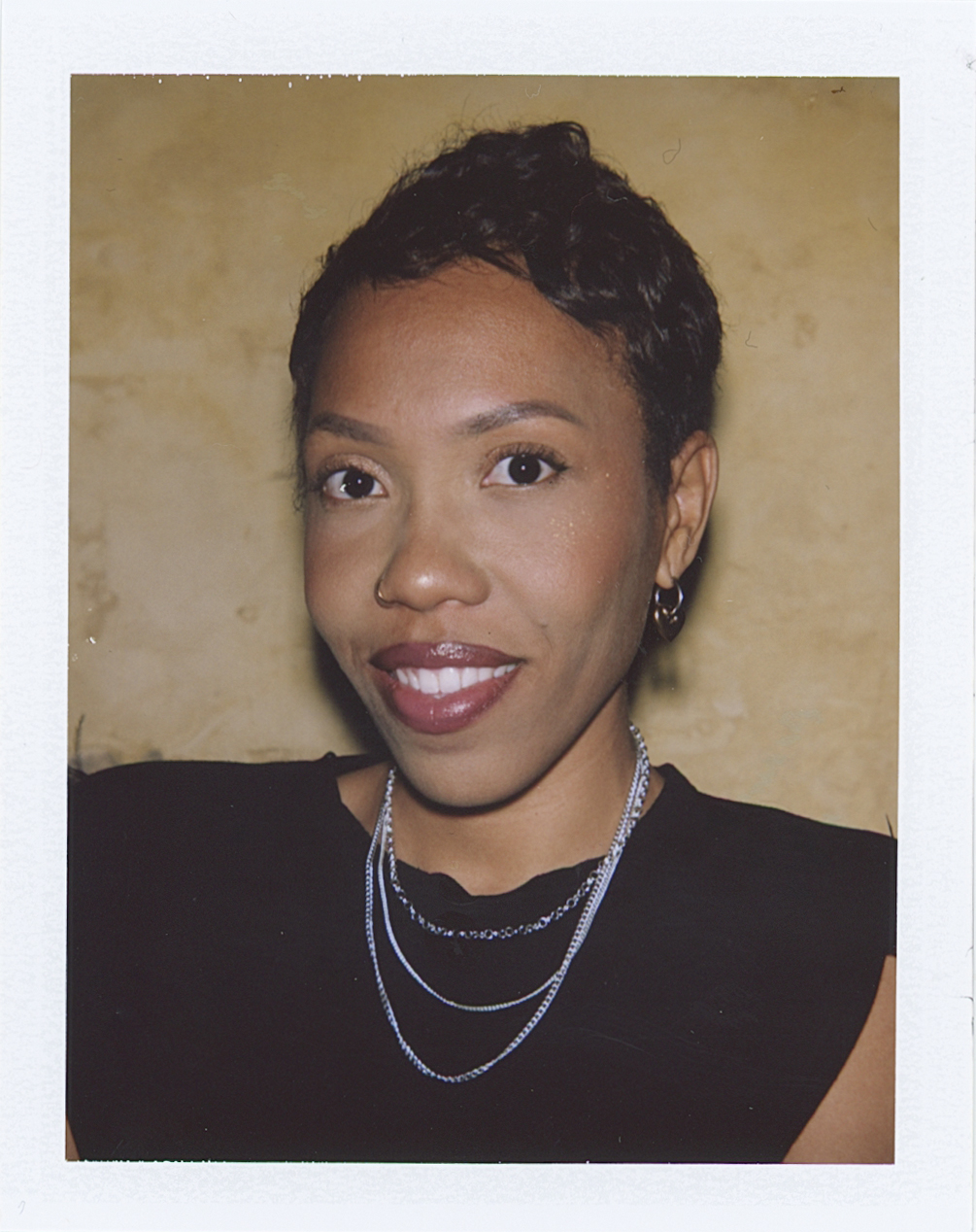
Photographer Kandice Chavous uses a director’s brain to craft rich, cinematic worlds that explore the fullness of the Black experience through mythology, fashion, and analogue film.
In this interview, she discusses building tension between shown and imagined stories, embracing artistic imperfections, and the power of making viewers linger.
Your work has such a strong sense of atmosphere. What are you trying to create when you make an image?
I am trying to create a world more than a beautiful image. I want you to feel like something happened right before the shutter was snapped and the conversation continues after it. I am interested in that tension between what I show you and what I leave for your imagination.
A lot of my work explores the Black experience, but I am interested in its fullness rather than the traditional monolithic way it is represented. Culture, vulnerability, romance, mythology, isolation, beauty, desire, even mundanity all have a place within our story. Worldbuilding allows me to create a space where those things can coexist without having to explain themselves.

There’s a really strong sense of fantasy and world-building in your work. What usually comes first: the image in your head, the clothes, the location, or the character?
Usually it starts with a feeling or a very small visual idea. Sometimes it’s a location, a piece of clothing, a painting, a line from something I’ve read, or even just the way the sunlight dances across the trees, my brain is always on and looking for a frame to capture.
My background is in fashion design and filmmaking, so I naturally think about all of those elements as pieces of the same story. The clothes tell me something about the character. The location tells me something about their circumstances. The lighting tells me how I’m supposed to feel about them. I do a lot of visual research and pull references from completely different places, then start finding the relationships between them.
Your images feel incredibly cinematic. Do you tend to think in terms of stories when you’re making a photograph, or does the story emerge afterwards?
Definitely before. I actually found my way into still photography through moving image, so I think I’ve always approached a photograph with a director’s brain.
Even when I’m making a single image, I’m thinking about what happened five minutes before that frame and what might happen five minutes afterward. Who is this person? Why are they here? What are they thinking that they aren’t saying? Those questions affect everything from body language and casting to lighting, framing and wardrobe.

But I also don’t want to answer every question for the viewer. I like ambiguity. I can know the story I was telling when I made the image, but someone else might see an entirely different story. That space between my intention and their interpretation is probably one of my favourite things about photography.
You’ve worked with mythology and historical references, but your work never feels like straightforward retelling. What attracts you to taking something old and making it feel contemporary?
I think I am less interested in retelling mythology than I am in interrogating it. These stories have survived for hundreds or thousands of years and been skewed by the teller because the emotions underneath them are still incredibly human: ambition, grief, desire, fear, love, belonging.
But historically, Black bodies haven’t always been allowed to occupy those worlds as simply and expansively as everyone else. So when I reference mythology, classical imagery or historical visual language, I am interested in what happens when I change who gets to be the protagonist of the story. I am more interested in taking the emotional architecture of something old and building something new from it. The reference becomes a starting point rather than the destination.

You shot Icarus’s Fall on Super 8. What is it about analogue film that still excites you, particularly when so much contemporary image-making is digital?
I love that the filmstock refuses to give me complete control. I have to embrace the idea of letting go.
Digital photography can become incredibly precise. You can see the image immediately, correct it, perfect it and keep working until you’ve eliminated almost every accident. Film asks me to surrender some of that. With Super 8 especially, there is grain, movement, inconsistency of the stock and an element of waiting to see the final image. I don’t completely know what I have until the film comes back. That imperfection feels incredibly human and humbling to me.
For Icarus’s Fall, II challenged myself to two rolls of super 8 and one roll of 120 film. That was 12 frames and 6 minutes to tell the story I wanted. I wanted to see what it was I had to say and if I could say it in with those limitations, either I am a storyteller or I am not, that was the challenge.
When someone encounters one of your images, what do you hope they feel before they even begin to work out what they’re looking at?
Curiosity. I want there to be that tiny moment where you don’t completely understand what you’re looking at, but you want to stay with it. Maybe something feels beautiful, strange, romantic, unsettling or familiar without immediately knowing why. We’re surrounded by images now, and we’ve become incredibly good at consuming them quickly. I don’t really want my work to be consumed quickly. I want someone to linger.
If the feeling arrives before the explanation, then I’ve done what I wanted to do. Because ultimately I don’t think an image has to explain itself in order to communicate. Sometimes the thing you can’t immediately name is the thing that stays with you.




Leave a Reply