
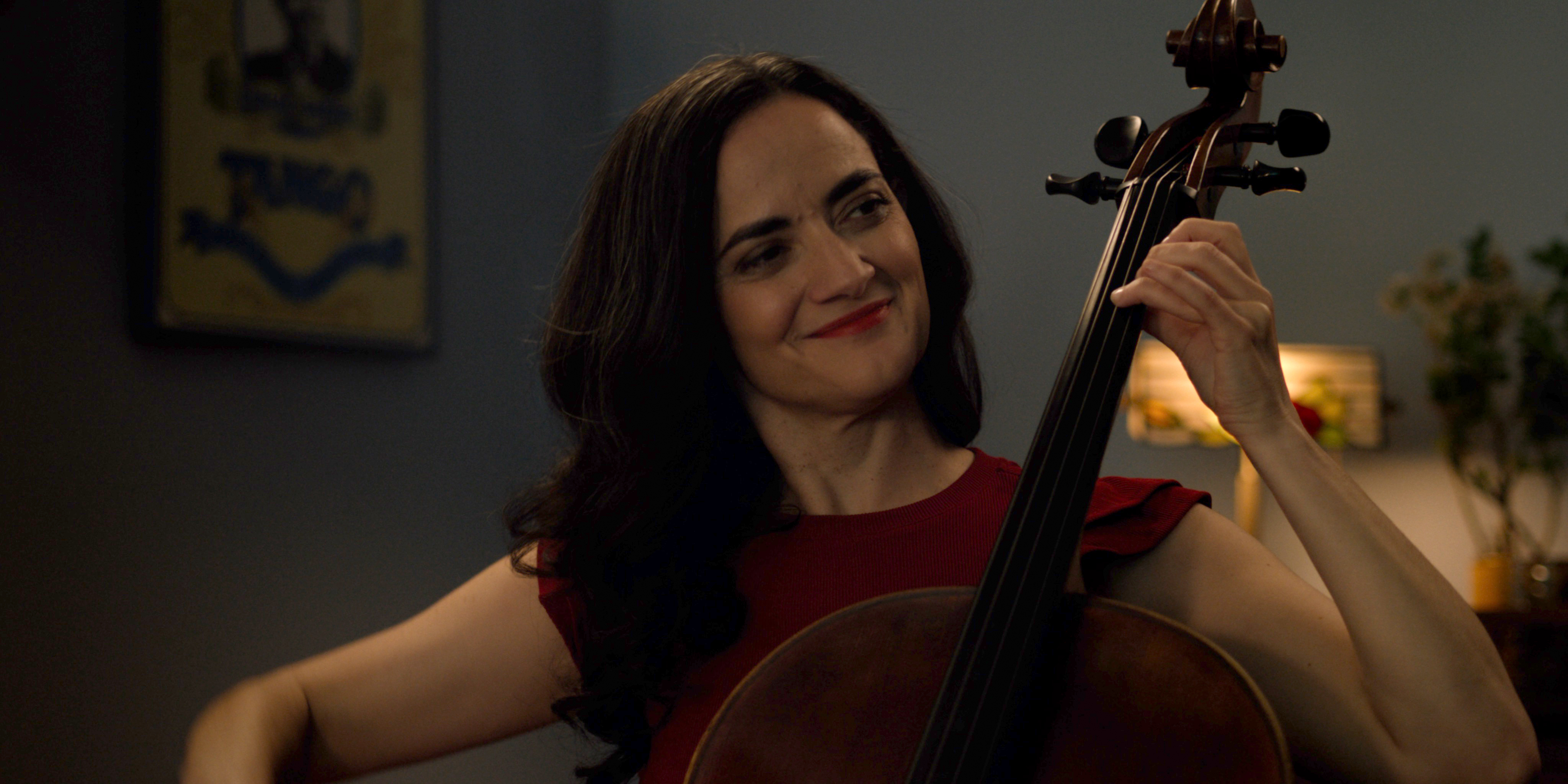
Set on an icy Chicago night, The Birthday Gift follows an Argentine mother and daughter whose intimate birthday dinner is upended by an unexpected guest, forcing them to confront the long-term repercussions of their country’s dark history.
In this interview with Close-Up Culture, executive producer and lead star Cruz Gonzalez-Cadel breaks down how she transitioned the story from its original stage play roots, the profound emotional honesty of performing in “Spanglish,” and her mission to challenge narrow industry expectations for Latine and immigrant creators.
You’re wearing two hats on The Birthday Gift, as both an actor and executive producer. How did those roles influence each other, and did being involved behind the scenes change how you approached your performance?
Every actor should consider wearing a producer hat at least once in their lives. I believe that stepping behind the camera helped me to holistically understand filmmaking at a granular level and has made me a sharper on-screen actor. It brings a new perspective to the work and clarifies how one person’s performance is part of a larger conversation. It makes me exist on set more in community with what every department needs and is bringing to the production. In a weird way, it allows me to be more present and in the moment instead of being hyper-focused on my own performance.
The film centres on an Argentine mother and daughter whose birthday dinner is disrupted by an unexpected guest. What drew you to the story and to the character you play?
I have a deep history with both the story and the character I am playing. Our film, The Birthday Gift, is based on a stage play written by Stephanie Alison Walker, called The Abuelas, which had its world premiere in 2019. It was produced by Teatro Vista Productions in Chicago and I had the immense privilege of originating the role of Gabriela. It was a spiritual experience. I was very drawn to Stephanie’s writing and her talent for taking on major historical/political events and making them feel personal and specific. As an actor, the chance to step into the shoes of a nuanced and complicated character, written with care and depth, is a gift. It was also the first time I saw myself, an Argentine immigrant living in Chicago, fully realized on the page. When the play closed, I knew the next step was to widen its reach. I was not done with Gabriela or the story the film unearths. It was then that Stephanie and I began dreaming of adapting her story to the screen and joined forces with the brilliant Paula Pizzi to both adapt the play and layer Spanish into the story, making it a fully bilingual experience.
The film’s bilingual nature feels central to its world. As a performer, how does moving between Spanish and English affect the way you connect with a character or express something emotionally?
Paula, Ignacio, Margarita and I are Argentine immigrants and the bilingual nature of the film beautifully mirrors the experience of being an expat. When living in a different country, one’s language is a powerful tool for connection with fellow expats. I have begun life-long friendships from hearing an Argentinian accent in a bus. It brings a sense of instant intimacy. I have lived in the USA for more than 18 years and at this point, my brain operates mostly in Spanglish. That being said, when I feel deeply, I feel in Spanish. My deep emotional life feels more honest when expressed in Spanish and I love that this film gives us all the opportunity to exist so authentically on screen.
What was the atmosphere like on set when filming such an intimate story? Did the cast and crew find ways to build the kind of closeness the film requires?
“Four Argentines and an American walk into a bar…” The atmosphere on set was joyful, culturally rich and also very focused. Our producer Rachel Stander curated a diverse crew who were passionate about the script and bringing it to life. We scouted many locations and landed on filming at our co-writer Stephanie’s house because we wanted the home to feel lived in and warm. In return, it made the shoot welcoming and relaxed so the ambience was that of a very long dinner party. At the same time, under our director Arianna Ortiz’s leadership, the cast and crew were able to very quickly switch gears into the difficult and emotionally challenging scenes. Arianna masterfully protected the space that allowed us to embody the emotional extremes of the material.

The film has now qualified for the Oscars following its win at LALIFF. When you first became involved, did you imagine it might reach this stage, and what has the journey been like for you?
I’ve always believed, very strongly, in the power and the heart of the story and characters Stephanie created in the source material. The collaboration with Paula to adapt the play to the screen and the added layer of language only made the story stronger and more specific. I believe that through specificity comes universality and I love that everyone can find themselves in the film in one way or another. The experience of sharing our film with audiences and winning the Grand Jury prize at LALIFF, confirmed our instincts that this story about one Argentine family confronting the long term repercussions of its country’s dark history, could transcend one format and resonate with a larger audience. Did I imagine it? No. Did I believe it could happen? Absolutely.
As both an actor and producer, what kind of stories are you most excited to be part of? Is there something you’d love to explore next that you haven’t had the chance to do yet?
As an actor, I learned how inaccurate assumptions and unconscious biases shaped the roles I was expected to play, or rather not play. I was told, often with a tone of concern, that my accent would limit me. That Shakespeare was out of my reach. That there was no room for someone like me in “non-immigrant” roles. That Latine stories were not often produced because they were not marketable. These were not meant to be cruel statements, but rather were offered as practical truths to save my time (and heart).
And yet, when I walked through my city, I saw a different truth. I saw Latine and immigrant folks, just like me, woven into every part of the city of Chicago – people falling in love, grieving, starting businesses, telling jokes, raising families. Living full, complex, ordinary lives. So I began to ask myself: if I can see us in the world around me, why can’t I see us reflected on screen?
That question has fueled and inspired me ever since – not out of frustration, but from a deep sense of possibility. My work as an actor – and now as a producer – is about challenging narrow expectations and expanding the space for stories and characters that reflect the full, complicated, imperfectly nuanced humanity of people like me. I approach obstacles as opportunities and seek brave collaborators. When we push outside of the boxes we’re given, we not only create space for ourselves, we open doors for others.




Leave a Reply