
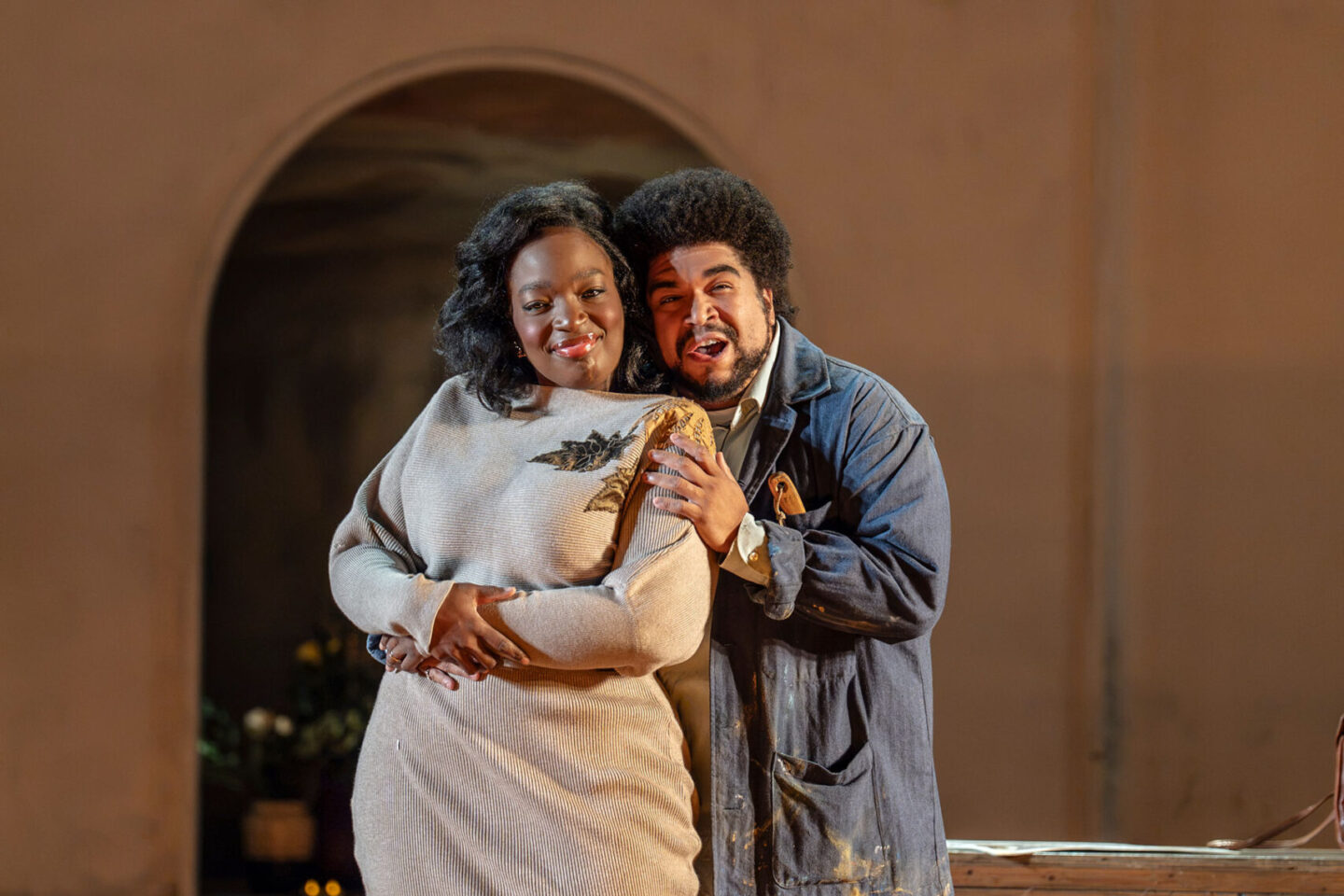

If you’re looking for a way to divide an opera audience, look no further than taking one of the genre’s most beloved works and giving it a radical reimagining. English National Opera’s latest production of Puccini’s Tosca, directed by artistic director Annilese Miskimmon, has certainly done that. It is a production that seems unlikely to win over the traditionalists, and one that has attracted its fair share of criticism. But for all its imperfections, there is something exciting about what ENO is attempting here. More importantly, I think it is working.
Relocating the action from 19th-century Rome to a concert hall in an unnamed Eastern European state under authoritarian rule, Miskimmon places art and artistic expression at the centre of a story about power, control, and political oppression. Here, music becomes something to be feared and controlled, while the destruction of artistic expression becomes an instrument of political violence. This takes some getting used to, particularly for those who hold a more traditional vision of the opera, but there is a clear intention behind the reinterpretation.
Opera has long struggled with perceptions of exclusivity, of being an art form reserved for an older, wealthier, and more traditionally minded audience. There is a danger in trying to preserve these works so faithfully that they become distant from the audiences who might otherwise discover them. ENO’s willingness to experiment feels like a worthwhile endeavour, and one that the art form needs. This Tosca is not necessarily a production for the purists, but it is one that invites a different generation to engage with opera on its own terms. I would much rather see a company take these risks than retreat into the safety of convention.

The real triumphs of this production are Axelle Fanyo in the title role and Christopher Purves as the menacing Scarpia. As Tosca, Fanyo brings vocal strength, emotional vulnerability, and commanding stage presence to the character. It is all the more impressive as the French Soprano performs in beautifully clear English. Tosca is a woman whose world is progressively stripped away from her, and Fanyo captures the character’s shifting emotional landscape with remarkable conviction. Christopher Purves, in contrast, is wonderfully sinister and sadistic, bringing an unsettling authority to one of opera’s most reprehensible villains. Meanwhile, Ben Glassberg masterfully leads the ENO Orchestra through a score that remains as magnificent and emotionally resonant as ever. Puccini’s music is ultimately the production’s strongest asset, carrying the romance and tragedy that have made Tosca such an enduring work.
That is not to say the production is without its shortcomings. At times, the staging is unnecessarily busy, with the central characters pushed upstage or onto the balcony. The set itself is also somewhat ambiguous, sitting somewhere between a church and a concert hall without ever quite establishing a clear identity. Meanwhile, the gratuitous destruction of musical instruments by Scarpia’s henchmen prompted more than a few winces from the audience. These choices do not always feel entirely justified and sometimes distract from the drama rather than enhance it. Nevertheless, even when the directorial vision falters, there is an energy and ambition to the production that makes it difficult to dismiss.
I suspect this will remain a divisive production, and I can understand why those approaching it with a more traditional appreciation of Puccini might find its choices frustrating. But I also think there is something to be said for judging a production on what it is trying to achieve, rather than solely on how closely it adheres to what has come before. It might not be a Tosca for everyone, but it is a Tosca that feels alive, adventurous, and willing to take risks. And if the alternative is an art form that becomes inaccessible to the next generation, I know which I would prefer.
Tosca is currently booking for 7 Nov – 11 Dec 2026 – for info






Leave a Reply