
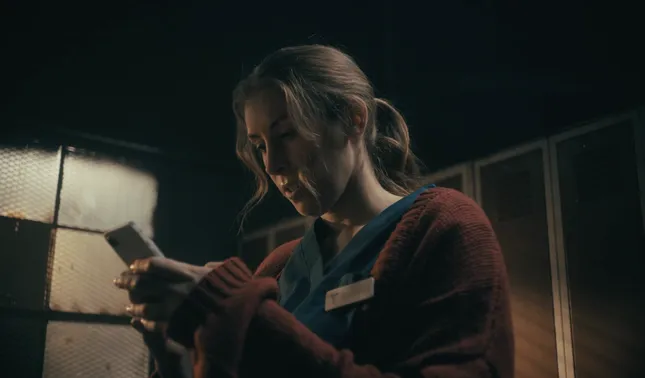
Is it better to live a life of constant pain, or no longer be able to feel pain at all? In Syringe, filmmakers Talisha Elger and Lara Marks turn this unsettling premise into a gripping piece of psychological body horror, using the conventions of the horror genre to expose the very real inequalities that exist within women’s healthcare.
The short follows Neenah, a nurse living with chronic gynaecological pain, who agrees to trial an experimental medication called Nyrophil. Promising relief from her symptoms, the treatment initially offers a welcome reprieve. But as Neenah begins to lose her ability to feel altogether, what initially seems like a medical breakthrough takes a sinister turn.
At the heart of Syringe is an experience that is be painfully familiar to many women: the struggle to have their health concerns taken seriously. Medical gaslighting, the normalisation of debilitating symptoms, and the tendency to prescribe quick fixes rather than investigate underlying conditions are all woven into the film’s premise. As the filmmakers explain, they wanted to explore how women’s healthcare can become a cycle of prescribing medication as a means of silencing patients. The syringe itself becomes an extension of this idea, representing not simply medical intervention but a substance that is administered to make a problem disappear without necessarily addressing it.
One of the film’s most interesting decisions is its central character’s dual position as both patient and nurse. Neenah occupies a complex space within the medical system: a patient who has experienced the normalisation of her symptoms, she eventually finds herself administering the very treatment that has compromised her own wellbeing. This contradiction adds an important layer to the film’s critique. Neenah is simultaneously a victim of the system and someone who becomes complicit in perpetuating it. Her decision to offer the treatment to another patient may not necessarily be an endorsement of the system, but a reflection of how she has been conditioned to accept its limitations.
This is further complicated by the film’s depiction of female medical professionals more broadly. By resisting the more straightforward narrative of women being dismissed exclusively by male doctors, Elger and Marks make a broader point about the systemic nature of the problem. This decision takes inspiration from real life; Elger has spoken candidly about her own experiences of being dismissed by female doctors, including being told that because her symptoms were not adequately represented in existing medical literature, there was little that could be done. The problem, then, is not simply individual prejudice but a healthcare system shaped by decades of insufficient research and investment in women’s health.
Perhaps most unsettling is the film’s exploration of what happens when pain is removed altogether. While Nyrophil initially promises freedom from suffering, its consequences are far more profound than Neenah anticipates, as she is told “Now that you can’t feel anything, you can’t complain,” Elger and Marks explain how pain is a survival mechanism, a means of self-protection and an essential part of maintaining agency over one’s body. By removing it, Neenah does not simply lose the sensation of suffering; she loses a degree of control over her own physical experience. The film’s central irony is therefore particularly effective: a treatment designed to free women from pain ultimately strips them of their autonomy.

Visually and thematically, Syringe makes excellent use of the conventions of body horror to give shape to the anxieties explored throughout its short run time. The clinical environment, experimental treatment, and disturbing atmosphere create a sense of unease that is both cinematic and grounded in reality. The inclusion of brightly coloured, AI generated medical advertising reinforces the filmmakers’ concerns about the commercialisation of healthcare, where women’s bodies become sites of profit.
Ultimately, what makes Syringe so compelling is how Elger and Marks give the experiences of women’s healthcare a visceral, unsettling form, using filmmaking to prompt conversations that are too often avoided. The filmmakers hope to use the film’s festival journey as a platform for engaging with health experts and people with lived experiences to advocate for greater research and awareness.
Ambitious in its subject matter and excellent in its execution, Syringe is an outstanding example of socially conscious genre filmmaking. It understands that sometimes the most effective horror comes not from imagining an unfamiliar nightmare, but from holding a mirror up to the realities we have learned to accept.





Leave a Reply