
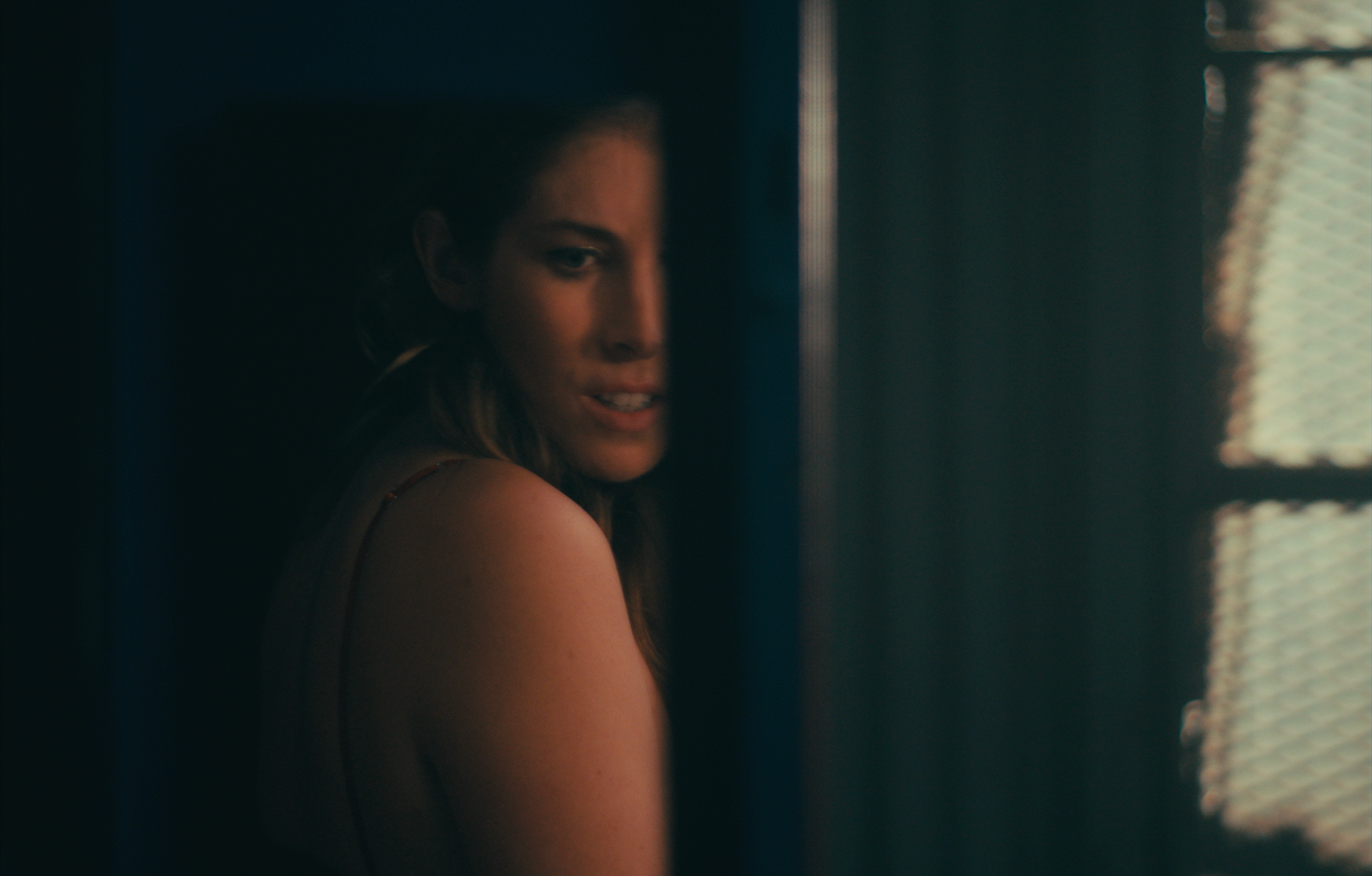
In their short body-horror film Syringe, filmmakers Talisha Elger and Lara Marks turn the everyday experience of navigating women’s healthcare into something deeply unsettling. Exploring medical gaslighting, bodily autonomy and the silencing of women’s pain, the film uses the language of horror to expose realities that are all too familiar.
Close-Up Culture’s Senior Writer Genevieve Dammery spoke to Elger and Marks about the film’s origins, its unsettling medical landscape and the conversations they hope it will inspire.
Your film has such an evocative title. A syringe carries so many associations: treatment, intervention, bodily autonomy and the physical discomfort of something penetrating the skin. How did you settle on the title, and what did you want it to convey?
Talisha Elger: It’s funny because I don’t usually put a huge amount of thought into my titles. I always wanted to use the medication itself as a starting point, so at one stage the film was actually going to be called Pills. But what I love about Syringe is that, because it’s a body horror, it immediately evokes something penetrating the skin. There’s something inherently uncomfortable about a needle, so it felt like a perfect title for a horror film. Even the name of the drug, Nyrophil, just came into my head one day. I thought, that’s what it’s going to be called, and we went with it.
Lara Marks: There’s also something interesting about the idea of a substance being injected into the body. One of the themes we wanted to explore is how, in women’s healthcare, the response is so often to take a substance or medication as a quick fix. It’s almost a way of putting a Band-Aid over the problem and silencing the person experiencing it. When the doctor slides the lollipop across the desk, for example, it becomes a symbol of that gesture of silencing. I think the syringe carries a similar quality.
The film uses body horror to explore women’s healthcare, which is a particularly effective choice of genre. Was it always intended to be a horror film, or did that decision come about as the story developed?
Talisha Elger: Even before we came up with the idea, I knew I wanted to make something tonally quite dark. That’s naturally what I gravitate towards when I write. Then, when we started discussing women’s health as a subject, it felt like the perfect opportunity to explore it through body horror. It was a natural combination: I wanted to make something dark, and the subject matter lent itself so well to the genre.
Lara Marks: I also think horror offers an alternative lens through which to examine a subject. You can shed light on something by placing it in a dystopian or heightened context, but what’s particularly interesting about women’s healthcare is that, for so many women, they’re already living through something that feels like a horror story.
There’s something almost ironic about presenting these experiences as dystopian when, in many cases, they’re not far removed from reality. The genre helps audiences recognise just how frightening some of the things we’ve come to accept as normal actually are. Think about contraception and the way contraceptive methods are administered, for example. Women are expected to accept certain interventions, side effects and changes to their bodies as completely normal. By placing those experiences within a horror context, we’re asking why something so unsettling has become so normalised.
Horror can also be a particularly effective way of communicating experiences that audiences might not otherwise understand. Talisha, you mentioned that you’ve had some interesting reactions from men watching the film.
Talisha Elger: I think horror films are the perfect vessel for communicating certain experiences. The first example that comes to mind is something like Get Out. Some audiences watch that film and find it hilarious because they’re familiar with the experiences being depicted, while others are completely shocked. We’ve had a similar response to Syringe. Men have come up to us after screenings and said they had no idea women experienced these things, whereas women often respond with, “Of course, this is exactly what we go through.”
Lara Marks: We had a Q&A after one screening where a very lovely male audience member asked a question about Buddhism and the concept of suffering, and whether the film was exploring the idea that suffering is necessary for joy.
It was interesting because, from his perspective, he was interpreting the film through a much more universal, philosophical lens. We had to explain that, while that’s an interesting interpretation, the film was specifically about women’s experiences of pain and not being believed when they seek help. He was very sweet about it and said he hadn’t thought about it that way before. It was a nice moment, and it really demonstrated why these conversations are important.
One of the most interesting dynamics in the film is having Neenah occupy the roles of both patient and nurse. She’s simultaneously experiencing the healthcare system and participating in it. What drew you to that particular character dynamic?
Talisha Elger: When I was writing the film, I wanted Neenah to be in close proximity to the drug and to have the opportunity to make the choice to use it herself. That was the original thinking behind her being both a nurse and a patient, but it developed into something much more interesting.
Lara Marks: I think there’s something particularly compelling about the fact that she’s both a victim of the system and someone who perpetuates it. As a patient, she’s experiencing its failures, but as a nurse, she’s also working within that same system and becoming complicit in it.
That’s part of the wider problem we’re trying to explore. These are systemic issues within women’s healthcare, and the commercialisation of the industry, particularly in the United States, adds another dimension. Healthcare is an industry driven by profit, and the film’s advertisements and pharmaceutical messaging speak to that commodification. Neenah’s decision to administer the drug to another patient, despite having experienced its consequences herself, might initially seem contradictory. But she’s also trapped within the system. She’s come to believe that this is the only option available.
Talisha Elger: Exactly. She’s reached a point where she has to decide whether to continue living with the pain or eliminate it. She knows what the drug does, but she also believes it’s the better option available to her. That’s what makes the decision so complex. I also wanted one of the doctors to be a woman because, in my own experience, the problem isn’t necessarily limited to male doctors dismissing women. I’ve had experiences with female doctors who have told me that they don’t know what’s happening because it’s not in the medical literature. Rather than trying to work through the problem with me, they simply didn’t know what to do. I’ve even had to tell a doctor what to prescribe me. It’s important to recognise that the problem isn’t always an individual practitioner. It’s also about the system they’re working within.
Lara Marks: That’s exactly it. The lack of research and investment in women’s health means that certain conditions aren’t adequately represented in the literature, and consequently, the solutions aren’t always available. Everyone is operating within that system.
Talisha Elger: I also think there’s an interesting relationship between victimhood and control in Neenah’s character. A lot of women don’t necessarily want to see themselves as victims. Neenah is a victim of the system, but rather than accepting that position, she tries to regain control by convincing herself that she’s no longer experiencing pain. In a way, she refuses to acknowledge that the system has failed her because doing so would mean accepting how little power she has within it.
The medical environment is usually somewhere we’re encouraged to feel safe. It’s a place we enter expecting to receive help, and yet the film transforms that environment into something threatening. Was it important to you to subvert that sense of safety?
Talisha Elger: I think that’s where the contrast between how women and men experience the film becomes particularly interesting. For women, there’s often an immediate recognition of what’s happening because they’ve experienced something similar. But I think it can be more confronting for audiences who haven’t had those experiences. There’s also a lack of transparency within the medical industry, and I think people increasingly want to understand what’s happening to their bodies and why certain decisions are being made.
Lara Marks: When you enter a medical environment, you expect to feel safe. You go in expecting help, and it’s incredibly disillusioning when you realise you’re not necessarily going to receive it. By subverting that expectation, we’re encouraging audiences to question the way the industry operates. We shouldn’t automatically assume that all the answers are available, that the research is sufficient or that the existing medical framework is necessarily working as it should. We need to be questioning those things, conducting more research and investing more in women’s health. Ultimately, we’d love to use the film as a wider platform to engage with health experts and people living with conditions such as endometriosis, vulvodynia and chronic pain. We want to advocate for more research and funding, while highlighting just how relevant these issues remain and how little progress we’ve made.
One of the film’s most unsettling ideas is the relationship between pain and the loss of sensation. The treatment is supposed to alleviate suffering, but its side effect is that the patient becomes disconnected from her own body. What interested you about that contradiction?
Talisha Elger: For me, it’s largely about silencing women. It’s almost as simple as saying: now that you can’t feel anything, you can’t complain. There’s also the idea that you become less human when you’re disconnected from your own body. Women aren’t always treated as fully human in these environments, and that adds another layer to the film. But ultimately, it’s about silencing women and taking away their ability to express their suffering.
Lara Marks: There’s also an element of control. The ability to feel pain is a survival mechanism. It’s a form of self-protection and a way of maintaining control over our own bodies. By eliminating that sensation, the film introduces a really dark irony: yes, you no longer feel pain, but you’ve also lost a degree of agency over your own physical experience.
We were also interested in how loss of sensation appears as a side effect of various contraceptive methods. In the pharmaceutical advertisement within the film, there’s a reference to side effects including loss of sensory perception, libido and emotional responsiveness. These are things that people already experience, and yet when you see them presented in that context, you realise how extraordinary it is that they’ve become accepted. Some of these experiences are so closely associated with womanhood, including sex drive and emotional responsiveness. There’s something quite disturbing about the idea that these aspects of yourself can be gradually stripped away and treated as an acceptable consequence of treatment.

Both of you have touched on your own experiences of navigating women’s healthcare. How much of your personal experiences informed the film?
Talisha Elger: I remember being younger and going to the doctor, who asked whether I was taking the pill or any other contraceptive medication. When I said I wasn’t, she immediately suggested that I should be and prescribed it to me. I started taking it, but after about three months I couldn’t continue because of how it was affecting me mentally.
Lara Marks: I had a similar experience. I was around 18 when I started taking the pill, and I developed really debilitating anxiety. When I went to the doctor, rather than questioning whether the contraceptive might be contributing to it, I was prescribed antidepressants. I remember asking whether I should consider coming off the pill, and the response was that we shouldn’t change too many things at once, so I should just continue taking the antidepressants. It’s that constant cycle of prescribing medication rather than addressing the underlying problem. It can become another way of telling women to stop complaining.
Talisha Elger: And because these experiences are so normalised, women don’t necessarily talk about them. There’s a sense that you’re expected to put up with certain things, and you don’t want to be seen as someone who is constantly complaining. It’s important to create spaces where women can share these experiences and feel understood.
The introduction of Nyrophil raises questions about who gets to decide what constitutes a successful medical treatment. Were you interested in exploring the distinction between treating someone’s symptoms and actually understanding their suffering?
Lara Marks & Talisha Elger: This is definitely a central question of the film. Modern medicine tends to focus on treating symptoms with a metaphorical band-aid, rather than getting to the root cause of the suffering. There is often a disconnect between how patients evaluate the success of a treatment and how the larger pharmaceutical companies evaluate it. When the latter’s focus is on maximizing profit, success is often judged on how quickly symptoms can be eliminated rather than on finding the underlying problem. This is particularly prominent in women’s healthcare where the lack of research makes it difficult for medical professionals to identify the cause of symptoms. There are so many gynaecological and pelvic pain conditions that we don’t understand or that don’t have effective treatments because the science just isn’t there; endometriosis, adenomyosis, PMOS, vulvodynia, vulva lichen planus and lichen sclerosis, vaginismus, ovarian cysts or uterine fibroids, to name a few. As a result the solution is often to offer a quick fix. When the doctor hands young Neenah a lollipop, this acts as a sugar-coated symbol of this.
Did you have any concerns about balancing the film’s social commentary with its responsibility to work as an entertaining and genuinely unsettling piece of horror cinema?
Lara Marks & Talisha Elger: We knew we wanted to use this film as a vehicle for social commentary, but we always felt that story has to come first. Our primary focus was on character, emotional arc, narrative and the visual language in order to craft an unsettling and emotionally truthful piece of cinema. Metaphor serves an important purpose here too as it can evoke feelings and ideas without prescribing what the audience should think, allowing the viewer to come to their own interpretations and conclusions. We felt that if the film worked effectively on an emotional level by letting us experience what the characters are experiencing, the social message would be conveyed powerfully too, and ultimately would leave the audience contemplating.
Were there particular films, filmmakers or works of body horror that influenced Syringe?
Lara Marks & Talisha Elger: Perhaps our biggest influence was Todd Haynes’ Safe. Safe is a haunting example of medical gaslighting, where the protagonist is repeatedly dismissed in her attempts to express what is happening in her own body. We were inspired by this film’s use of sound design to draw the audience into the world and make the familiar unfamiliar, and the use of composition to communicate the character’s isolation. Another key influence was Anu Valia’s short film, Lucia, Before and After, which won the Jury Prize at Sundance. We loved how close this film stays to the main character, enabling the viewer to find things out with her in real-time, and we wanted to bring this into Syringe. This film also relies heavily on metaphor, where specific subtle images such as a stain on the ceiling or a dirty car window bring us closer to her emotional and subjective experience. For the Nyrophil infomercials, we were inspired by the use of glossy pharmaceutical advertising in Coralie Fargeat’s The Substance and how this can be employed to exploit people’s vulnerability. Finally, we drew upon Emerald Fennell’s Promising Young Woman, as another example of a film where a woman seeks to reclaim control in a system that ultimately offers no way out.
How did you approach depicting chronic pain on screen without necessarily relying on conventional visual shorthand for suffering? Was there an interest in communicating the isolation and psychological consequences of pain as much as its physical reality?
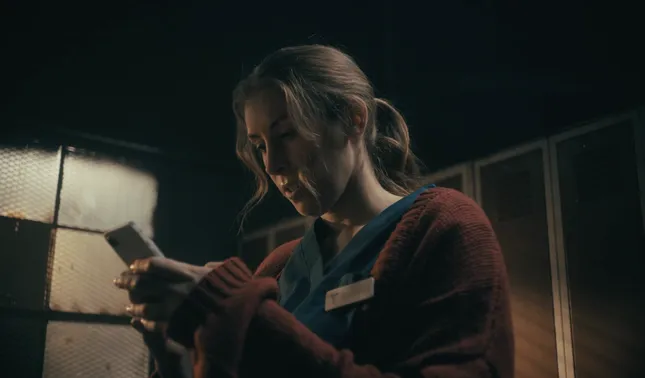
Lara Marks & Talisha Elger: One of the most challenging parts of making a film about chronic pain is that it’s invisible, so we had to come up with creative ways to illustrate the psychological consequences of suffering. For example, the film’s opening image depicts young Neenah on a see-saw looking miserable. Whilst a seesaw is an image we’d generally associate with playfulness and joy, the choice to subvert this was a way of immediately conveying Neenah’s internal suffering. Furthermore, the restraint and reticence in older Neenah’s character suggests that she has been worn down by a lifetime of suffering and dismissal. When it comes to isolation, we sought to communicate this through the architecture of the shots and framing, such as the wides of Neenah in the locker room showing her all alone. Equally, the hospital environment which we might expect to be crowded and bustling is quiet and dimly lit. There is only ever a suggestion of the outside world; in the waiting room we see a hint of a leg, in the doctor’s office we hear the phone ring and the doctors’ faces are blurred, and in the bar Neenah sits alone. This creates the uneasy sense that Neenah is detached and disconnected from the external world. Finally, in Neenah’s daily world the film’s aspect ratio is narrower and more claustrophobic to evoke her isolation, but in the dreamlike post-Nyrophil sequences such as when Neenah rides the bull, the aspect ratio changes and widens as though her world is expanding with the relief the drug offers.
Films addressing women’s health often face a lack of visibility and understanding even before they reach an audience. Did that influence your approach to producing and positioning Syringe?
Lara Marks & Talisha Elger: A topic like women’s health can definitely alienate people. If people haven’t experienced this kind of suffering, it can be hard to relate. Furthermore, as women it can be hard to see ourselves as victims – we are told that pain is normal, so speaking up about it can feel like a sign of weakness. During our fundraising process we encountered people that questioned the relevance of the story. However, we found that through open conversations, it was possible to come to a shared understanding. This is also why we wanted to tackle the more general dangers of a medical industry fuelled by profit, as this relates more universally to anyone seeking care. Ultimately, in producing and positioning the film, we knew it would be important to know our audience and a key goal was to help women feel seen and heard. Almost every woman we know has faced some kind of issue in this realm so we believed it would resonate with the women who have experienced this, and the men in their lives who have stood by them. A wonderful example of this was our brilliant Emmy Award-Winning sound designer, Harrison Meyle, who very kindly chose to work on the film because of his belief in the topic, having witnessed his wife go through many similar struggles.
How do you navigate the practical realities of producing a short film that is trying to tackle a subject as expansive as systemic issues in healthcare? Were there conversations about what could realistically be communicated within the film’s runtime?
Lara Marks & Talisha Elger: There are so many layers and elements to tackle within this topic and we definitely found ourselves overwhelmed by how much we wanted to say. We realized early on in the process that the expansive nature of this topic really merits exploration in a feature. However, for the short film we came to the decision to hone in on pain as the central theme, and this became our North Star. This helped us to streamline the story, while touching on many different areas within the 14 minute runtime.
Was there anything about the filmmaking process that fundamentally changed your perspective on the issues the film explores?
Lara Marks & Talisha Elger: A moment in the process that shifted our perspective was when we decided to cast the second doctor as a woman. The obvious choice initially was to cast a man as the doctor to indicate the medical misogyny, however as we progressed in our research, it became clear that the issues are far wider and more systemic, so we felt a female doctor would be a more interesting choice to reflect this.
Women’s pain is frequently minimised, but there’s also a danger that stories about women’s suffering become defined entirely by trauma. How did you ensure Neenah remained a character with agency, rather than simply a vehicle for communicating a broader social issue?
Lara Marks & Talisha Elger: First, we made the choice for Neenah to be a nurse. The fact that she works within the medical industry and treats patients gives her a degree of agency from the outset. We wanted to illustrate that she continues to show up professionally despite her suffering, a sign of her active resilience. We incorporated dry humor into her character to show how she chooses to make light of her situation rather than allowing herself to be defined by her trauma. Her choice to take such extreme measures to test the limits of the drug’s effects represents an active attempt to try and reclaim some autonomy within a system that has taken her control away.
What is next for you both, and where can audiences see Syringe next?
Lara Marks & Talisha Elger: Our goal is to make Syringe a feature. We want to lean further into the darkness and horror, and to deepen our exploration of our relationship with pain and our bodies, how pain can both limit us and protect us, and what happens when that is taken away. We want to expand on Neenah’s emotional journey as she navigates this new normal of Nyrophil. What else does she do with this newfound power, and what are the repercussions and wider implications? There is also more to explore in the world around Big Pharma and the AI commercials, and how something disturbing becomes accepted when it’s presented as care.
We are at the beginning of our festival journey. We premiered at HollyShorts UK and will be screening at the BIFA-qualifying NEIFF. We have also just received official selections for the Worldwide Women’s Film Festival and the Ocean City Film Festival. Follow our instagram page @syringefilm for updates on our festival journey and on where to see Syringe next!




Leave a Reply