
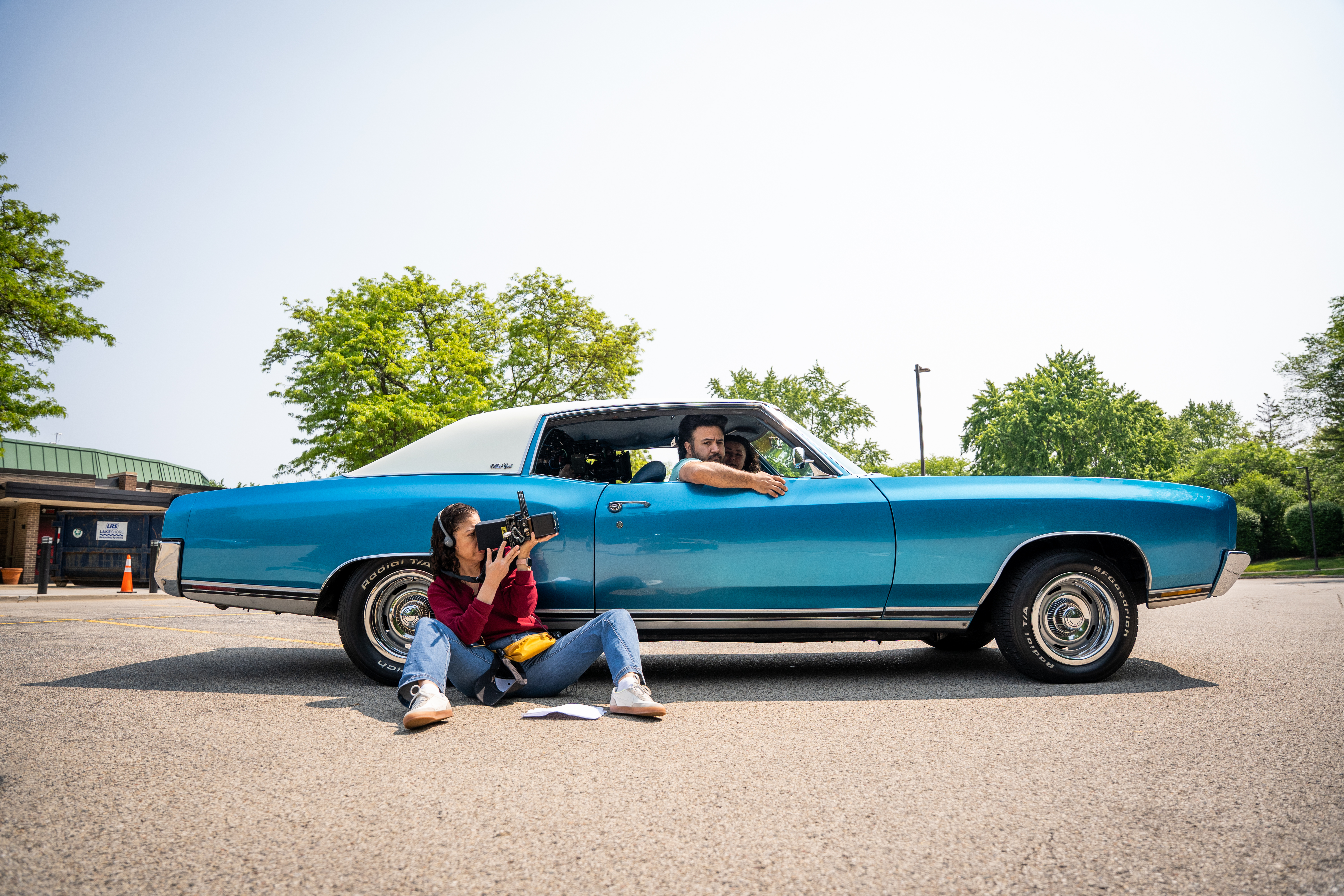
Fresh off its Grand Jury Prize win for Best U.S. Latino Live Action Short Film at LALIFF, the bilingual short The Birthday Gift has officially qualified for the Oscars. Set on a frigid Chicago night, the film welcomes audiences into a warm, inviting home for an intimate birthday dinner, only for an unexpected guest to upend the lives of an Argentine family and force them to confront the long-term repercussions of their country’s history.
In this interview with Close-Up Culture, director Arianna Ortiz reveals her deep theatrical roots with the project’s source material, the creative choice to forgo a traditional musical score in favour of live cello and natural soundscapes, and her ultimate mission to direct films that entertain, surprise, and crack audiences wide open.
The film unfolds over a birthday dinner on an icy Chicago night, with an unexpected guest changing the atmosphere. What drew you to the idea of telling a story in such an intimate, contained setting?
I actually have a very long history with the source material, which was a play by Stephanie Alison Walker called The Abuelas. As an actor, I already had a deep bond with these characters. In fact, almost the entire team met in the theater by working on Stephanie’s plays, including much of the cast. Cruz, who plays Gabriela, originated her role on stage in the World Premiere of The Abuelas. Nate, also returns to his role as Marty. Margarita, who plays Carolina, was in the companion play The Madres.
Paula Pizzi, who plays Soledad, reminded me that I introduced her to Stephanie to collaborate on translations of her work to Spanish. They began collaborating as writers. So almost everyone’s connection to the material runs very deep. It’s a passionate group.
But as a a filmmaker, I was personally excited by the challenge of this story contained in a home on an icy Chicago night. Winter forces most of us indoors, right? It was important to me for us to show the audience how freaking cold it gets in Chicago, hence the opening shot. I really wanted to establish the frigid cold and then welcome the audience into this warm inviting home filled with charismatic Argentines. I’m passionate about making stories that entertain the audience and then reveal themselves and their true heart.
So, the film is shot specifically to invite the audience into the party and put them at ease. And as the story unfolds, my sound team plays a vital role in subtly reminding us how icy and cold the city is outside. It’s not an easy setting to escape.
The film centres on an Argentine mother and daughter. What interested you about exploring that relationship, particularly the things family members sometimes struggle to say to one another?
You mean… the truth? Whew. The writers and I have had some in-depth conversations about the things Soledad has not told her daughter and why. But the only truth that matters to Soledad is that she loves her daughter. That’s what interested me.
It’s why the final moments of the film are so powerful. I often say to Paula that her performance as Soledad is the secret sauce of the film. She’s not a grating overbearing mother-in-law stereo type. She’s taking up a lot of space on this evening and in the lives of her daughter and son-in-law. But for the audience, she’s gorgeous and delightful. And the chemistry and love between her and Cruz as Gabriela is fully felt on screen. This is, of course, despite the typical grating that can be felt between a child and parent.
But pure love is the key to what is ultimately a heartbreaking story.
The film is bilingual, moving between languages as part of its characters’ lives. How did you approach using Spanish and English to shape the relationships and emotional tone of the story?
I think anyone who lives in or is around a bi-lingual environment can tell you that language is so malleable. The use of both languages in the film is very authentic to that experience. But it also serves as another layer of musicality in a movie where music is almost another character in the film.
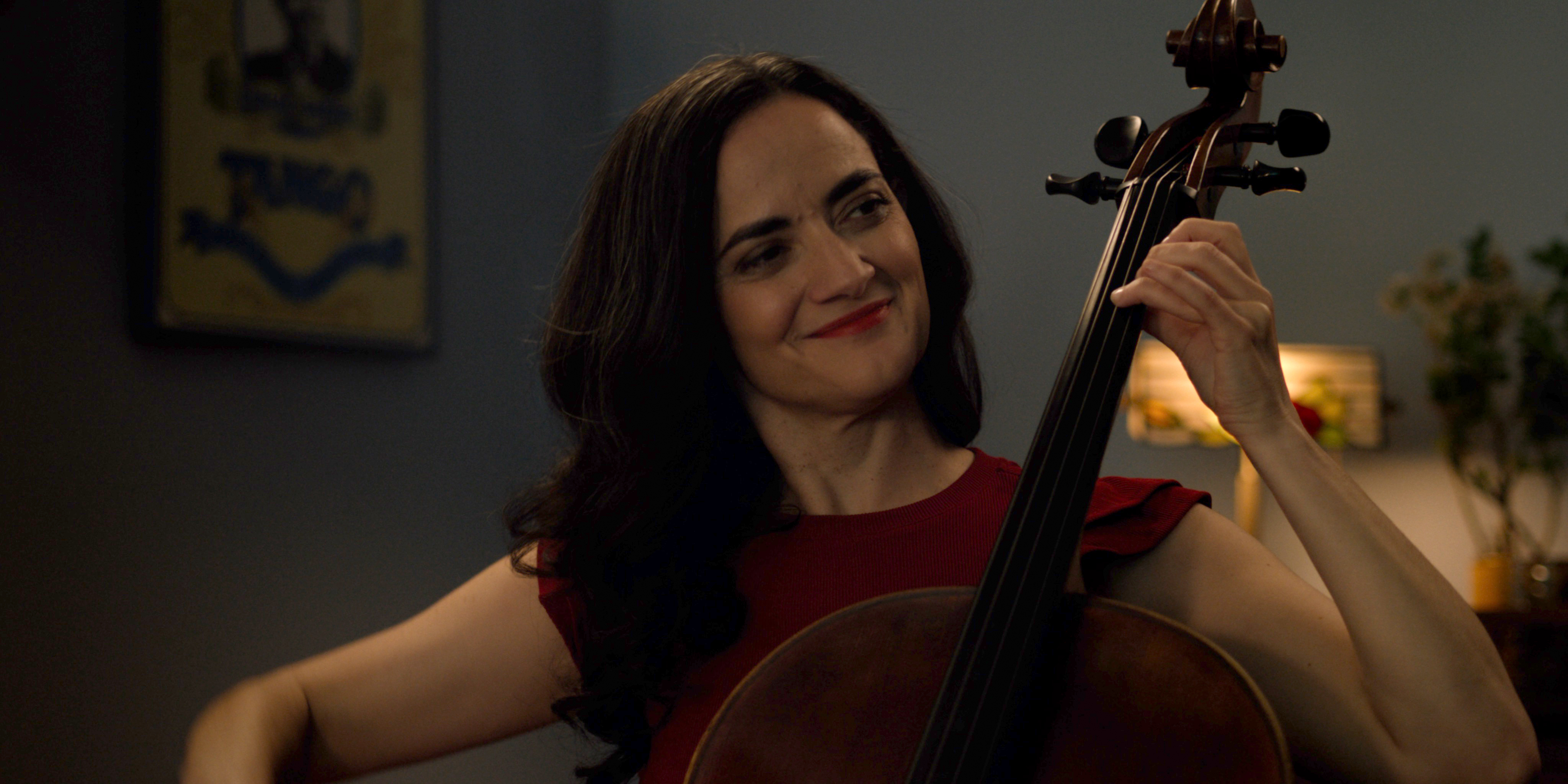
I’m not sure if most folks notice right away that there is actually no score in the film. There’s only cello played by the character of Gabriela. And all the cello was played live on set. As the film came together in post production, we ultimately decided the live cello was all we needed. As a result sound design and the musicality of the language itself became the score. Big shout out to my sound mixer Bryan Parker. He also works on The Pitt, which has no score. His work contributes massively to the tension in the film.
Cesar’s story at dinner weaves both English and Spanish. Yet in the most personal moments, he must use his native tongue. Somethings simply do not translate. The subtitles were important. Building them was not just so English speakers understand the Spanish. It was very much a part of our creative process to get them just right given the stakes in the film. Very grateful to our co-writer, Paula, who got in the weeds with us on that work.
And creatively, we don’t need subtitles in the final moments. I trusted that the audience would understand what was happening. You don’t have to speak Spanish to know this family is facing something massive.

There’s something intriguing about setting a birthday – a moment that’s usually associated with celebration – against a potentially unsettling encounter. What interested you about that contrast?
Such is life, no? Laughter at funerals. Tension at parties. Laughing politely while dying inside? It was important for me to not be too heavy handed with the stakes of the dinner guests, so we could take the audience on a journey. I experienced a major loss in my family this year. I’m often moving through the world now feeling as if I have this horrible secret trying to burst out of me. I sometimes think if I’m touched the wrong way, the dam will break. I think anyone who carries grief and loss with them has a version of this.
The writers setting the story at a birthday party lends itself to a delicious contrast of joy and pleasure versus what is revealed. That tension was so important to me. I absolutely adore when Soledad is excited about the chocotorta for desert. She’s like a little kid at her birthday party! Her charm and excitement, along with all the music and tango just let everyone have a wonderful time. Except for those trying to keep it together.
As a filmmaker, how do you approach building tension in a short film, where you have such limited time to establish characters and take the audience somewhere unexpected?
It’s a team effort! I give a big credit to my writers and my actors. As the director, I definitely felt like a music conductor – both as the script came together and on set. I remember the writer’s had underlined a word in a key moment. I asked them to take that out before we locked the production script. I knew I didn’t want the actors to push and the underline might cue them to do just that.
We had a day of rehearsal that was invaluable. The actors then fully embodied their individual stories and characters so that the smallest looks and glances said so much. My camera team captured all that and my editor and I spent a lot of time working on what we wanted the audience to see. I learned so much working with my colorist on the final look of the picture to take that even father.
And then my sound mixer came in with that sweet final layer enhancing and building on the tension around the dinner table; the sound of forks or a glass being set down. I get very geeky about sound. It’s my favorite part of post. Magical stuff. Movie magic and team work!
The Birthday Gift has qualified for the Oscars after winning Best U.S. Latino Live Action Short Film at LALIFF. What has that recognition meant to you, and has it changed how you think about the stories you want to tell next?
The remarks by the LALIFF jury made me explode into tears. They understood how deceptively simple the film is and how intentional that simplicity is.
There’s an ongoing erasure of Latinos in the U.S. in entertainment…and on the streets of U.S. cities. The film is not about that and yet somehow that is reflected in our story.
I mentioned earlier that I’m passionate about stories that entertain and then reveal themselves to be much more. I’m on a bit of a mission with my work, a calling to make entertaining films that crack you open. My stories happen to center women and Latinos. Winning LALIFF and now other festivals has been very affirming for what’s ahead. I love surprises.




Leave a Reply