
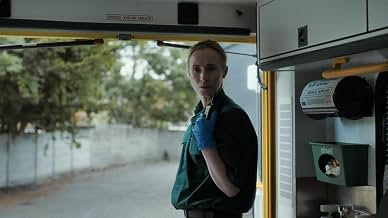
What happens when your professional duty directly collides with your maternal instincts? In the nerve-jangling seven-minute short thriller G.S.W., a paramedic makes the horrifying discovery that the dying gunshot victim she is treating in her ambulance may be the suspect behind an active shooting at her son’s school.
We spoke to writer-director Jonny Durgan to find out more…
The starting point for G.S.W. is a particularly frightening dilemma: a paramedic discovers that the man she’s treating may be responsible for a shooting at the school her son attends. What interested you in putting a character in a position where her professional duty clashes so directly with her instincts as a parent?
I think I had some subconscious element in me as my son was starting school; it made me chase the worst-case scenarios in my head, and it escalated from there. Also, both my parents were medical professionals in their careers; my mum was an A&E nurse for years, so we always heard stories about her most stressful days dealing with high-pressure, life-or-death situations – so I must have mashed those two things together somewhere in my mind and came out with this film.
You describe the central conflict as a choice between showing grace and passing judgement. Neither Beth nor Jo has an easy answer, and the situation makes it difficult to separate justice from revenge. Did your own feelings about that dilemma change as you developed the script?
That’s a good question. I definitely tried to have the characters at the end of the film be different to how they started. But also, even when they make their choices, even the wrong one, the audience stays on their side. When the film has been screened, every single person said they would do the same as they did, so I feel like we achieved what we set out to do and a testament to Genevieve and Kya and their performances, as they brought a nuance to the characters that I never thought about when writing the script, especially when the themes are all about grey areas and how morality shifts very quickly when new elements come to light.
You cite Uncut Gems, Boiling Point and The Bear as influences on the film’s escalating tension. With just seven minutes to tell the story, how did you decide how quickly to raise the stakes without giving the audience time to catch its breath?
I was careful to drip-feed the information. Firstly, it’s dealing with someone who has been shot; then it’s something happening but not sure what; then you find out what and finally how it causes everything to come crashing down around them. It’s like rapid-fire punch and punch, and with the skill of Ruairi, our DOP, and Olly Morgan, our editor, we accentuated that feeling with the camera and edit, and once Izaak, the sound designer, added his touches, it all came together to be a bit of an assault on your senses. The only time you catch your breath is at the end, and even then, it hopefully leaves you in a bit of a shock.

The ambulance becomes an increasingly claustrophobic space, and you use changes in aspect ratio and increasingly kinetic camera movement to intensify that feeling. How closely did you plan those visual choices in advance, and how much room did you leave for the tension to develop organically on set?
Well, being in such a confined space means you have to lean into the situation; there was no room to put a tripod down, and there wasn’t much in the way of doing coverage shots from other angles, as it would just be a bit repetitive, with the actors not moving great distances. The space informed us, but also we had to feel in the thick of it, so naturally that means being handheld and kinetic – we referenced the work of Paul Greengrass a lot, especially Captain Phillips, as he has a background in documentaries and it gave us a feeling of realism, at least that’s what we hoped for.
We only shot for one day, so there was an element of tension and underlying stress on the day, at least in my mind, so I can’t say whether or not that informed the actors, but it certainly felt like you don’t need to act stressed when you’re up against the clock and the fading light. But one thing we did do was shoot sequentially; it meant that, through the day, we could build and build towards the frantic ending of the script. Also, from a technical aspect, it meant we didn’t have to keep resetting makeup and hair and all that kind of stuff.
Genevieve O’Reilly and Kya Brame play characters who respond very differently to the same crisis. What did each actor bring to Beth and Jo that surprised you, or made you reconsider how a particular scene should play?
I can’t speak highly enough of them. With such tight timings, we needed to be rapid, and they were nailing takes and kept us on schedule purely because of their talent. With one look, they conveyed so much that it added so much, especially when the camera is so tight and close. The interpretation of the lines was so much deeper than how I’d written them; the words didn’t change, but the meaning of certain lines did.
Genevieve made Beth much more hard-nosed than how I’d written it, and much more believable as a character as a consequence. Kya made Jo’s transformation much deeper; by the time the credits roll, you have theories about what Jo would do next from just a look that she gives. That’s all Kya. If anyone is making a short film with limited time and resources, I would say cast actors who are great actors; it’ll save your arse!
You left a successful career in advertising to return to education and pursue filmmaking, despite having a mortgage and a young family. Now that G.S.W. has qualified for major awards consideration and reached international festivals, has the experience changed your definition of what a successful creative career looks like?
Yes and no. I think the festivals and awards aren’t something I thought about, and it certainly isn’t a barometer of success for me. If you make a film thinking of awards, then you’ll only be disappointed, and won’t be authentic anyway. Films are so subjective; even short films that win Oscars have critics, so you can only make something for yourself and in your voice.
The only measure of success I had was hoping to learn more, to add new experiences and to make something for myself without worrying about clients, briefs, media placements and all the issues that you need to consider in advertising, but with that comes the feeling of having nowhere to hide. I can’t blame anyone but myself if it doesn’t turn out the way I thought it would.
But thankfully it did, and that was the only real measure of success I had. Everything else is just extra.




Leave a Reply