
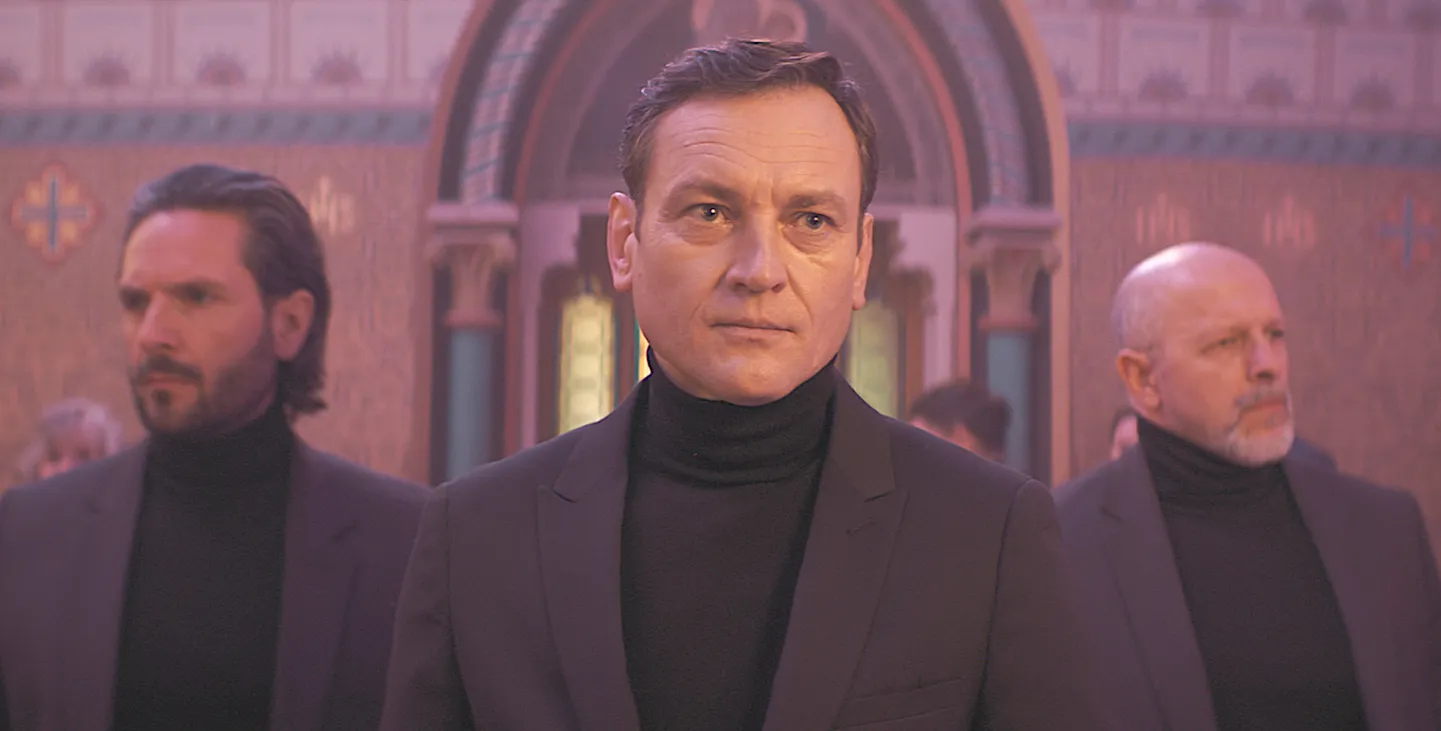

David Balda’s Manipulation sets its sights on an ambitious subject: the shadowy networks of power that operate behind political institutions and the Church, exploring how easily truth can be distorted by those who seek to control it. With secret societies and conspiracies at its centre, the film has all the ingredients for an intriguing thriller. Unfortunately, its tangled storytelling makes it difficult to become fully invested in the mystery that it attempts to unravel.
Manipulation centres on Matteo (Radoslav Gavlas), a young man who belongs to a powerful secret society led by a man known as the Master. Following an initiation ritual, Matteo is promoted within the organisation and tasked with contacting Father Vitus (Heino Ferch), a priest whose involvement is crucial to the society’s plans. However, as Matteo begins to witness the organisation’s disturbing practices, he starts to question the world in which he has been raised. Through his relationship with Anna (Anna Ctvrtnícková), Matteo becomes caught between competing forces seeking to control the Church and the wider political establishment.
There is certainly no shortage of ideas, but the film struggles to bring them together into a coherent whole. Its various threads become increasingly difficult to follow, leaving the viewer working to piece together the relationships, motivations and wider implications of events rather than becoming immersed in the drama. The film brings together an international cast, which adds to the sense of a European conspiracy, but much of the cast appears to be working outside their native languages. This can occasionally make the dialogue feel stilted, with exchanges lacking the natural rhythm and emotional immediacy needed to draw the audience into the story.
It is difficult to separate the demands of acting in a language other than one’s mother-tongue from the performances themselves, but the effect is noticeable, particularly as Manipulation is a film dependent on lengthy conversations to establish its intricate web of allegiances and betrayals. Rather than clarifying the complex plot, these scenes can make it harder to connect with the characters fully.

A thriller examining the intersection of power, religion and conspiracy could offer a compelling and contemporary reflection on the anxieties surrounding misinformation and institutional control; these are, after all, themes that are as relevant as ever to society today. Yet Manipulation too often prioritises exposition over clarity, with lengthy exchanges of dialogue explaining the forces at play without making them any easier to understand and thus diminishing much of the suspense that is otherwise built throughout the film.
Where Manipulation fares considerably better is in its cinematography. Shot across Prague, Ferrara, and Bologna, the film makes excellent use of its European locations, with almost every shot a beautiful still in itself. The compositions are striking, with carefully considered framing and lighting giving the film a visual sophistication which unfortunately goes unmatched with its screenplay. There is a strong sense of atmosphere in these images, and Balda demonstrates a clear eye for the visual possibilities of his settings.
Ultimately, Manipulation is an ambitious undertaking that never quite realises its potential. Its subject matter is ripe for exploration, and its visual execution demonstrates considerable promise, but the convoluted narrative makes it difficult to connect with the story or its characters. The film looks impressive, but striking cinematography can only do so much when the central mystery remains frustratingly elusive. There are glimpses of a more compelling thriller beneath the surface, but Manipulation struggles to bring its many ideas into focus.






Leave a Reply