
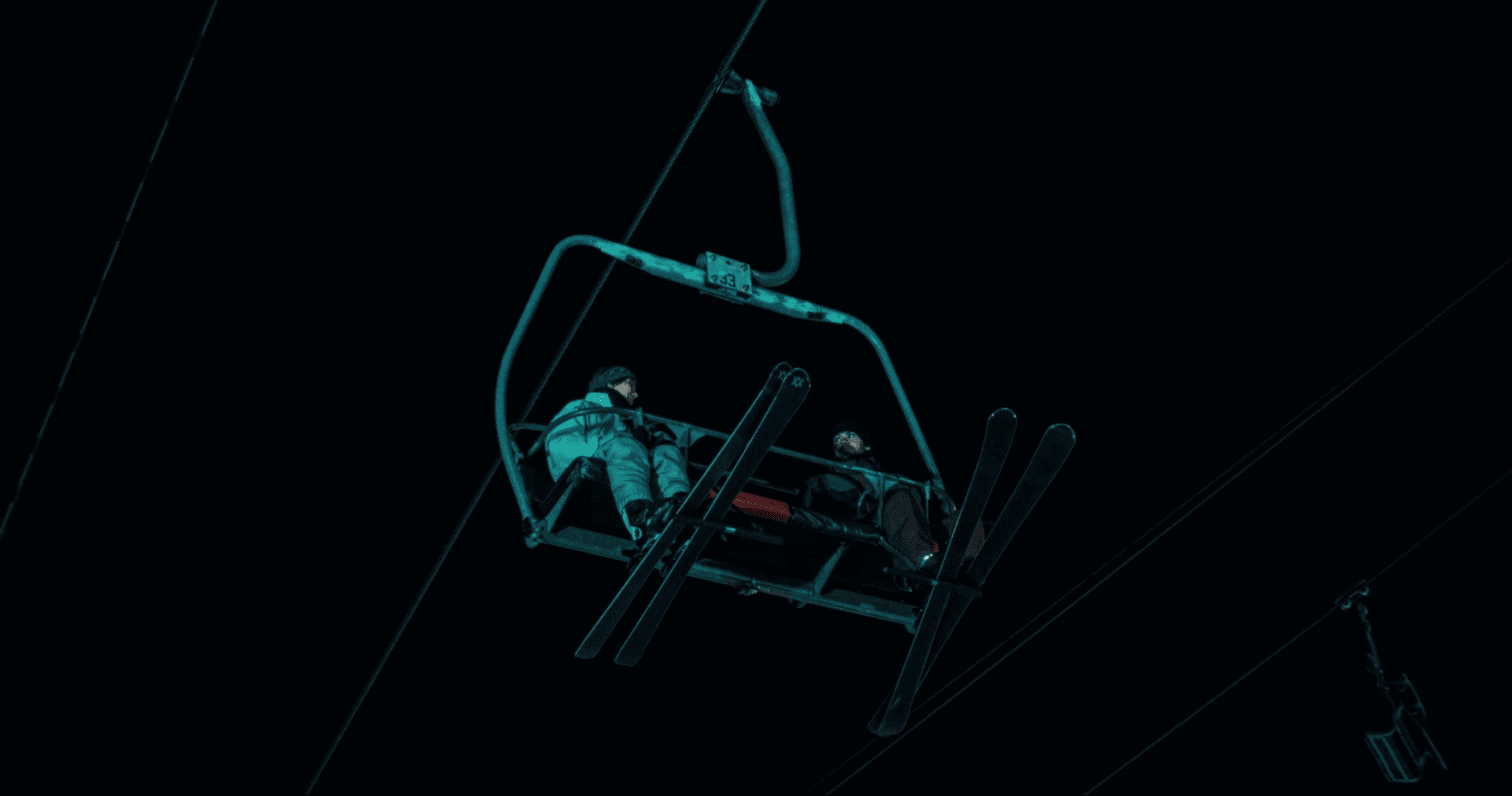
What happens when nature decides to fight back against our artificial winters? In this interview with Close-Up Culture, director Rodolphe Populus reveals how he turned a familiar holiday pastime into an eco-horror survival story.
Getting stuck on a ski lift is something most skiers have probably imagined at some point. I certainly have. What made you think, “I want to turn that into a film”?
Rodolphe: What I love about a chairlift is that you’re completely powerless. You’re travelling from point A to point B and there’s absolutely nothing you can do about it. You’re suspended in the air, essentially stuck.
There’s also something interesting about skiing when there’s mist or poor visibility. You can see the chair directly in front of you and maybe another one beyond it, but after that you can’t see anything. That leaves so much to your imagination.
So I wanted to take this very familiar skiing experience and turn it into something frightening. Skiing is usually associated with fun, holidays and freedom, so I thought it would be interesting to transform something that people use for pleasure into a nightmare.
In France, we have a very famous comedy from the 1980s called Les Bronzés font du ski. I think practically every French person has seen it. It’s a film about a group of people skiing, and one of its most famous sequences involves someone getting stuck on a chairlift. So in the French imagination, the chairlift is also associated with comedy. I liked the idea of taking something that is culturally associated with humour and turning it into horror.
I also wanted the chairlift itself to feel like a character – almost like a monster. You’ll see lots of inserts and close-ups of the machinery: the wheels, the cables, the mechanisms. I find it quite an impressive and very specific machine, and I wanted to make it feel threatening.
The two characters are strangers, aren’t they? What interested you most about them and the relationship that develops between them while they’re in this situation?
Rodolphe: Yes, they’re strangers, and that was important to me. When you’re on a chairlift, you’re very often sharing it with strangers.
At the beginning, they’re polite with each other, but they’re already slightly arguing. The man wants to lift the safety bar because he wants to get his phone out, while the woman doesn’t want him to do that because she’s afraid of heights.
I liked the idea of taking that very ordinary interaction between two strangers and gradually stripping away the politeness. At first, you’re behaving properly because you’re strangers. Then, as the situation becomes more about survival, that politeness disappears. You get to the point where you’re thinking, “What the fuck is happening?”
In an early draft, I also considered making them the same age and introducing a kind of flirtation between them. But I decided I didn’t want that. It was much more interesting to me if there was no romantic relationship at all. They’re simply two strangers forced to survive together.
You’re working with a very limited setting – essentially the chairlift. How did you use the camera, sound and landscape to maintain the tension without constantly repeating the same shots?
Rodolphe: That was one of the most difficult things. We had many more shots we wanted to make, but we simply didn’t have enough time. When you’re filming on a chairlift, you’re constantly chasing time.
For every shot, we might have had two or three takes, four at most, because we had to move on to the next shot. Setting up a shot on a chairlift can take an hour, so you don’t have the luxury of saying, “Let’s wait another minute and get this close-up.” You have to adapt.
That’s why editing became so important. One of my best collaborations on the film was with my editor, Joffrey Pilaud. I already knew him, but this was the first time we had worked together, and he brought so many ideas that I hadn’t thought of myself.
You’ll see quite a lot of black frames and smash cuts, as well as inserts of the chairlift itself. The beginning and the end of the film also take place away from the chairlift, so the chairlift isn’t the entire film.
We were constantly looking for different perspectives. Sometimes we’re with the protagonists, sometimes we’re looking from another chair, and sometimes we put the camera down on the slope and look up at them from underneath. We also have a very wide shot when the chairlift starts moving again, where the protagonists are tiny figures in the distance. They’re entering this dark world.
So it was really about constantly finding a new visual perspective and then using the editing to bring all those elements together.
We also shot part of the final section using a GoPro, which gave us another visual texture.
You mentioned earlier that the characters hear a loud roar. Without giving too much away, can you tell us a little more about that element?
Rodolphe: Yes. There is clearly something there. You hear this enormous roar, and the characters – and the audience – understand that there’s some kind of creature.
I was very influenced by Jaws and Steven Spielberg’s approach to monsters. It’s often much better not to show the monster. Partly because we didn’t have the budget to create a beautiful monster, but also because I genuinely believe that suggestion is more frightening.
So the monster exists through the sound of its roar, through screams, through footprints in the snow and through the consequences of its presence. There are dead bodies, for example. At certain moments, you might see a shadow or a shape, but you never get a complete look at the creature.
It was very important to me to leave space for the audience’s imagination. You can imagine that it’s a bear, a wolf or something completely different. I love that because everyone can create their own monster.
A lot of the work was therefore done with sound. The sound design was extremely important in making the creature feel present without actually showing it.

Is the monster a metaphor for something, or is it primarily a horror device?
Rodolphe: The whole point of the film is actually to make a film about climate change and the way global warming is affecting ski resorts.
Every year, ski resorts have to close because they’re not high enough and they no longer have enough snow. That’s really at the heart of the film.
The protagonists talk about how, a few years ago, the station used to be completely covered in snow. The woman has been coming to the resort for many years and remembers when everything used to be white. Now there are rocks everywhere and much less snow.
They also discover that the night before, the resort had sent a helicopter to the top of the mountain to collect snow and bring it down to the ski slope.
There’s a story behind that. When they built the resort, they had tried to go to the top of the mountain, but there was an accident and nobody ever really knew what happened. They stopped going there after that. Then, decades later, the resort sends a helicopter back up to bring down snow – and afterwards, everything starts happening.
I wanted the audience to be able to connect those dots themselves. I don’t want to give them too many clues.
It’s really about human beings going against nature. The image of a helicopter going to the top of a mountain to take snow away is very powerful because it shows how far we’re willing to go to maintain this artificial version of nature.
In fact, the footage you see during the end credits is real. In France, in 2020, a ski resort actually sent a helicopter to collect snow and bring it down the mountain. There was video footage of it, and it caused something of a scandal in France. We use that real footage in the end credits.
So, yes, the monster is ultimately a metaphor for nature rebelling against human actions.
What’s your own relationship with skiing? Is it something you’ve done throughout your life?
Rodolphe: I used to go skiing every year during the Christmas holidays with my family. But once I became an adult and had to pay for myself, I stopped going as often because it’s really expensive!
Now I probably go for one week every two or three years. But I love it. I love skiing and snowboarding.
For me, skiing is about all these sensations. It’s about fun, having good food, partying at night, being in nature, breathing the fresh air, having conversations on the chairlift. It’s a very particular environment – almost its own little world.
That’s why I wanted to explore it through horror. I wanted to take this beautiful amusement park, this place that’s normally associated with pleasure and freedom, put a monster inside it and see what happens.
And is The Last Snow ultimately intended as a stepping stone towards a feature?
Rodolphe: Yes, absolutely. We made the short film with the intention of developing it into a feature. We’re currently working on the feature version, so that’s definitely something we want to do.
The Last Snow is screening at BFI London Film Festival – for more info



Leave a Reply