
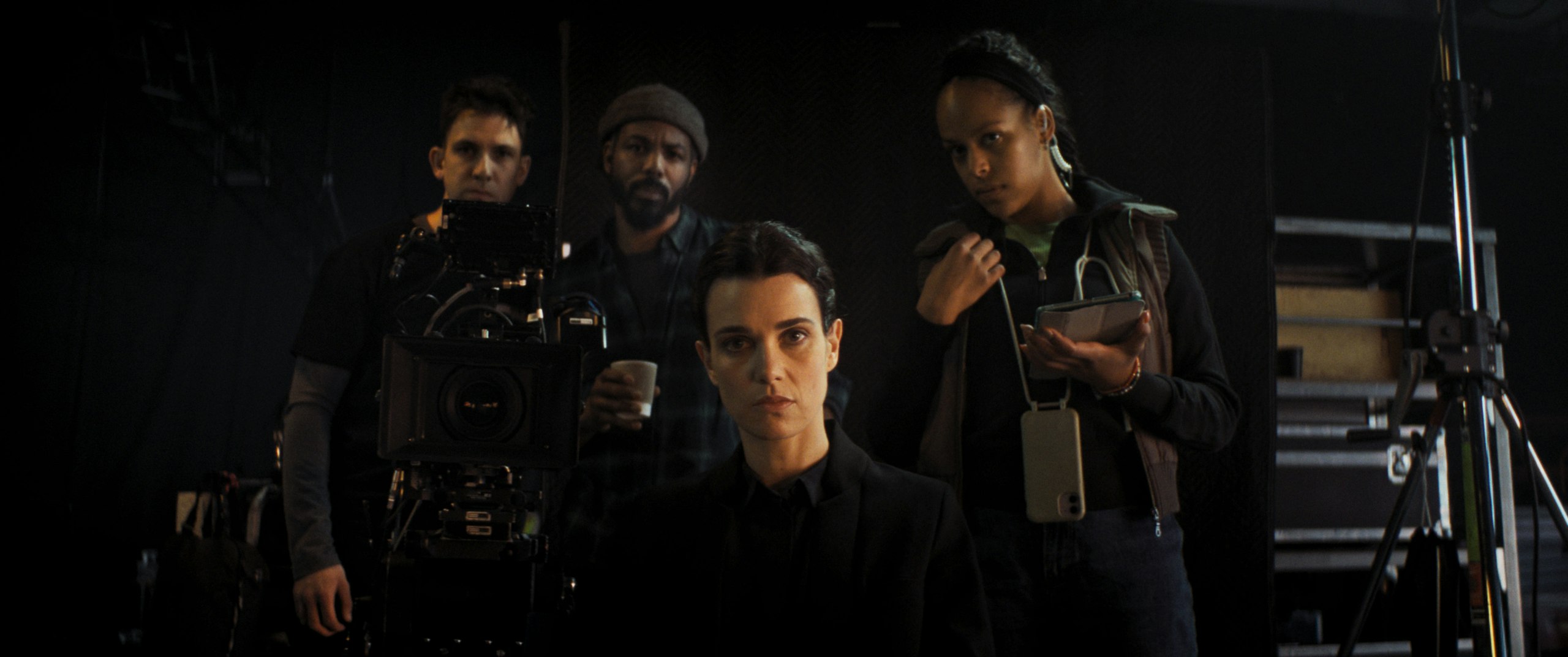
Drawing on her experience on major sets like Skyfall and Queer, filmmaker Katey Lee Carson discusses her BAFTA-qualifying short The Secret Assistants and why her crew rejected Hollywood hierarchies by splitting a £14,000 budget entirely equally.
Sophie is put in the position of having to risk her own career to challenge someone more powerful than her. Do you think we’ve become too comfortable with telling people to “speak up” without acknowledging what that can actually cost them?
I think we need to stop placing the responsibility of fixing an abusive system on the person with the least power in the room. Each situation is unique. The decision to speak up is a deeply personal one and no one should be forced into speaking up. They should be supported if they choose to do so, but I don’t believe we can judge anyone if they cannot find it within themselves to muster the immense courage required to risk their livelihood and in many cases their dreams.
During the height of the #MeToo movement, Rickie-Lee and I both found ourselves at dinner tables where people would hit us with something along the lines of: “I hope you’re not accepting poor treatment or bullying.” And I just thought to myself: we don’t accept it. We get on with it. We have learnt how to navigate it because that is what we have had to do to survive and move on to the next one. Perhaps we could be accused of normalizing abuse but what other choice do we have? Never work again? We are not important people. We are perceived as replaceable, and they will replace us, not the abusers. We have seen this time and time again.
The people who are brave enough to speak up are heroes. They build safer work environments for all of us. That being said, life is sadly not a Hollywood film. Most stories do not have happy endings accompanied by heart-warming music, and if you are low down on the ladder, it is completely unfair that the expectation should be placed on you to clean up the industry.
It is of course important that people continue to speak up but I think we need to be much more understanding of what we are asking a person to risk before we insist that they speak up. Or, rather, we need to create an industry where those who do speak up are supported from beginning to end. They are heard. The abusers are held accountable. And the people who come forward are allowed to continue working. Because at the end of the day, that’s all we are asking: let us do our jobs in safe environments. Nothing more and nothing less.
Don’t put us in a position where we have to speak up. Stop hiring the people who cause these situations.
The film doesn’t present Sophie with an easy moral choice. Were you interested in asking whether staying silent can sometimes be a form of self-preservation rather than simply complicity?
Absolutely. I wanted to put the audience in the shoes of a well-meaning witness who is in an impossible situation. To ask themselves honestly, if no one was looking, what would I do? To explore that grey area between awareness and action. You’ve seen something. It was horrible. Now what are you going to do about it?
If the answer is, “I’m going to put my head down and get my job done because I’m terrified of losing my position,” then did they really have much of a choice?
Does their lack of action prove that they condone what happened? Or is the ability to stick to your morals a luxury that is directly linked to where you sit in the hierarchy? At the end of the day, there are 15 people in the room with Sophie. Why is it Sophie who should choose to speak up, why not the other 14?
I have no answers to these questions. It is wildly complex, but real life is wildly complex and with this film we wanted to show what really happens. There’s no Hollywood sheen, no one is coming to the rescue and there is no neat answer. These things happen. Most of us, at one point or another, have witnessed something and then carried on working. That is the reality of working in highly competitive industries.
It’s very easy to judge someone’s silence when you are sitting outside the situation, without having to risk anything yourself. I wanted the audience to stew in that uncomfortable space and ask themselves what they would actually do if they were Sophie.
You’ve worked on some huge productions yourself, including Skyfall, Guardians of the Galaxy and Queer. How much of the film comes from things you’ve personally witnessed or experienced within those kinds of hierarchical environments?
One of the reasons so many of our wonderful crew signed onto the project, was that they all know a Henry Mann. And that is sadly not an exaggeration. Henry is an amalgamation of people we’ve worked with over the years. I first started in this industry when I was 17, working as a PA in advertising, and ever since I started I’ve been keeping notes. It began as a notepad for what I should be learning: how to use a radio, set etiquette, what each person does on a film set. But soon another form of note started to creep in. I began jotting down some of the really awful things I’d heard people say on set. A lot of Henry’s dialogue is taken from those original notes, verbatim.
Richard Hope, the wonderful actor who came on board and saved our film by agreeing to be our Henry a week before we shot, called me immediately after reading the script and said, “Oh, I know Henry. Everyone knows Henry.”
So, in short, so much of the film comes not only from what I’ve witnessed, but from what my colleagues and crew members have seen and experienced on sets over the years.
People will tell you about their experiences with a Henry as if they’re showing you their war scars. Often they won’t tell you the name of the perpetrator, preferring instead to say, “A producer/director/head of department/actor who I won’t name.” Even if the person is long gone, they are still afraid of what could happen if they are heard speaking out against them.
I wanted Henry to be the incarnation of all of those experiences. The everyman. So that anyone who had ever been up against a Henry could see their experience reflected on the screen. Henrys do not just exist in the film world, some of the strongest reactions to the film have come from the medical profession, from tradespeople, from executives in the corporate world – every industry is unfortunately rife with Henry Manns.
You made the film for £14,000, but perhaps more interestingly, everyone from the producer to the runner received the same daily rate. Why was it important for the production itself to embody the values that the film is arguing for?
Rickie-Lee and I know first-hand just how important every single crew member is. Everyone has a function, and we all work together to serve the film. We are growing tired of the immense wage gaps within film crews. Top-heavy budgets are part of the problem. If your entire budget is built around attaching one person to your movie, and that person knows it, they have all the power, and it becomes very difficult to function as a team and to call out bad behaviour.
We wanted to make a film where everyone knew where the money was going, where everyone knew what everyone else was earning. We are well aware that we were only able to do this because it was a short film, and that this type of production model becomes more complex on a feature or a series. But we wanted to try it, and we had fantastic results.
An amazing crew was formed, and everyone worked so tirelessly to make the film what it is. Every single member deserves as much credit as the next, and we wanted the budget to reflect that. It also completely transformed our set. So many people commented on it after the shoot. It felt different. It felt like a future industry we all wanted to continue working in.

The film is essentially about what happens when ambition collides with power. Having now made it, do you think the industry actually gives ambitious people enough room to succeed without asking them to compromise themselves?
Not yet, but I believe we can change that by stopping the practice of attaching value to abusive individuals.
There are many hopeful dreamers in this industry. Kind, generous artists and technicians who just love cinema and are obsessively passionate about their craft. It’s a dream career for so many people, and sadly, people take advantage of that. They know how much people want this, and they know that so many will put up with an extraordinary amount because they are chasing their dreams.
This is also an incredibly expensive industry. What we create costs an immense amount of money, and it can take years and years to get a project off the ground. So there you are, with a dream in hand. You’ve worked so hard. You can just about hear that little 10-year-old version of yourself saying, “Are we ever going to actually do this, or should we maybe take up accounting?” And then someone says, “Well, if you get this guy on board, you’ve got your movie.”
It becomes very, very hard to say no.
Now, if the person you need to get on board is lovely, then there is no issue. But if they have a reputation for abusive behaviour, that’s where the trouble starts.
This is a business at the end of the day, and no one is asking it not to be a business, but let’s ask ourselves what on earth is so valuable about these people that we would allow them to hurt others in the name of storytelling? Surely there is someone else who is equally as talented, equally as valuable, who is not guilty of horrible misconduct. I refuse to believe that there isn’t.
You describe The Secret Assistants as the first film from a wider production slate. Having spent years working within the machinery of major productions, what kind of industry are you and Rickie-Lee Roberts trying to build for yourselves
First and foremost, we want to build an industry that will last for generations to come. An industry that is sustainable, flourishing, making a profit and keeping people employed around the world, while producing film and television that nourishes and entertains society.
To do this it needs to be an industry that respects its workers. One that provides its teams, who are also its most adoring fans, with safe working environments. Yes, our first allegiance is to the film, and yes, crews will always work as hard as they can to make the film the best it can be. But that does not mean we need to abuse people in the name of making a better film.
Working in film can be such a beautiful experience. The majority of the industry is good. We just need to stop allowing a system that protects the people who make it unsafe and create a system based on respect for everyone. Open the doors and let in the light. Stop over-valuing the work of people who are polluting our industry.
That is the kind of industry we want to build.



Leave a Reply