
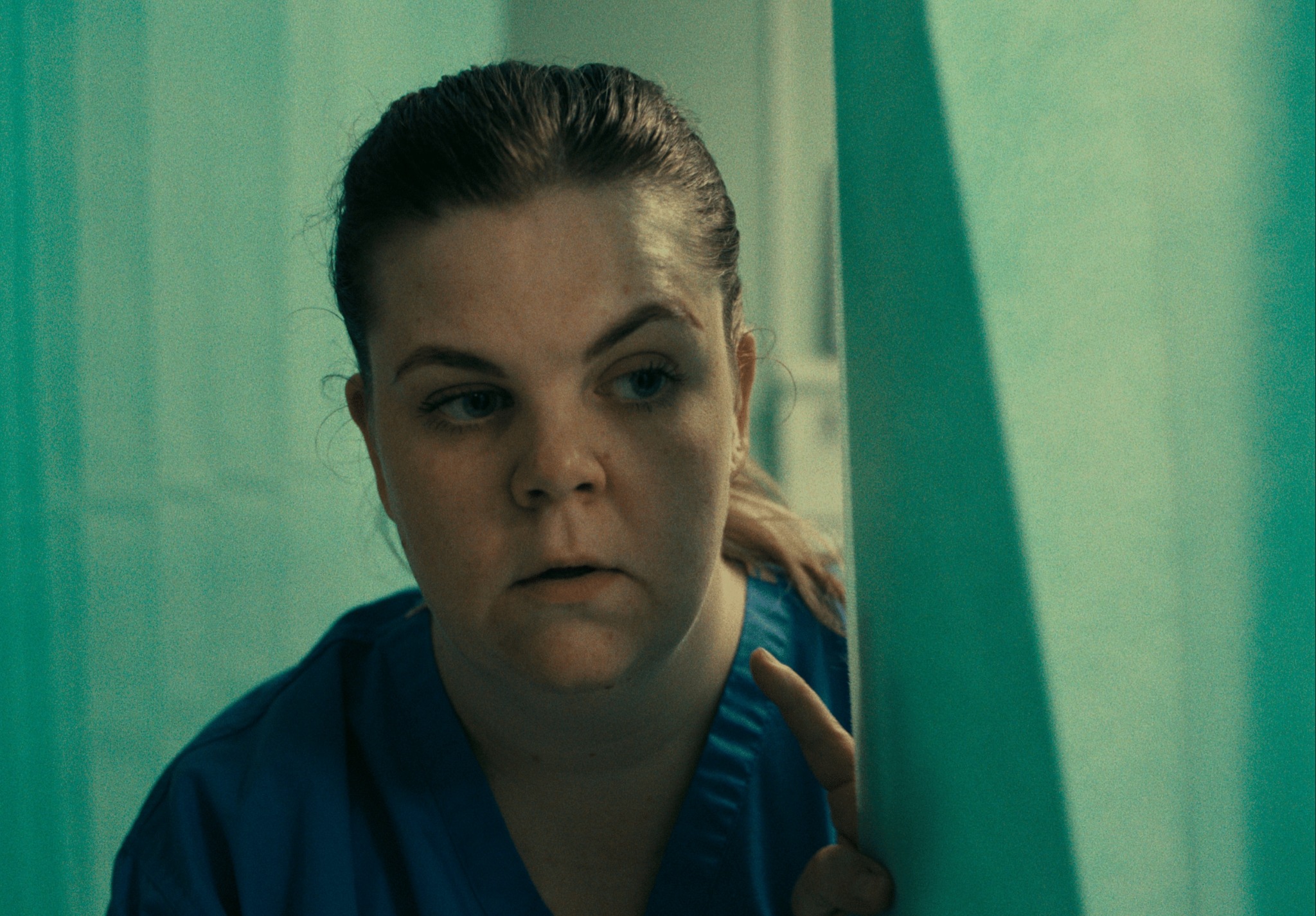
Director Kristian Lever takes us behind the scenes of his devastating short film, Mine for a Moment, which explores the human breaking point behind a maternity ward abduction.
What was it about Cheryl’s story that first stayed with you and made you want to explore her experience through film?
The film was inspired by a real story I heard about a woman who disguised herself as a nurse and took a newborn from a maternity ward. That night, I couldn’t sleep. I kept imagining the woman behind the act: someone driven by desperation and grief, who wanted so badly to become a mother that she crossed an unimaginable line. I felt sorry for the woman I imagined, even though I couldn’t excuse what she had done. That tension stayed with me.
At the time, people close to me had experienced miscarriages, and I was also seeing how another kind of loss was affecting my mother. My brother had cut off contact with our family for years. He was alive, but I could see how deeply his absence changed her. She had always been such a bright, positive person, and I watched grief gradually take up more space in her life.
When I told my mother I wanted to make this film, she shared something I hadn’t known: she had suffered a miscarriage when she was younger. The doctor who told her was about eight months pregnant. My mother said that, in that moment, she felt emotions she had never felt before. Hearing that helped me understand how grief can bring out feelings that surprise even the person experiencing them. It made me want to explore Cheryl as a human being, without asking the audience to excuse her actions.
The film deals with miscarriage, infertility and grief, but you tell the story through a very intimate character study. How did you find the emotional balance between giving Cheryl space to grieve and moving the story forward?
I wanted the audience to question its own moral response to Cheryl. On paper, taking someone else’s child is almost impossible to forgive. But I wondered what would happen if we stayed close to her long enough to understand her grief. Could we feel compassion for her, even while knowing that what she plans to do is wrong? Could we even catch ourselves hoping, for a moment, that she succeeds?
Cheryl has built a lie around the pregnancy she lost, and when her husband is about to return, she feels cornered. That gives the story its urgency. I wanted the audience to get to know her, then feel the tension build through one obstacle after another. There is a brief moment of release, and that is when the emotional truth of what she has done can really hit. For me, the ending is more heartbreaking because we have been caught up in wanting something for her, even while fearing the consequences.
Casting was essential. Gina Fillingham has a warmth that makes Cheryl immediately human. I wanted her to feel like someone you might know: an ordinary, lovable person in extraordinary distress. That makes her choices harder to watch, and the audience’s feelings about her less straightforward.
Cheryl creates an entire reality around the pregnancy she has lost. What interested you about the relationship between imagination, denial and grief, and how did you translate that internal experience visually?
One detail of the real events bewildered me: the woman’s husband had also been arrested, then released when it became clear he had not known what was happening. I kept wondering how someone could be so close to a person and yet unaware of something so enormous. In our film, Cheryl’s husband works overseas for months at a time. Their life together happens largely through phone calls and video calls, which makes it possible for her to maintain a version of reality that would be much harder to sustain if they were in the same room.
I think the deception begins with Cheryl herself. She has lost the pregnancy, but she cannot fully accept that loss. Continuing to tell her husband she is pregnant also lets her keep telling herself, in some way, that the life she imagined is still possible. When he is about to come home, that fragile reality is threatened. She feels cornered, though she also desperately wants the baby.
Visually, I wanted us to remain very close to her experience. Our cinematographer, Iikka A. Salminen, showed me a reference from Son of Saul, and I connected immediately with the idea of a camera that stays close to its central character as the world moves around them. We developed that approach for the maternity ward scenes, choreographing much of the movement between Gina, the camera and the other characters. One action leads into the next, almost like a continuous theatre sequence. Staying so close to Cheryl lets the audience experience the mounting pressure with her.
Coming from a background in dance and choreography, do you find yourself thinking about actors and scenes in terms of movement, rhythm and physical expression as much as dialogue? Was that particularly true when directing Gina Fillingham in this role?
My background in choreography was especially useful in the maternity ward scenes. Cheryl encounters one obstacle after another, and every movement had to be carefully planned and timed perfectly: when we used the real baby, when we switched to a doll, how the baby’s chaperone moved around the camera, even the moment the plates crashed to the floor. We worked through those details almost like a piece of choreography so that the scene could feel immediate and unpredictable on screen.
Dance has also taught me to pay attention to instinct, timing and changes in emotional intensity. I can often feel when a scene needs to hold back or when it needs to build. Because I also edit, I’m constantly thinking about the rhythm while we are shooting and watching takes.
With Gina Fillingham, we didn’t rehearse in a formal way, such as reading lines. We talked a great deal and had a shared understanding of Cheryl. In the final scene, for example, we knew the physical and emotional points we needed to reach: the struggle to get the baby back, and the moment when Cheryl breaks down. Celyn Jones, who plays Darren, was part of that conversation too.
The three of us talked about how Darren’s quiet and subtle urgency could come through in the simplest physical action. Before he can reveal to Cheryl what he is thinking, he needs to get the baby away from her. Celyn was brilliant at conveying that silent urgency. I think of those shifts in the scene almost as I would the crescendos and quieter passages in music.
There’s a real sense of stillness and tension in the film, even as Cheryl’s circumstances become increasingly urgent. What were some of the visual or directorial choices you used to create that atmosphere?
I drew a lot from the greats, such as Hitchcock’s idea that suspense comes from letting the audience know something a character does not. In our film, we know what Cheryl is trying to do, so even a simple action can feel threatening. A door opening, a trolley being pushed into the ward, or the sound of a curtain moving in the distance might mean that someone is about to discover her.
We paid close attention to those small details, especially sound. The slightest coo from the baby beneath a blanket can become almost unbearable when you know what it might reveal. Visually, we could create the same feeling with what remained out of sight: who might be on the other side of a curtain, or just beyond the frame.
I wanted to see how far we could build that tension through simple things. The moments of stillness give the audience time to notice them and to anticipate what might happen next, making it more psychological. Then, when the tension briefly lets up, there is room for the emotional ending to land.
After spending so much time with Cheryl and her story, did making the film change the way you think about grief – particularly the different ways people try to cope with a loss that they can’t simply move on from?
I don’t think making the film necessarily changed the way I see grief so much as my understanding of grief was the reason I wanted to make it. I’ve seen how loss can change someone, and how difficult it can be to understand what another person is carrying.
What has moved me is the response from audiences. People have come up to me after screenings and shared experiences of loss, or spoken about someone close to them who was struggling. Their circumstances may be very different from Cheryl’s, but they recognise something in her inability to let go of the life she imagined.
It has been wonderful to see how willing people are to feel compassion for her while still understanding the seriousness of what she does. At a time when empathy can sometimes feel in short supply, those conversations have reminded me that people are capable of looking beyond a simple judgment and seeing the human being underneath.





Leave a Reply