
By Genevieve Dammery
Some films are controversial because of what they contain. Others are surrounded by controversy so inseparable from their identity that it is difficult to imagine one without the other. Ken Russell’s The Devils somehow falls into both categories.
More than 50 years after its original release, Russell’s infamous 1971 film is returning to cinemas in a newly restored 4K version. The restoration, released by BFI and Warner Bros, reconstructs Russell’s preferred 2004 edit, making it the first officially released version that reflects Russell’s original vision.
The Devils is a film about the abuse of institutional power: a story of religious hysteria, political calculation and collective paranoia in which accusations of possession become a mechanism for controlling a population. Based on Aldous Huxley’s non-fiction book The Devils of Loudun, the film, setin seventeenth-century France, follows Urbain Grandier (Oliver Reed), a priest whose political opposition to Cardinal Richelieu puts him in the path of a campaign to destroy him. When Sister Jeanne (Vanessa Redgrave), a sexually repressed Mother Superior of a local convent, becomes obsessed with Grandier, her desire is transformed into accusations of demonic possession.
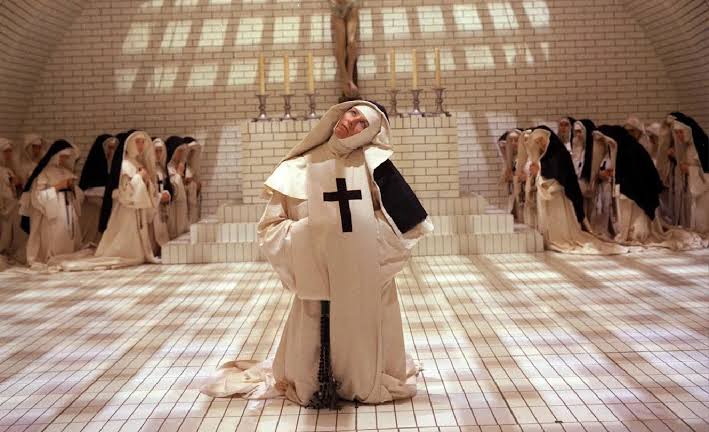
The resulting film is an assault of colour, sound, sex, andviolence. Derek Jarman’s enormous white architectural sets make Loudun feel monumental, yet claustrophobic, while Peter Maxwell Davies’ score gives the film an extremeintensity. The Devils presents the Loudun possession not as historical realism, but as historical nightmare. It is easy to approach the film expecting to be provoked for provocation’s sake. There are certainly images designed to offend. Naked bodies, religious iconography, sexual violence, nuns having orgies, torture and blasphemy are thrown together with such excess that at times it felt like an experiment to test the limits of what an audience is willing to endure.
But underneath the spectacle is a coherent political argument. The film’s real target is the way institutions can manufacture belief and exploit fear. The possession of the nuns becomes a spectacle through which desire, political ambition and religious authority was used to justify violence. Grandier is not destroyed because he is guilty of the crimes attributed to him; but because he is a useful scapegoat.
This, ironically, is what makes the film’s censorship history so perversely appropriate. When first released, The Devils was subjected to cuts by the British Board of Film Censors, andthen additional cuts requested by its own distributor. The most infamous omission was the sequence subsequently known as the “rape of Christ”, and the American version of the film was cut even further. For decades, The Devils existed in a state of incompleteness. Audiences were watching a film about institutional authorities controlling what could be seen while simultaneously watching a film that had itself been subjected to institutional control. This contradiction ultimately became part of the mythology of The Devils.
The mythology has, at times, overshadowed the film itself. For decades, the missing footage became the story. The question of what audiences were not allowed to see became as fascinating as what they were allowed to watch. Watching the restored version, however, the remarkable thing is how little the film needs its mythology to remain disturbing.

Russell’s work has aged in unexpected ways. Some of it feels contemporary; some of it feels unmistakably rooted in the cinematic culture of the early 1970s. The film’s depiction of female sexuality remains uncomfortable, particularly in the way Sister Jeanne’s desire is transformed into something monstrous. Redgrave is extraordinary, but so is Reed.Grandier could have been reduced to the archetype of the charismatic, persecuted male hero. Reed instead plays him with vanity and arrogance alongside genuine charisma. He is hardly a saint, but that makes his destruction more troubling.The film does not require its victim to be virtuous before asking us to recognise the injustice of his persecution.
This moral ambiguity is one of the reasons The Devilscontinues to resist easy interpretation and is why the film feels less like a historical drama than an examination of how societies behave when authority, repression, and fear collide.The convent becomes a theatre. Demonic possession becomes performance. Torture becomes public entertainment. The authorities do not simply punish Grandier; they put him at the centre of a neatly constructed narrative in which punishment becomes the only way out.
The Devils so clearly demonstrates that power does not always operate by hiding the truth, sometimes it operates by putting on a show, and this, perhaps, is why it feels so relevant to today’s audience. Not because its seventeenth-century story has direct contemporary parallels, but because the understanding of spectacle feels remarkably modern. The film is obsessed with the transformation of private fears into public entertainment and of individual accusations into collective certainty. The crowds watch, react and participate. The institutions give the crowd’s extreme reactions legitimacy. Once the spectacle becomes sufficiently convincing, questioning it becomes almost impossible. There is an uncomfortable parallel here with the culture of social media, where outrage, accusation and personal suffering can be transformed into public spectacle within seconds, with audiences simultaneously acting as spectators, commentators and participants. Like the crowds of Loudun, we do not simply consume these spectacles; our attention and reactions help sustain them.
The film’s most unsettling quality is not the obscenity, the blasphemy or even the gratuitous violence. It is the recognition that institutions can turn fear into certainty, desire into evidence and spectacle into truth. And that we can so easily participate too.
It is a fitting way for The Devils to return. A film about censorship, power and collective hysteria has finally escaped the forces that tried to contain it, only to remind us that the mechanism of control was never confined to seventeenth-century Loudun.
Ken Russell’s The Devils has its UK premiere at the BFI London Film Festival on 9 October and is released in cinemas in the UK & Ireland on 30 October 2026






Leave a Reply