
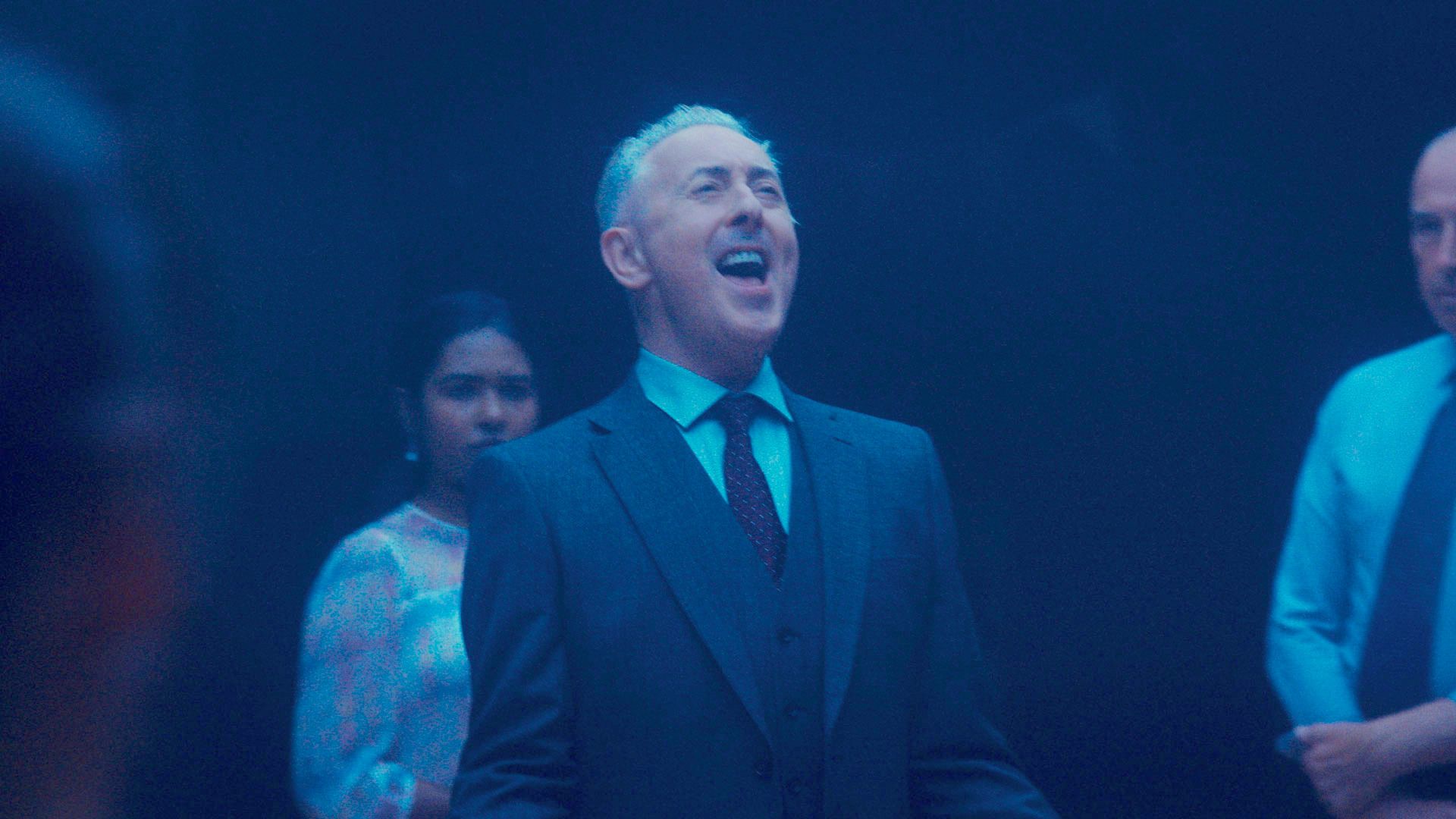
Director Michael Bruce discusses his debut short film, Kiloran Bay. Starring Alan Cumming and Jack Wolfe, it sets a queer man’s unresolved shame against the joyful backdrop of a traditional Scottish cèilidh.
The cèilidh is usually associated with community, celebration and belonging – but in KILORAN BAY, you place a queer man’s unresolved shame inside that communal space. What interested you about using something so culturally joyful to tell a story about the things we struggle to say out loud?
For me, cèilidhs are a purely joyful thing you do as a group in a community, and you’re right, it’s about throwing yourself into a safe space, following the steps as best you can, and not being ashamed if you go wrong. In fact, going wrong is one of the joys of cèilidh dancing. It felt like a really useful launching pad for a personal story about someone who felt like an outsider in the community they grew up in.
Someone who found safety in concealing who they really are, tried to follow the rules and join in, and found themselves unable to hide well enough. Growing up as a queer person, you are always checking the room to make sure you’re not exposed as ‘the other’. That can be an exhausting façade to maintain, and the music and movement of a cèilidh presses on that artifice. In a cèilidh you can’t help but let go. For Torquil, letting go and allowing his true self to be seen is the most dangerous thing he can do.

There’s something particularly Scottish about the film’s idea of leaving home, carrying it with you, and eventually having to return to it. How much of KILORAN BAY is about Scotland itself – and how much is about the version of ourselves we leave behind when we leave home?
I think it’s a universal idea, not limited to Scotland. When we grow up, even if we don’t leave the literal place, we do move into a different space within ourselves. Perhaps we lose touch with the freedom of youth, the joy of dancing at a cèilidh.
Sometimes a taste, an aroma, a tune on a fiddle can bring us right back to who we once were, and perhaps still are, at our core. The effect is magnified if, like Torquil, you physically moved to a different place and became a different version of yourself. He’s become adept at hiding. What was once a survival tactic has become unsustainable for him.
Music and movement become almost a second language in the film. As a composer and lyricist moving into directing, did you discover that there were emotions you could express through a song, a dance or a musical gesture that dialogue simply couldn’t reach?
Absolutely, and I think one of the main strengths of the film musical is its capacity to open up the emotional core of a character very quickly. I actually cut a lot of dialogue from the film because the music, the images and the strength of the acting carried it.
There’s an idea I wrote at the top of the first page of the script, and it comes from the canon of musical theatre history. ‘When the emotion is too great to speak, you sing. When the emotion is too great to sing, you dance.’ That became our guiding principle as we made the film.
Queer stories are often framed around coming out, but KILORAN BAY feels more interested in what happens much later – when you’ve technically escaped, yet the shame and memories have followed you. What did you want to say about the difference between leaving somewhere and actually becoming free of it?
Moving away and becoming a new version of yourself can work for a while. But if the shame underneath it remains unresolved, it may surface in ways you don’t expect. I think it’s possible to live a new life, but inevitably, if you return to the places that shaped you, you will find the past still there in some form.
In Kiloran Bay, Torquil literally comes face to face with his past self and has to reckon with him, the things he did as a young man, and the shame he still carries about that. I don’t think it’s about escaping a place, but finding peace with who you are when that place is inevitably still a part of you.
You’ve worked across the West End, Broadway, the National Theatre and the RSC, and now your first film brings together your musical language with your Scottish heritage. What changed creatively when you moved from writing for the stage to putting such a personal story on screen?
I found that in the cinema I could be much more economical with the storytelling. Kiloran Bay has a thirteen-minute runtime (including credits) and it tells a huge story spanning decades, without feeling rushed. The ‘cut’ is such a powerful tool in the cinema and allows you to present different timelines almost simultaneously.
The pace of Giorgio Galli’s editing matches the pulse of the song, which gives the film real dramatic and narrative drive. It felt like a combination of musical theatre-style storytelling with the visual freedom of filmmaking, and to me, as an artist, that opened up a whole new way of working.

There’s a beautiful tension in the film between tradition and self-acceptance: the wedding cèilidh represents a culture and community that can feel inherited, while your protagonist has spent years feeling he doesn’t quite belong within it. Do you see KILORAN BAY ultimately as a story about finding acceptance from a community – or learning to give yourself permission to belong?
I think, for me, Kiloran Bay is a film about self-acceptance. You cannot control others and how they see you, nor can you change the past. But perhaps if you journey back into your past, you’ll rediscover who you are in the present. I wanted to celebrate Scottish and queer cultures simultaneously, even if, for Torquil, feeling fully himself within the community he grew up in had not always seemed possible.
In Kiloran Bay, once he no longer needs the community’s permission to belong, Torquil can finally experience that community differently and rediscover the joy, warmth and glorious chaos of dancing at a cèilidh.






Leave a Reply