
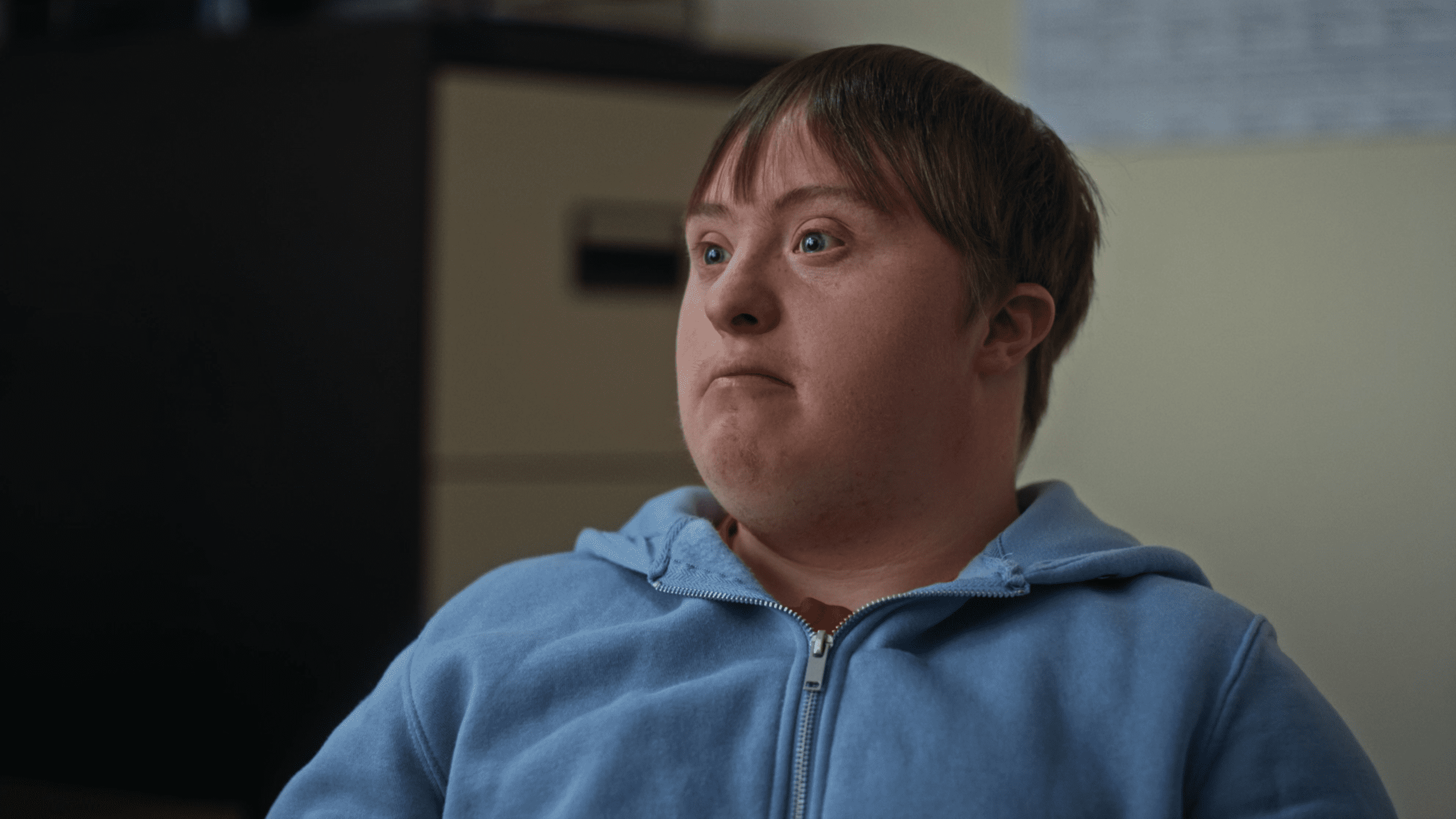
When a care worker vanishes, a gripping thriller unfolds where the most marginalised voice holds the ultimate truth. Director Aisling Byrne breaks down how her ensemble blew up traditional filmmaking structures to deliver a sharp, defiant lesson in genuine on-screen authorship.
In Mary Is Missing, the central mystery depends on whether we believe the people who are giving us the evidence. What does the film say about the assumptions we make when a person with an intellectual disability tells a story that doesn’t fit the version of events we expect?
I think, in general, the idea of ‘Storytelling’ itself became a really important theme for my co-writer Caitríona and I very early on. The film was co-created and devised with our ensemble of learning disabled actors, and we needed a framework that could hold as many of their brilliant -and often unexpected- ideas as possible. So it became, in some ways, a story about stories; the stories we tell about ourselves, about other people, and the stories we decide are believable.
At the beginning, a title card reads Based on a True Story, before True disappears and we’re left with Based on a Story. It’s a tongue-in-cheek audience invitation to question truth and fiction from the outset.
Tom, played by Wesley Fairbother is actually the voice of truth in the film, but when he tries to tell people what’s happened, he isn’t believed. And beneath all the film’s offbeat twists and turns, that points to something wider; when a person with an intellectual disability talks about drug dealers, or love affairs, or something that doesn’t fit the life we imagine for them, why is our instinct to assume it can’t be true?
I think we’re very quick to construct quite narrow ideas about what intellectually disabled people’s lives look like, what they experience, who they love, what trouble they might get into, even what kinds of stories they can credibly belong in. So the film is having a bit of fun with that. The truth in Mary Is Missing is deliberately stranger and more colourful than the bad cover story, and the person everybody doubts is the person telling us the truth. It asks the audience not just what they believe, but what assumptions made one version of events seem more believable than another in the first place.

Thirteen of your nineteen cast members are artists with intellectual disabilities, and they were involved in a 12-week writers’ room that helped shape the film. How did that process change your understanding of who gets to be an author of a story – rather than simply its subject?
Crucially. People with intellectual disabilities are still rarely invited to take up space as authors of their own work. We’re beginning to see greater representation and an appetite for inclusion and diversity, but that inclusion doesn’t always happen from the ground up.
With Mary Is Missing, the premise from the beginning was that the film would be genuinely co-authored, and, crucially, that it would be a story our artists wanted to tell. The ensemble are members of Run of the Mill, an inclusive arts organisation I founded in Ireland over ten years ago to platform the talents and ideas of the intellectually disabled community, so that kind of authorship is fundamental to how we work.
If we really want to move the dial on representation, disabled voices can’t be brought in as an afterthought. They need to be present at every stage of the creative process. And creatively, there is simply no substitute for that lived experience. Our artists drew from their own lives, cultural influences, humour and genre tastes, and the result is, I think, a genuinely unexpected film. It is the richer for it.
I love that the cast created characters with agency, flaws and contradictions, fully fledged characters that don’t exist as symbols in the story. That’s what genuine authorship gives you, richer characters, less predictable stories, and perspectives we simply wouldn’t have arrived at without them. That’s what authorship changes, you’re no longer asking people to fit into stories written about them; you’re creating the conditions for them to decide what the story gets to be. That is also, as a director, why I believe we did not struggle to achieve grounded performances from our cast. The film’s plot is in some ways fantastical, but the characters are rooted in truth.

The film deliberately destabilises the idea of an objective “truth”: we see conflicting accounts, memories and perhaps even fantasies. Was it important to you that the audience experience some of the uncertainty that comes with being someone whose perspective is routinely questioned or underestimated?
Ooh I think that’s an interesting take! Though I wouldn’t say I consciously set out to replicate that experience for the audience. I think the film is more interested in credibility, who we instinctively believe, and why.
Everyone in the film is constructing their own version of events, truth and fiction start to blur. And ironically, Tom is telling the truth, but his version seems the least believable, as Lauren says when he finally recounts the full tale ‘this is worse than Nashville’. I think our ‘culprits’ actions too are governed by uncertainty. Without giving too much away, ultimately they have made a very shocking discovery and are unsure how to act, giving rise to a hastily concocted cover story that cannot hold. As Patrick says in the film’s climax… ‘we just didn’t know what to do’.
In how the audience experiences all of this, it was important to me that the film never becomes too earnest about that. It’s still a strange, funny mystery, but underneath I think there is a gentle challenge for the viewer – whose version have I trusted, whose have I dismissed, and what made me make that judgement?
There’s a fascinating tension between the conventions of the psychological thriller and the reality of the characters at its centre. Why did mystery and suspense feel like the right cultural language for telling a story about learning-disabled people, rather than approaching the film primarily as a drama about representation?
In truth, it was quite simply because that’s the kind of film our artists and cast wanted to make. Many of our ensemble cast/ co-creators love crime procedurals, recurring drama and soap, and so came into the writers’ room wanting something high-stakes, propulsive and full of twists. It was important that we honoured those creative instincts rather than deciding that a film with learning-disabled characters had to be a particular kind of worthy social drama.
My own instincts and preferences as a filmmaker are actually much more rooted in social drama, and naturalism, I love Shane Meadows, Chloe Zhao, Lenny Abrahamson, the Dardennes, work that prioritises truthful performances, real places, a very grounded visual world. At Run of the Mill we believe there’s a kind of magic in collaboration, so I became really interested in what might happen if we fused those two languages, my more grounded approach as a director with the heightened plotting and genre instincts the artists were bringing into the room.
The result is this slightly strange genre blend that I’d like to think feels quite tonally unique. And short film is such a brilliant space for that kind of risk and experimentation. I figured, maybe it works, maybe it doesn’t, but isn’t it exciting to try something new?
A care worker disappearing creates an investigation into the people who were closest to her, but the film gradually makes us question who is actually being investigated and who is being listened to. What were you trying to expose about power, authority and whose version of events society instinctively trusts?
I think this really connects to what I said earlier about credibility and the stories we decide to believe. Tom is telling the truth, but he’s repeatedly dismissed, while other, far less truthful versions of events are afforded greater authority.
So there is something about power in that, who gets believed, who gets listened to, and who gets to define what happened. The learning disabled community are disempowered constantly in society and are subject to so much institutional and systemic gatekeeping of their lived experience. But I think the film explores that quite playfully rather than trying to provide any definitive answers.

You’ve now made several films with learning-disabled artists at the centre of the creative process. Has Mary Is Missing changed what you think authentic representation actually means – particularly the difference between putting someone on screen and genuinely giving them creative agency behind the story?
I’ve been Artistic Director of Run of the Mill for over a decade, so changing how we make work to be more meaningfully inclusive, not simply who appears in it, has always been central to my practice. I think that kind of meaningful change takes time.
Headspace was my first film after moving from theatre, our debut short as a filmmaking team at Run of the Mill and Arcade Film, and in many ways as a director I was still figuring out the craft. I think you have to understand a modality before you can start to break it, experiment with it and reshape it. Mary Is Missing stands on the shoulders of that earlier work and allowed us to push much further; particularly around co-authorship and how genuinely our artists could shape the story from its inception.
I’ve was a socially engaged artist first and a filmmaker second. That has carried over into all the work I make. The amplification of the community has to sit at the heart of the work for me to care about telling the story. So the ambition now is to keep moving that dial, developing and sharing models for meaningful authorship where learning-disabled artists aren’t simply represented on screen, but have genuine creative agency in determining what gets made in the first place.



Leave a Reply