
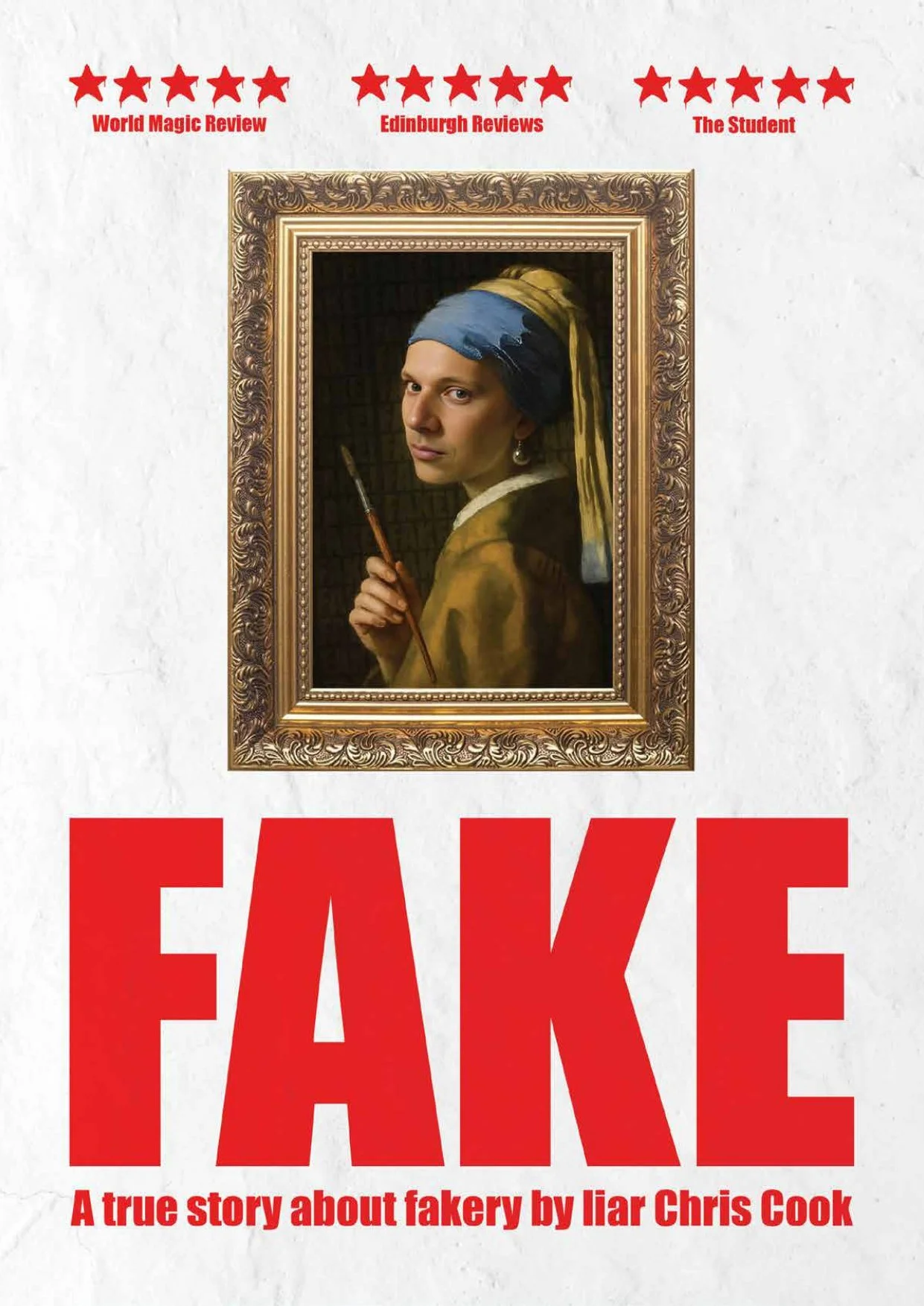
Acclaimed magician Chris Cook pulls back the curtain on Fake, his hit fringe show exploring our cultural obsession with deception and misinformation.
What first inspired you to explore deception and illusion in Fake?
I think working as a magician means you’re naturally fascinated by deception. Inherently, no one ever believes anything a magician says so I’ve always wanted to explore how to get an audience to trust and believe me whilst also knowing I might use magic to deceive them. When I was 17 I worked in a cinema. The manager there knew I was interested in magic so gave me a copy of Orson Welles’ last film F for Fake. It totally captivated me and I was immediately hooked by how he blended fact and fiction to create a type of documentary unlike anything else. This was the biggest inspiration for the show.
Where does magic end and storytelling begin in the show?
The two are intrinsically linked and neither can exist without the other. Both the storytelling and the magic propel each other through the show and at various points you might confuse one for the other. Some of the stories themselves are in fact magic tricks and some of the magic tricks may exist only in your imagination.
Why are we so fascinated by being deceived?
We live in a world now where it’s hard to trust anything you see, read or hear. But the allure of deception is so compelling. If it wasn’t then there would be no interest in conspiracy theories or hot-takes but in fact everyone is constantly convinced there is more to the world than first appears. I think the show exists to remind people that often the truth is simpler than it seems but also that you shouldn’t let the truth get in the way of a good story.

Does performing Fake ever make you question what you consider to be “truth”?
I’ve done more research for this show than anything else I have created. As a result, I think I have a pretty clear handle on what the truth behind the show is. But that said, I think the grey area lies in people’s opinion and perception of what makes something art. Is a band covering someone else’s song art? Is an author an artist if they write an unauthorised sequel to their favourite work? It is not for me to decide, but I think there is a level of fakery to anything creative.
How has the show evolved through its Prague and Edinburgh Fringe runs?
The hardest part of the show is condensing it into an hour-long show when I’ve done hundreds of hours of research, experimentation and writing. NASA has a saying which is “if you can’t explain something simply, you don’t understand it well enough”. I think Fake is a lyrically dense show with multiple stories running side by side, so the thing I’m constantly refining is how to make it easy for an audience to understand and relate to.
Who, or what, inspired your interest in magic?
As a kid, my dad would show me little magic tricks and I always thought it was a fun way to connect with people. It always seemed inherently silly and I don’t think I was looking to be taken seriously. I was also hugely inspired by Derren Brown’s early work as well as Paul Zenon’s TV shows. I think both displayed a humour and warmth that was appealing but underneath both magicians was an intriguing and captivating dark side.
What do you hope audiences are left thinking about after seeing Fake?
I want audiences to leave questioning how they value art. I think art can be a big, scary word but if you replaced it with the word play it feels a lot less intimidating. I think art is so often simply ‘play’ so I hope audiences leave feeling they can make their own ‘art’.
Fake runs at Lower Marsh Arts Club from 23–28 September – click for tickets


Leave a Reply