
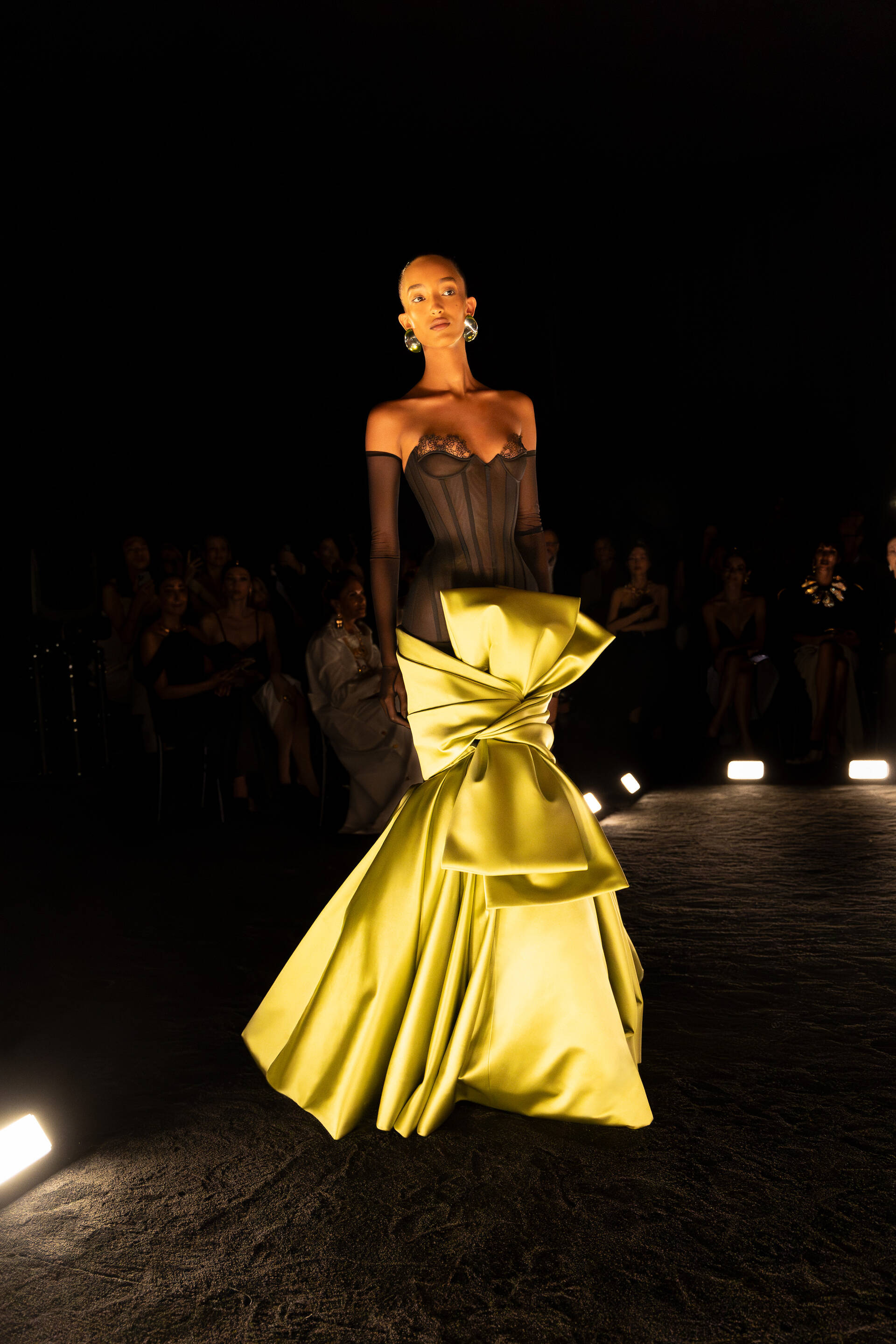

By Genevieve Dammery
In the midst of their rivalry, Coco Chanel once called her “that Italian artist who makes clothes”, but Elsa Schiaparelli understood that fashion could do more than dress the body. It could distort it, provoke it, and amuse it.
At the V&A, Schiaparelli: Fashion Becomes Art traces a career in which the conventional boundaries between fashion and fine art were dismantled and rebuilt, presenting Schiaparelli not simply as a designer of clothes but as an artist who happened to work in couture. Bringing together more than 400 objects, the exhibition spans Schiaparelli’s work from the 1920s, to current pieces crafted under the creative direction of Daniel Roseberry.
The exhibition places Schiaparelli’s designs alongside paintings, sculpture, photography and objects by the artists with whom she collaborated. It is an important curatorial decision. Schiaparelli’s clothes make little sense when understood solely as garments; their meaning lies mainly in their conversation with surrealism and with the artistic avant-garde of interwar Paris. Her collaborations with Salvador Dalí are among the exhibition’s most striking pieces, including the famous Lobster Dress, once worn by Wallis Simpson, and the Skeleton Dress. The latter, with its raised bony forms appearing to emerge from the surface of the fabric, was much admired by Dali. A letter from Dali to Schiaparelli is presented alongside the dress in which he writes “Dear Elsa, I really love the idea of the bones on the outside…”

Rather than treating Schiaparelli’s surrealist associations as a footnote, curator Sonnet Stanfill demonstrates how they were fundamental to her creations. Works by Dalí, Man Ray, Jean Cocteau and Pablo Picasso sit amongst Schiaparelli’s designs. There is an irony here: fashion spent much of the 20th and 21st centuries attempting to establish itself as a respected art form, yet Schiaparelli never seemed interested in making that case. Her work does not aspire to the traditional solemnity of fine art. It is witty, theatrical, and sometimes ridiculous – a true embodiment of the surrealist movement.
One of the most remarkable things about Schiaparelli’s legacy is that it survived its own disappearance. By 1954, the house had declared bankruptcy and Elsa Schiaparelli had closed her couture business. For decades, Schiaparelli existed largely as a memory: a name attached to a handful of extraordinary garments and to a period of collaboration between fashion and surrealism. The acquisition of the Schiaparelli name and archive in 2006 provided the means for its resurrection, with the house returning to 21 Place Vendôme in 2012. This history gives the exhibition’s contemporary section an added significance. Daniel Roseberry is not simply designing under the Schiaparelli name; he is actively participating in its renaissance, taking a house whose founder had been absent for almost sixty years and attempting to establish what her disruptive spirit might mean in contemporary fashion.
Under Roseberry, the house has become one of the most visible proponents of fashion’s current obsession with spectacle. His work occupies a substantial portion of the exhibition, creating a dialogue between Schiaparelli’s original designs and their contemporary descendants. Here, the parallels are unmistakable. Roseberry pays homage to Schiaparelli’s fascination with anatomy, exaggeration and the uncanny, translating these ideas into an era of red carpets, celebrity culture and social media.
There is an interesting tension that arises when comparing the old and new designs. Schiaparelli’s original work was subversive because it emerged from a particular artistic and cultural moment, but Roseberry is working in a fashion landscape that has already absorbed much of what Schiaparelli pioneered. Surrealism has become a recognisable aesthetic; the shock of an anatomical motif has diminished after decades of fashion repeatedly testing the boundaries of taste.

The later work therefore raises an intriguing question: can fashion still be shocking when spectacle has become one of its primary currencies? The exhibition itself does not resolve this, but the juxtaposition demonstrates how and why Schiaparelli’s ideas have survived. What once seemed radical has become part of the vocabulary of contemporary fashion because designers such as Roseberry continue to revisit it.
The real subject of Schiaparelli: Fashion Becomes Art is collaboration: between fashion and art, body and garment, designer and artist, past and present. Schiaparelli’s achievement was not simply to make extraordinary clothes but to expand the possibilities of what clothing could communicate. There is something distinctly modern about that proposition. In an era when fashion increasingly functions as image, performance and cultural commentary, Schiaparelli’s belief that clothes could carry ideas was prophetic. Almost a century after her most radical experiments, the exhibition makes clear that her legacy is not confined to a handful of famous dresses or eccentric accessories. It lies in the permission she gave fashion to be intellectually ambitious and unapologetically strange.
Schiaparelli: Fashion Becomes Art is an exhibition about transformation. It shows how a designer can transform clothes into artworks, the body into a canvas and the everyday into the surreal. Most impressively, it demonstrates that Schiaparelli’s greatest creation may not have been any individual garment at all, but a new conception of what fashion could be.
The exhibition runs until 8 November
Title image: Photo © Giovanni Giannoni. Photo courtesy Patrimoine Schiaparelli, Paris




Leave a Reply