
In preparation for this article – the first in a series about the 21st century in film so far – I watched countless movies, read books, listened to albums, and consumed as much culture as I could from the year 2000. Yet nothing struck me as much as watching VHS camcorder footage from New Year’s Eve 1999.
That’s not because these videos contain anything spectacular. Rather, they are clumsily filmed home videos that ramble on – unedited – sometimes for close to an hour. The content ranges from the charming, mostly owed to nostalgia (whether it’s for a time lived through or not), to the offensively unwatchable. But still they do capture, at least on a personal level, the energy that surrounded this significant moment in history. And, in very loose terms, we might even call them the first films of the 21st century.
In one video, a group of American twenty-something-year-old men herald in the New Year with measly oven food, Mario Kart on the Nintendo 64 and beer pong. The camera holder – the Steven Soda-‘nd-burger of this picture – spends an extended period fawning over a 25-inch flat screen with a proudness similar to Michael Scott in the classic ‘Dinner Party‘ episode of The Office. Later, the guys watch the ball drop on said TV (this impressive piece of tech is a big theme of the video) as they yell about the Jetsons, Y2K and nuclear bombs – a sloppy drunk microcosm of the paranoia and optimism hanging over the night.
Another video features a house party with rowdy American teenagers. For the big countdown, the camcorder is placed on top of the TV in what would have been a well set up shot if not for the drunken bodies which block our view moments later. The video ends with one youngster scolding another (“No hookups at my fucking house!”) before the screen cuts to blue for 17 minutes – an unintentional artistic choice that might have drawn a standing ovation at certain film festivals.
Funnily enough, this blue screen reminds me of one of the best films to be released in the year 2000: Agnes Varda’s The Gleaners and I. A documentary in which we follow this legendary filmmaker on a journey around France, as she meets those keeping up the tradition of gleaming. Varda films with a hand-held digital camera and a big aspect of the documentary is her sense of freedom and fun with this way of working. Something she’d refer to herself as ‘cinecriture’ (cinema-writing). There is one sequence where she films herself pretending to ‘catch’ big lorries in her hand as they zoom by on the motorway. In doing so, Varda brings us back to our childhood, finding ways to pass the time on long car trips. Just like the gleaners she encounters, there is a yearning for – and appreciation of – simplicity.

In another scene, Varda forgets to turn her hand-held camera off for a minute or so, leaving the viewer looking at the ground with the camera’s lens cap drifting around the screen. Rather than editing this blunder out, Varda adds jazz music and in a voiceover proclaims this a sequence as ‘The Dance of the Lens Cap’. She sees beauty in a mishap that has probably occurred on thousands of family vacation videos. Perhaps because it is all part of the journey of this distinctively personal film in which, along with delving into the lives of gleaners, Varda also rediscovers a sense of innocence and playfulness in her filmmaking process that she’d had making short films in the 1950s. It’s a joy to witness.
Varda’s film shows how personal and cheap filmmaking could be by the year 2000. Digitisation brought accessibility. No need for a bloated budget or a big crew. And with this, those New Year’s home videos and The Gleaners and I were on close-to-level playing fields, but for the genius of Varda. This speaks to the democratisation of cinema that was in motion and would only accelerate further as the 21st century progressed.
While low-tech cameras were making filmmaking accessible, much more costly advancements in computer generated imagery (CGI) and other post-production techniques were opening up space for new cinematic realms in Hollywood. The 1990s showed plenty of promise in this respect with the striking CGI visuals in James Cameron’s The Terminator 2: Judgment Day (1991) and Titanic (1997), Steven Spielberg’s Jurassic Park (1993), and the Wachowksi’s The Matrix (1999). All of which wouldn’t look out of place as new millennium movies.
In 2000, Ridley Scott’s Gladiator utilised a CGI fly-around to display the grandeur of the Colosseum in ancient Rome. It was impressive work for the time but such a point-of-viewless choice was labelled as ‘devoid of feeling’ by Mark Cousins and it could be argued that CGI used in this way detracts rather than elevates this triumphant return to swords and sandals. Regardless, it is Russell Crowe’s commanding lead performance, especially countered by cowardly tyranny of Joaquin Phoenix’s Commodus, that leads this film to glory.
At its best, Gladiator uses broad brush strokes to capture the drama of the Jean Leon Gerome painting, Politico Verso (1872), from which the filmmaking team drew inspiration. It has those melodramatic blockbuster Hollywood moments that stir basic emotions and a satisfyingly simple revenge plot which – to answer Maximus’ iconic rhetorical question – leaves audiences entertained.
The enduring success of Gladiator is evidenced by the sequel set to be released nearly 25 years later. Scott will return to direct and we’ll see how he harnesses CGI this time around.

Gladiator is not the only film from the year 2000 that has clung to the cinematic consciousness and since been recycled by studios. Mission Impossible 2, a sequel in itself, was the highest-grossing film of 2000 and is now up to its seventh installment. The franchise – just like its lead Tom Cruise – hasn’t run out of juice or death-defying stunts yet.
Comedy Meet the Parents, which was nearly directed by Steven Spielberg, exploits the relatable anxieties of not hitting it off with your in-laws. Similar to American Pie (1999), most of the humour derives from second-hand embarrassment and nightmarish mishaps. You wince as much as you chuckle. Still, it is the dynamic between try-hard fail-harder Greg (played by Ben Stiller) and his soon-to-be father in-law Jack (Robert de Niro) carries most of the picture, as well as the two sequels (2004’s Meet The Fockers and 2010’s Little Fockers).
The Grinch Who Stole Christmas was another box-office winner one of 2000, becoming one the most successful Christmas films of all-time. The iconic illustrations of Dr Seuss’ books mean his tales are better suited to animated adaptations, but art directors Michael Corenblith and Merideth Boswell, along with costumer Rita Ryack, do a fine job of capturing the spirit and look of Whoville. And if it’s not animated, the next best thing is to have a lead actor capable of the cartoonish physical comedy of Jim Carrey, who had become one of cinema’s biggest stars in the 1990s.
This Seuss tale would get an inevitable animated adaptation in 2018 – probably leaving Carrey, who suffered horribly with hair and make-up for his portrayal of Grinch, cursing the comfortability of Benedict Cumberbatch in the recording studio.
Scary Movie was the most surprising box-office success of 2000. Written by Shawn and Marlon Wayans, this R-rated horror parody floods us with a barrage of ‘90s movie references and juvenile jokes. With this thick and fast attempt at comedy, Scary Movie does not inspire ambivalence: you love it, hate it, or are deeply offended by it. The best distillation of the movie is a scene where Ghostface (a parody of the killer from Scream) and a group of guys yell ‘Wazzup!’ down the phone at each other – a reference to a popular but obnoxious Budweiser advert.

The unique concept of, and creative deaths in, James Wong’s horror Final Destination would generate enough success and material for another four movies; all of which would be premised around teenagers’ gruesome and inescapable premonitions. Final Destination was by no means perfect, but it was able to pray upon the audiences’ everyday fears and create a sense of dread that has led it to resonate more than the star studded and highest grossing horror of 2000, What Lies Beneath.
Creative deaths are also aplenty in Japanese horror-action, Battle Royale. One of the most controversial films released in 2000, it follows a class of students who are taken to a remote island (the best island movie of the year by far – sorry Cast Away) and forced to fight to the death. It’s action packed, extremely violent, melodramatic, darkly funny and a film Quentin Tarantino admitted he wishes he made. You can see why: in one scene, a group of girlfriends go from friendly chit-chat to all out violence in the blink of an eye. A shocking, craftily executed sequence that Tarantino would have been proud of.
Battle Royale wouldn’t get a US release (the Columbine High School massacre happened in 1999) for over a decade and would be handed an R-15 rating (no one under 15 admitted) by the Japanese rating board. But as is often the case, the controversy only added to the aura and as well as being an international box office hit, Battle Royale has since proven to be one of the most influential films of the year. Even inspiring the ‘Battle Royale genre’, which includes a forgettable sequel to Battle Royale, the Americanised and somewhat sanitised young adult book-turned-film franchise, The Hunger Games, and the hugely popular Korean TV show, Squid Game.
Bret Easton Ellis’ highly controversial novel American Psycho, which satires 1980s yuppie culture, finally got a big-screen adaptation after being in development purgatory since 1992. In that time, a who’s who of emerging and established Hollywood stars would be linked to the lead role of Patrick Bateman – including Johnny Depp, Brad Pitt, Leonardo DiCaprio, Ewan McGregor, Ben Affleck and Edward Norton – until it was eventually handed the cheap option: Christian Bale. The English-born actor, who was still a relative unknown at the time, threw himself into the role with a borderline psychopathic commitment, getting into peak physical condition and staying in character at all times on set. Director Mary Harron even gave him the nickname “Robo-Actor” for his supposed ability to control his sweat glands.
Bale’s performance, along with clever direction by Harron (noticeably one of the few female directors mentioned in this article), helps make American Psycho a worthwhile movie. Certainly we can appreciate it more if we isolate the film from the novel, or accept just how difficult the novel is to adapt. And perhaps that has happened in the years since, with the film enjoying a cult resurgence in the 2020s, largely due to meme culture. Unfortunately, it was adopted by ‘masculine’ Andrew Tate types who either misunderstood the film or aren’t capable of reading the book.
Bale’s career would slide for a few years after the mixed response to American Psycho in 2000, until his undeniable talent shone through in 2004’s The Machinist. Christopher Nolan would put out the Bat-Signal not too long after.

Superhero movies weren’t quite ready for Nolan and Bale by 2000, but after the silliness of the 1990s there was a strong start to the 21st century for the genre. X-Men would leave casual audiences and comic book fans satisfied with its strong ensemble cast (including Hugh Jackman who is still donning the claws of Wolverine 24 years later) and solid action. Following up the success of Blade (1998), this commercial hit helped pave the way for more of the Marvel films (X-Men sequels included) that – aided by the advancements in special effects – would eventually come to dominate mainstream cinema in the 2010s.
A year after he stunned audiences with The Sixth Sense, M. Night Shyamalan’s Unbreakable contrasted with the superhero campiness of the previous decade, bringing realism and more grounded performances. Many films would follow suit in the 21st century, including two sequels to Unbreakable (2016’s Split and 2019’s Glass).
The romantic-comedy High Fidelity, based on a Nick Hornby novel, would get a short-lived TV remake in 2020. This time with a female lead, which is an unsurprising switch given the 2000 film doesn’t hold up as well to 2024 sensibilities. So much so that it feels more like a 1990s movie that would sit nicely next to Ferris Bueller’s Day Off in a Letterbox category titled: ‘Men with arrested development who are so self-important they need to break the fourth wall to talk some more about themselves’. That’s not to say High Fidelity is a bad movie, far from it. It’s a fun adaptation that might also happen to be your uncle’s favourite film.
Just like High Fidelity and Gladiator, Chicken Run would have to wait nearly a quarter of a century for its return. Set in Yorkshire, the film follows a flock of chickens as they try to pull off a great escape from a farm ruled by a tyrannical couple, Mr and Mrs Tweedy. It’s silly, witty and delightful to hear Northern accents in a film that isn’t made by Ken Loach. A British classic that – five years after Toy Story had become the first entirely computer-animated feature film and in the same year Disney spent over $100 million on visual effects for Dinosaur – showed there was plenty of life left in stop-motion animation.
Chicken Run was also praised for its female-led cast and strong feminist message. You could place it with Bring It On and Crouching Tiger, Hidden Dragon as the surprisingly ‘woke-before-woke-became-the-most-tired-and-misused-term’ films of the year 2000. The former of which tells the story of a rivalry between two high school cheerleading teams as they gear up for a national competition. Everything suggests Bring It On will be a formulaic teen flick, and structurally and stylistically it is so, but Jessica Bendinger’s script pushes past that and would be rightfully commended for its portrayal of systemic inequality.
The film also highlighted the talent of lead actress Kirsten Dunst. She’d go on to film her role in Spider-Man soon after and be paired with Tobey Maguire, whose year 2000 featured an eccentric performance in the quirky film, Wonder Boys. A charmingly confused movie that lacks any appeal, made a loss at the box office and would never be made today.

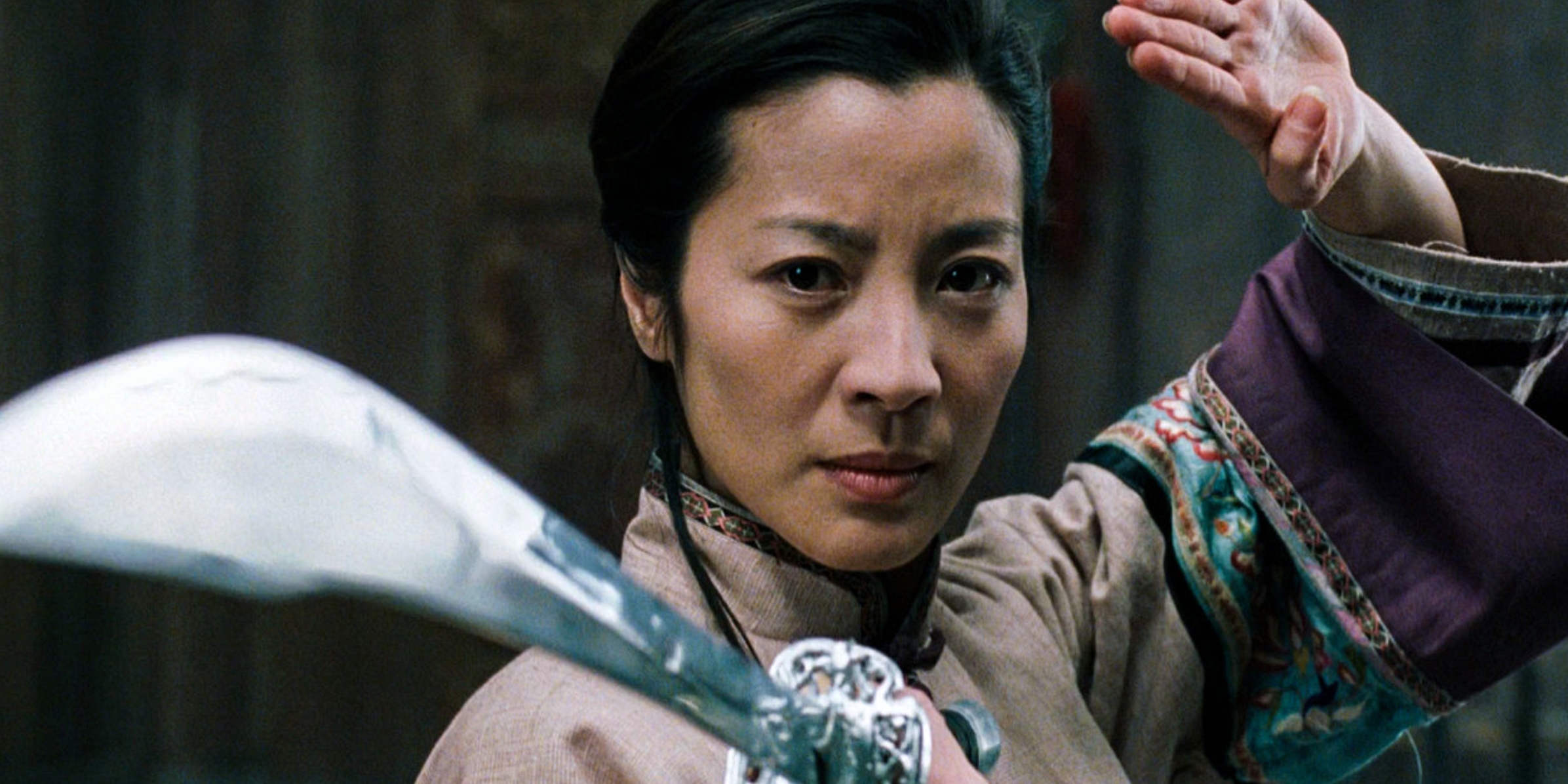
Crouching Tiger, Hidden Dragon whisks us away to Qing dynasty China – or rather Ang Lee’s romanticised, vision of this time. It is in this almost fantastical realm that the film thrives with beautiful blend of restrained drama and exhilarating martial arts action. For all the betrayal and deceit in the story, Lee works a softness – credit to Tim Yip’s Oscar winning art direction and Peter Pau’s Oscar winning cinematography – that’s as enchanting as it is exciting. If Gladiator was a typically Western exercise of macho sword waving, then Crouching Tiger was its quietly empowering, sword stealing Eastern antithesis. Regardless, this splendid tale defied the often-cursed subtitled tag to resonate with English speaking audiences.
The film would also challenge gender roles through its two captivating lead female characters: Michelle Yeoh’s noble Yu Shu Lien and Zhang Ziyi’s fierce Jen Yu. With today’s eyes, one might have expected this film would have catapulted both of these brilliant actresses, especially Yeoh, to the top of Hollywood. But Western cinema was not ready yet. Yeoh would have to wait until 2022 for her Oscar-worthy lead role.
Instead 2000 would be year for Julia Roberts to turn in an Oscar-winning performance as she starred in the biographical film, Erin Brockovich. Roberts, who shot to stardom in the 1990s, shows off her range in this central role, transitioning from sassy comedy in the opening act to serious drama in the second half of the film. It’s an impressive performance to lead a serviceable film (it’s the second best biopic of the year behind Ed Harris’ raw and unflinching Pollock, and third if we include the semi-autobiographical Almost Famous) that would also help cement Sodenbergh – whose 1990s was a bit rockier than Roberts’ – as a mainstream director. Sodenbergh would reunite with Roberts a year later to put a jewel in his Hollywood crown with Ocean’s Eleven.
Erin Brockovic wasn’t Sodenbergh’s only commercial and critical success of 2000. He’d win an Oscar for Best Director on the drama Traffic, which explores the illegal drug trade in America from three different perspectives. The most compelling scenes of the film follow a Mexican police officer (played by Benicio Del Toro) who is faced with corruption and cartel rule. These south of the border scenes are in Spanish-language, which marked another win for subtitles in 2000, especially considering this choice was something Sodenbergh and Del Toro had to fight the studio on. The scenes in Mexico are also distinguished by a yellow coloured filter; a visual approach that has since been called ‘The Mexico filter’ and would be used to similar effect in the outstanding TV series Breaking Bad.

In the same year as Traffic’s clever use of colour, O’ Brother, Where Art Thou? would become the first film to fully use digital colour correction. After filming in the lush green South, the Coen brothers and cinematographer Roger Deakins used this tech to give the film a sepia coloured look, bringing out a warm and dusty feel to this fun mythology-inspired Depression era tale.
This was the Coen brothers’ first movie since The Big Lebowski (1998) and while they had kept on the zany trail, their Lebowski stars Jeff Bridges and Sam Elliot spent their 2000 in the White House for The Contender. A film about political scandal in which Bridges pulls off the transformation from dressing gowns to suits, White Russians to expensive wine, bowling alley to Oval Office Dude to Clinton, so well that he’d get an Oscar nomination.
The other notable White House film from 2000, Thirteen Days, is a thriller that focuses on the 13 days of the Cuban missile crisis in 1962. We experience the tensions and political chess from the perspective of Special Assistant to the President Kenneth O’Donnell (played by Kevin Costner). A choice that allows us to see through the eyes of the common man (the film grounds this with scenes of O’Donnell eating breakfast with his family) and hear his protestations, fears and reasonings through a strong Boston accent that humanises him further. There are compelling moments in the film and it serves as a reminder -just as Nolan’s Oppenheimer would 23 years later – how often the fate of the world has rested on the conversations between, and egos of, middle-aged men.
The rigid and somewhat dry approach of Thirteen Days is dramatically different to the scintillating style of Wong Kar-wai’s In The Mood For Love. A film that exemplifies the vibrant and creative period international cinema was in as we entered the 21st century. Set in 1960s Hong Kong, we watch two neighbours who begin to fall in love after realising their partners are having an affair. Kar-Wai’s film is breathtakingly romantic but not in the usual swooning way. This is a tale of repressed desire. Our characters do not conveniently vocalise all in their inner feelings and fall into each others’ arms in typical Hollywood fashion – as in teary climax of the highest grossing romantic film of 2000, What Women Want. Instead, what cannot be said is felt through the film’s use of vivid colours, a yearning musical theme, Christopher Doyle’s gorgeous cinematography, and a genius use of space.
Colour is absent from Béla Tarr and Ágnes Hranitzky’s Werckmeister Harmonies. By far the most difficult film in this article, it tells the tale of a small Hungarian town that is thrown into chaos by the arrival of a mysterious circus. As with In The Mood for Love, plot doesn’t take precedence over style. Rather we sit and watch the film’s 39 slow, continuous shots and are left filled with dread or disinterest. Those who are inclined to stick with the film will be struck by a mysterious magic. It’s a truly haunting film, which ends with a stinky whale left abandoned in the middle of the town square. Is this desolate image a comment on the failure of Communism? The decline of religion? Man’s destructive nature? Our hopeless search for meaning? Or is it just a rotting whale?

Black-and-white scenes are also used in Christopher Nolan’s thriller, Memento. Based on writing by his brother Jonathan Nolan, it is the fragmented story of a man (played by Guy Pearce) with short term memory loss who tries to track down the perpetrator who killed his wife. Colour here distinguishes two sequences: one in black-and-white that runs forward in order; another in colour that runs in reverse order. It is all part of a disorienting puzzle that’s pieced together with scientific precision, in a way that would become typical of Nolan’s work (his most recent film, Oppenheimer, also uses colour to distinguish two different passages of time). The challenge is then set for the audience to grapple with, and unravel, the story – in this case while being led by a completely unreliable narrator. Memento does not make for passive viewing, but for those who are willing to commit their full attention and embrace Nolan’s challenge, it makes for a riveting experience.
The mysteries of Memento were also used in the marketing of the film, as Jonathan Nolan designed a website that offered further hints and clues to viewers. Following on from the ground-breaking marketing approach of The Blair Witch Project (1999), this was a new and interactive way to extend elements of the film outside of the movie theatre and engage with audiences. This, of course, would just be the beginning of the internet’s influence on cinema.
Memento was only Nolan’s second film but it rightfully put him on the map as one of the filmmakers to watch in the new millennium – and he wasn’t alone in doing so. Mexican filmmaker Alejandro González Iñárritu also showed a desire to play with form in his bold and visually striking directorial debut, Amores Perros. This piece of hyperlink cinema uses a three-part structure, just like Tarantino’s Pulp Fiction, to tell a tale of misdirected aggression, greed, betrayal and regret in Mexico City. The film showcases Iñárritu as another bright light from the New Mexican Cinema of the 1990s, which also saw the emergence of Guillermo del Toro and Alfonso Cuarón.
Darren Aronofsky’s second film, Requiem For A Dream, also features interwoven tales of woe. In this instance, it is addiction that ravages the lives of four lead characters. Aronofsky’s use of quick cuts, Snorricam, tight close-ups and other off kilter techniques conveys the disorientating psychological impact of drug addiction and the harrowing sense of losing oneself completely.
Requiem For A Dream is arguably the most uncomfortable film of 2000, with images that are etched into your mind even decades after, including a bathtub scene that is lifted directly from Satoshi Kon‘s outstanding animated thriller Perfect Blue. Aronofsky had declared his intent to shock, disturb, upset and provoke. Just mention this movie to anyone who has seen it and you’re sure to get reference one of cinema’s most brutal endings.

Similar to Bale in American Psycho, the lead actors of Requiem For A Dream went to great lengths to better understand and capture their character’s struggles. Leto being the most extreme of the bunch, even living on the streets of New York and losing a considerable amount of weight to prepare for the role. Suffering – even that of an unnerved audience – is the name of the game here.
Leto’s sacrifices aren’t quite the same as Ray Winstone’s, who spent a few weeks on holiday to get a deep tan in preparation for his lead role in Jonathan Glazer’s debut film, Sexy Beast. A British production that – in the same year Guy Ritchie’s Snatch served up another punchy gangster film – offered a refreshing take on the genre. The film opens with Winstone’s retired gangster, Gal, in bright yellow speedos as he enjoys retirement by the pool in sunny Spain. Gal’s bliss is soon spoilt by a foul mouthed, psychopath called Don Logan (played by Ben Kingsley) who wants to bring Gal back to London for one last job. You might chuckle at the creatively crude verbiage of Don Logan, a lot of which would make Malcolm Tucker proud, but there’s a sinister and jarring volatility to the character that makes it an uneasy watch.
Sexy Beast gifts us a brilliant Kingsley performance that also happens to be referenced years later when the actor appears as himself in an episode of The Sopranos. A show which first aired in 1999 and would go on to be one of the most influential works of the 21st century so far, raising the bar for the medium closer to film in terms of complex narratives, character development and production values.

For Glazer, Sexy Beast would not be a statement of intent like Aronofsky. His next film would be the psychological thriller Birth (2004), then came the menacingly mysterious and surreal sci-fi Under The Skin (2013), and most recently the Holocaust drama The Zone of Interest (2023). It’s a similar – albeit not as impressive – story for director David Gordon Green, whose poetic directorial debut George Washington (2000) would be the beginning of a scattered filmography including stoner comedies and horror sequels.
Kenneth Lonergan’s brilliant directorial debut, You Can Count On Me, showed off his writing talents. He’d win acclaim from critics and, most importantly from executive producer Martin Scorsese, who would draft in Lonergan to co-write the screenplay for Gangs Of New York shortly after. Actress Agnès Jaoui would also step behind the camera for the first time to dazzle French audiences with the drama The Taste of Others. While, Bong Joon-ho’s hugely entertaining first feature, Barking Dogs Never Bite (2000), showed signs of genius and that would flourish in the coming years.
As a number of filmmakers promised exciting work in the new millennium, one of the great international directors was reaching the end. Edward Yang, who was driving force in the rise of Taiwanese cinema in the 1980s and 1990s, delivered his masterpiece in 2000. Yi Yi is an intergenerational story that gives us a glimpse into the life of a middle-class family in Taipei. But this is no ordinary family drama, rather an understated epic that deals in intricate beauty. Beginning with a wedding and ending with a funeral, Yi Yi captures the extraordinary experience of life: what it means to be alive, the sense of regret and incompleteness that inevitably accompanies this experience, and a gentle reminder that it all moves on anyway.
Thinking back to Varda discovering the world in a refreshed way by using a hand-held camera, there’s a thread in Yi Yi that strikes a similar chord, where young Yang-Yang begins to explore life through a camera and takes photos of the back of his classmates’ heads. “I can only see what’s in front, not what’s behind. So I can only know half of the truth, right?” he asks him father. These are the quiet moments of profound insight where Yang sets himself apart.
Yi Yi would be Yang’s final film before passing away due to complications with colon cancer. It would mark the closing chapter of the New Taiwanese Cinema movement and prove to be the best film of 2000.






Leave a Reply