
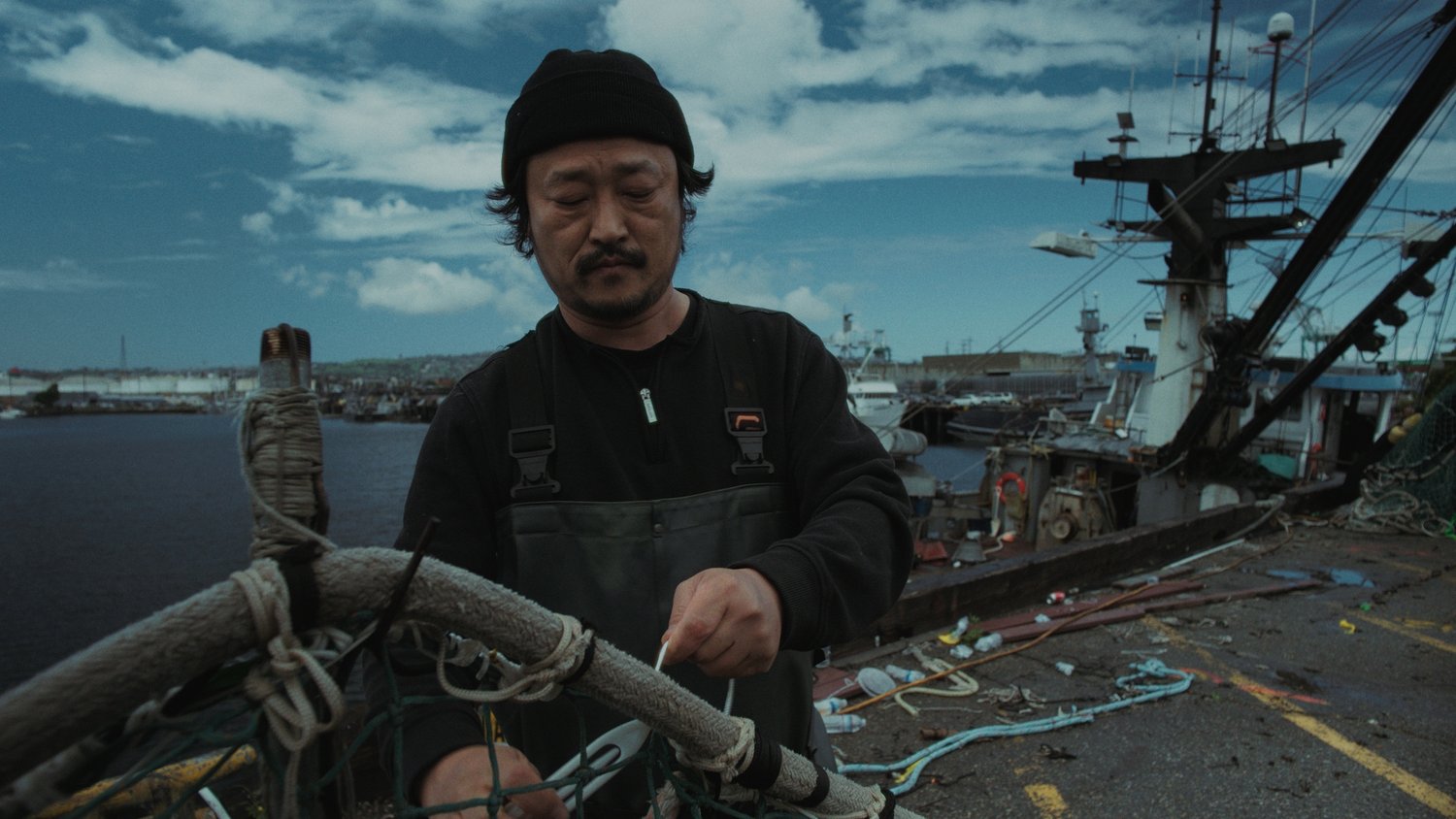
Justin Kim WooSŏk is a writer-director whose work focuses on loss, displacement, and our changing relationship with the natural world.
He joins us on Close-Up Culture to give insight into Sarajin. The award-winning short film follows a snow crab fisherman who is struggling to make ends meet for his immigrant family. When the snow crabs he depends on suddenly disappear due to climate change, he and his family have to decide whether to stay or leave their new home behind.
Was the story based on people you know?
This film was based on the fishermen in South Korea and Alaska I was following and observing while writing the film. I made this film through Lena Waithe’s Rising Voices program and was prompted to think about the future of work, and at the time I was spending time on the East Coast of South Korea, in cities like Gangneung, Sokcho, and Yangyang. I would walk around the fish markets, hang by the docks, and was able to join a few fishermen fishing in the East Sea.
It was around this time that reports that the Alaskan snow crab fishery, one of the largest and most important in the United States, was set to close for the first time ever, that 10 billion snow crabs disappeared and no one was sure where they went. I was intrigued by the fact this huge fishery collapsed, and that no one was talking about it. I started to write my script then. I flew to Alaska not long after to do my own research and observed fishermen working in the Gulf of Alaska. So when I naturally thought of the fishermen I met and observed while writing this story.
How important is it to tell these stories for East Asian communities?
It’s incredibly important. As institutions and media continue to fragment and echo chambers are dug deeper, I think it’s important to share personal and specific stories that seek to speak to collective experiences we all have or will share.
What inspired you to write this film?
Making this film gave me the opportunity to think more deeply about the decisions my parents had to make as we moved from place to place. I was really interested in the emotions and choices present in the window of time before an immigrant family has to move again. And more broadly, I wanted to speak to the kind of choices that families who are facing displacement due to climate change, especially fishermen, have to face.

The film touches on the hardship faced by this family, how reflective is this of today’s society?
I think the film is very contemporaneous, and will probably only become more so. The snow crab fishery remains closed for the second time in history this year (it first shut down at the beginning of my writing the script) and these disruptions will only continue to become bigger. Some people will say that human memory is short and nature moves in long cycles, but the level of disruption we’re seeing in economies and food systems is only accelerating.
What ran through your mind when you found out that Sarajin had qualified for Academy Award consideration?
I was very excited! And then immediately anxious. It felt like we were suddenly on a big stage.
Is this a story you would consider developing into a feature film?
We think this story is a special one, and could be adapted into a feature film. Currently, I am writing a feature loosely based on narrative and thematic threads present in this film.
How important do you think it is, that organizations like Indeed champion filmmakers?
This existence of this film, its subsequent movement through festivals, and the community of filmmakers I have met and worked with would not have happened without the support of Indeed (and Hillman Grad and 271) and the confidence and resources they entrusted me with.
What is next for you?
I am currently a Sundance Asian American Fellow and writing my first feature script!






Leave a Reply