
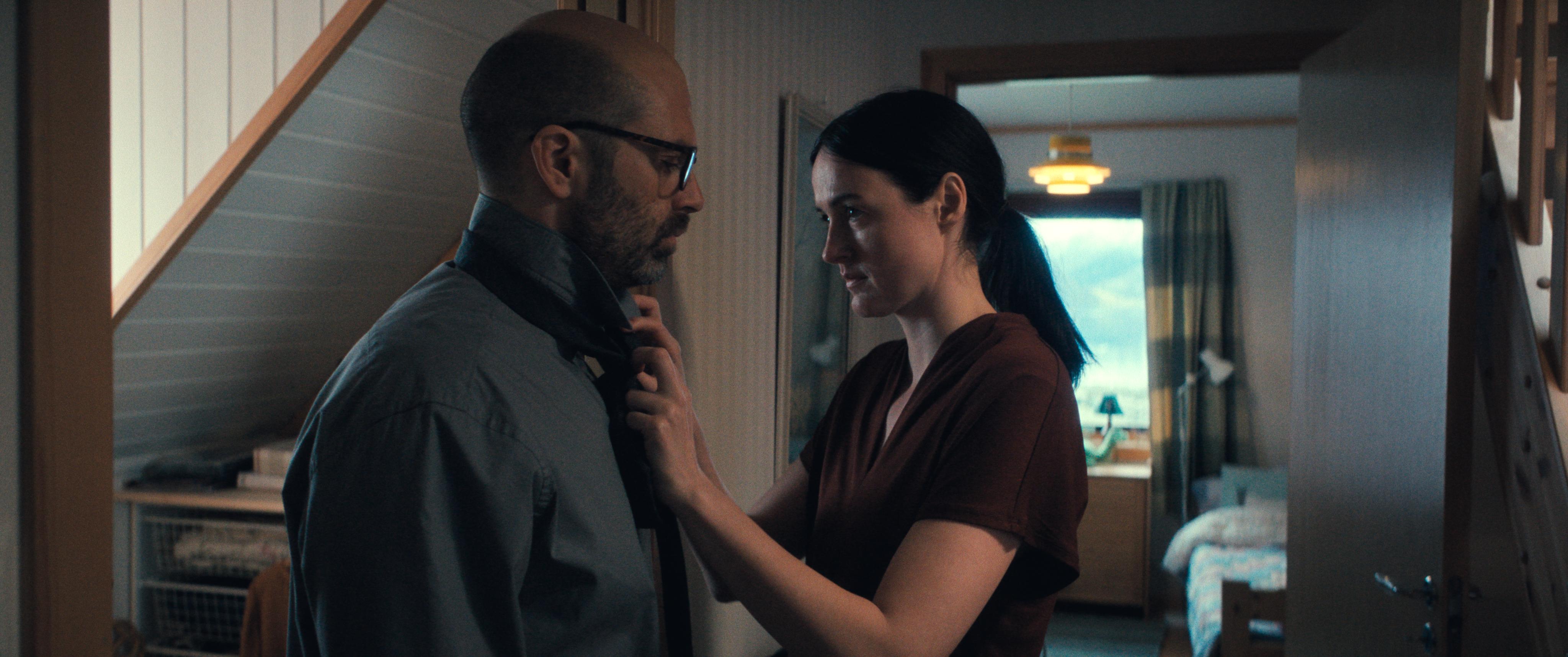

Cristian Mungiu has long demonstrated the ability to create films with a particular kind of moral unease that runs through them; the sense that even well-intentioned decisions can have deeply troubling consequences. In Fjord, Mungiu’s talent for fostering uncertainty once again provides the foundation for an absorbing and unsettling drama.
Fjord premiered at Cannes in 2026 and went on to win the Palme d’Or. It is Romania’s selection for Best International Feature at the 99th Oscars, and has a cinematic release that has been hotly anticipated by many. But does it truly live up to the hype? Well, the jury is still out.
The story follows Mihai (Sebastian Stan) and Lisbet (Renate Reinsve), a devout Romanian-Norwegian couple who relocate with their five children to a remote Norwegian community. Initially, the family settle into their new surroundings, developing a friendship with their neighbours. However, when concerns emerge about the children’s wellbeing, the family find themselves under the scrutiny of local authorities. What follows is a fraught examination of the boundaries between parental authority and state intervention, and the extent to which cultural and religious differences influence our understanding of what constitutes acceptable behaviour. The film’s great accomplishment is that it refuses to hand you a villain. Mungiu sets two sets of values against each other, a family’s way of raising its children and a society’s idea of what children are owed, and then lets each side be sympathetic, stubborn, and wrong in turn.
It is a controversial yet timely premise and Mungiu demonstrates patience in allowing the tensions central to the film to develop. At 146 minutes, Fjord is unhurried, but its measured pacing serves a clear purpose. Rather than relying on dramatic confrontations and sensational revelations, it finds tension in conversations, silences, and the gradual deterioration of relationships. As the viewer, you keep changing your mind about whom to trust, and the film is built in such a way that you feel uncomfortable about that. What begins as one family’s case slowly builds to a larger question: how do we live together when we can’t agree on what care looks like?

The performances from Stan and Reinsve are undeniably excellent. Stan is powerful as Mihai, capturing the character’s conviction and defensiveness, yet never reduces him to purely an antagonist. His conviction in his actions remains clear from beginning to end. Reinsve, on the other hand, brings an incredible subtlety to Lisbet, whose position within the family and the wider community is complicated and never entirely predictable as she juggles her role as a dutiful wife and nursing home worker.
Where Fjord is less successful, however, is in its handling of the supporting characters and the broader narrative surrounding the family. Noora, for example, the children’s friend, feels peripheral, with her presence doing little to meaningfully advance the central conflict or deepen the film’s moral debate, despite appearing in many of the scenes. More broadly, the children themselves are afforded surprisingly little airtime to articulate their own perspectives. Given that their wellbeing is the very subject around which the entire dispute revolves, the limited exploration of their perspective feels like a significant omission. Mungiu devotes considerable time to contextualising the parents’ behaviour, exploring their religious convictions and personal circumstances in an apparent effort to encourage a more sympathetic understanding of their position. Yet this accumulation of context becomes counterproductive. Rather than bringing greater clarity to the moral questions at the heart of the film, it can feel overwhelming, muddying the narrative and drawing attention away from the people whose experiences should arguably matter most.
Fjord makes striking use of its Norwegian setting. The expansive landscapes and imposing natural surroundings provide a beautiful but unforgiving backdrop to the claustrophobic circumstances unfolding within the community. The contrast between the apparent tranquillity of the setting and the hostility developing between its inhabitants is particularly effective.
The film’s greatest achievement is its willingness to engage with uncomfortable questions without pretending to have definitive answers. Its exploration of cultural difference, religious conservatism and the responsibilities of social institutions feels especially pertinent, but Mungiu is careful not to turn the film into a simplistic argument for one side or another. Instead, he exposes the prejudices, assumptions,and competing convictions that can shape how people respond to situations they do not fully understand.
While its careful pacing and considerable run time occasionally test the audience’s patience, Fjord is ultimately a rewarding piece of filmmaking. It is an intelligent, absorbing drama that leaves its audience to engage with its complexities, but refuses to spell out its conclusions.
This is not a comfortable watch, nor is it meant to be. It is the kind of film you argue about in the car park afterwards, and still think about days later. It’s serious, humane, and one of the most compelling dramas of the year. And after several days, I am still not sure what to think.







Leave a Reply