
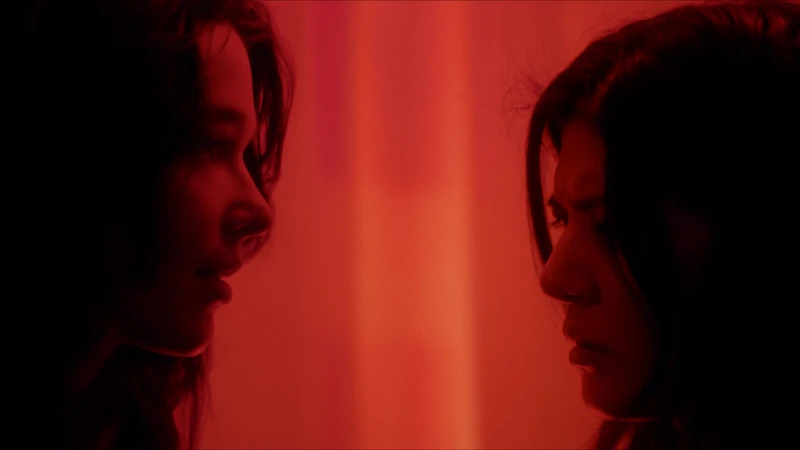
Written, directed, and produced by Sharon Sibyl Gatt, the Oscar-qualified short film Decode Me follows an autistic programmer as she decodes her self-worth in an enlightening conversation with her dragon friend.
We caught up with award-winning filmmaker Yorgo Glynatsis, who served as a producer on the film, to discuss mentoring Sharon’s personal story, building a neurodivergent-friendly set, and the film’s remarkable international festival run.
What initially attracted you to Decode Me, and what made you want to become involved in bringing Sharon’s story to the screen?
I was initially drawn to the original point of view on autism and neurodiversity in the story – especially the fact that it centres on two female characters and the conversations and experiences Jane and Elizabeth go through. Generally, in film and TV, the focus is on the parents’ or caregivers’ perspectives, and we mainly see autistic men or boys. With Decode Me, we focus on the experiences, thoughts, and emotions from the perspective of an autistic woman, which is still underrepresented and misunderstood.
Sharon and I were with the same acting agency a few years ago, and she was the graphic designer for my first short film, Trigger. She supported my early career as a film director and producer, so naturally, I wanted to give back to her, support her filmmaking journey with Decode Me, and help her tell her personal story.
The film tackles an experience that is still underrepresented in cinema. How important do you think it is for filmmakers to make space for stories about neurodivergence that don’t necessarily fit familiar expectations?
Millions of people are neurodivergent – and reportedly around 50% of Gen Z identifies as neurodivergent – so every person has a different story and experience. As filmmakers, I feel we have a responsibility to honour those stories, represent them authentically, and highlight diverse experiences within the neurodivergent community. Audiences also want more original stories and characters, as we can see from more people showing up in cinemas for independent films. There is a real demand for original, diverse neurodivergent stories.
You also served as a mentor on the project. How did you work with Sharon to help develop her vision while making sure the film retained its personal identity?
We started by meeting once a month for script sessions. I gave her creative constraints – writing between 10 and 20 pages, with a maximum of two or three characters and one or two locations – so she wouldn’t overthink the writing process, and so it wouldn’t be too complicated to budget and film from a production perspective.
During the writing process, we constantly discussed how to keep the balance between staying truthful and authentic to her experience as a late-diagnosed autistic woman while translating her story on screen for a broader audience. From the very beginning, our goal was to tell Sharon’s story in a way that would also relate and appeal to a non-neurodivergent audience. We kept that mindset throughout the writing, production, casting, festival strategy, and distribution release.
Accessibility was a key part of the production, with an access coordinator and a neurodivergent-friendly set. What practical changes did the team make, and do you think these approaches should become more common across the industry?
From the beginning, Sharon wanted to hire an access coordinator so the cast and crew would have a dedicated person to voice their needs to safely. Both of us had past experiences as actors where we felt uncomfortable asking for certain accommodations on set to feel safer or more relaxed, out of fear of being seen as a “diva” or “demanding.”
We hired Abbie Hills as our access coordinator, and she helped us create a neurodivergent-friendly set by sharing a Language and Disability Etiquette Guidance document, informing the cast and crew about her role before and during production, and providing a quiet space on set for breaks from the noise and busyness of filming, along with fidget toys and access to an outdoor area. Bigger productions are starting to adopt these changes and hire access coordinators, which makes me hopeful that more sets will accommodate their cast and crew – especially since it doesn’t take much effort to create a safe and supportive environment.
What were some of the biggest creative or practical challenges involved in producing Decode Me, particularly as a UK-Malta co-production?
Because we were funded by Arts Council Malta, we had to ensure a good balance between Maltese and British cast and crew. We hired Maltese heads of department, including cinematographer Kris Brady, costume and production designer Mattia Scicluna, hair and make-up artist Sandra De Gaetano, and photographer Andrew Mizzi.
Creatively, our challenge was keeping the pace and action flowing between the dialogue, since it’s a dialogue-heavy story with two characters in a bedroom. We held a table read and rehearsals with our cast, Mia Foo and Megan Placito, to work on the pacing and authenticity of the characters and conversations. In terms of filming, we had just two days to shoot all the scenes and create two distinct moods in the bedroom using lighting: cool blue and purple tones when Jane is working at her desk, and warmer colours like red on the bed when Jane and Elizabeth have their intimate conversation. Because of our Arts Council Malta funding, we also had a strict delivery deadline, giving us roughly six months from filming through post-production to complete and deliver the film.

The film has enjoyed an impressive festival run, with five wins, more than 15 selections, and Oscar qualification. Did you anticipate this level of response when you first started working on it?
Based on my experience with previous short films – and because we planned our festival strategy with Rebekah, The Festival Doctor – I knew we would be selected for a few festivals, though I didn’t expect to be in consideration for an Oscar this awards season. Attending the Clermont-Ferrand International Short Film Festival and Market really helped us connect with distributors in person, as well as having Decode Me on their digital market.
Off the back of that trip, we secured two distribution deals: our Oscar-qualifying distributor, Voce Spettacolo, and our commercial distributor, 7 Palms Entertainment, which is quite impressive and rare for a short film. We are very grateful for the success and exposure Decode Me is receiving across Malta, the UK, and the US. The film is now available to stream online via several platforms, which can be found on our website: www.decodemefilm.com.
Having worked across different productions and platforms, what do you think makes a short film stand out and connect with audiences beyond the festival circuit?
Personally, I think original, authentic stories with a clear message or point of view stand out because they are thoughtful and relatable. I love stories that blend different “niches,” genres, and meaningful messages, because that’s ultimately what makes them universal. Narrative stories with a clear beginning, middle, and end tend to attract broader audiences, while experimental shorts find their home in niche festivals and online platforms. My advice to new filmmakers is to tell the story they want to tell – one that is close to their heart – and they will find their audience.
What would you like the success of Decode Me to mean for Sharon, for Maltese filmmaking, and for other filmmakers looking to tell underrepresented stories?
Telling your truth and sharing your own stories will always be the greatest success, because it takes a lot of vulnerability. When you do, people connect and relate to it, and it can become a step toward healing, understanding, and growth for them as well. I hope Sharon, Maltese filmmakers, and fellow creatives everywhere recognise the power of their own stories, cultures, identities, and skills, and feel proud of who they are and what they are bringing to audiences. One step at a time, we are building our legacy – everyone deserves to tell their own story, and the world is our oyster.

Leave a Reply