
Across three interconnected short films, director Maeve Murphy examines the pervasive nature of violence against women, tracing its manifestations through rural landscapes, urban streets, and the domestic sphere. Speaking to Close-Up Culture’s Senior Writer Genevieve Dammery, Murphy discusses the inspiration behind The Geography of Violence, the importance of solidarity and the possibility of changing the narrative.
Violence against women and girls is not confined to a single place, circumstance, or social environment. It can occur in the isolation of a rural landscape, within the architecture of a city, or behind the familiar walls of a family home. The perpetrators may be strangers, intimate partners, or those who we trust to protect the public. Yet, despite the differences between these experiences, the structures that enable them are often strikingly similar. It is this uncomfortable commonality that Irish filmmaker Maeve Murphy explores in The Geography of Violence, a trilogy of short films comprising Siobhan, St Pancras Sunrise, and The Wolf.
Originally conceived as three standalone works, the films have since been brought together as a cumulative 30-minute piece, examining violence against women and the social conditions in which it persists. The origins of the project can be traced to the #MeToo movement. Murphy was profoundly affected by the scale of the experiences being shared. “It really shocked me to the core, the #MeToo movement, the scale of it. It was thousands and thousands of women,” she recalls in our interview. “I really wanted to respond to that, and also as a filmmaker, try and work out how women respond in a film, and what do I think as a film director?”
Murphy describes the trilogy as an exploration of a violence that is not isolated to individual incidents, but which shifts its appearance across different environments and relationships. “It’s this sense of shape-shifting throughout society, this violence against women emerging in different forms,” she explains.
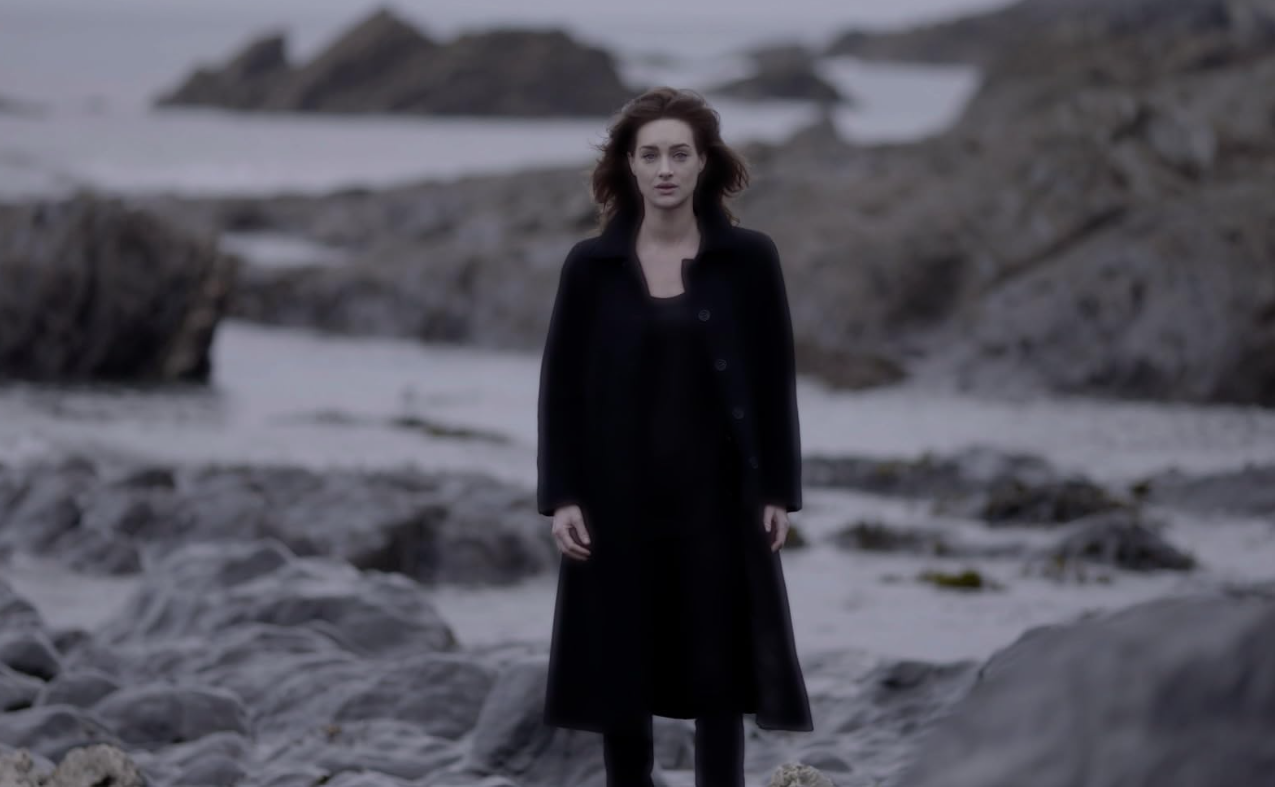
The first film, Siobhan, is an examination of sexual violence and the desire for retribution. Drawing on the conventions of the rape-revenge genre, Murphy constructs a ghost story in which the boundaries reality and psychological disturbance remain uncertain. Set against the distinctive landscape of a Devon beach, the film initially appears as a familiar story of revenge. Yet Murphy questions precisely that expectation. “I knew by the end of Siobhan, which is a ghost story that plays off the cinema rape-revenge trope, that I wanted to continue, as revenge was not the way,” she says. “The use of violence to get back for violence was not the way.”
Where Siobhan explores the inadequacy of revenge, St Pancras Sunrise turns towards the possibilities of collective action. Set in London’s King’s Cross, the film follows a young musician whose encounter with a sex worker develops into an unexpected friendship. The film draws on the real-life murder of Patsy Malone, a sex worker killed by a Metropolitan Police officer, and the subsequent resistance organised by the English Collective of Prostitutes (ECP). Murphy’s research led her to photographs documenting the women’s occupation of Holy Cross Church in 1982, a protest against police harassment and the treatment of sex workers. The historical material became integral to the film, which incorporates documentary footage of the occupation. “I felt really excited and empowered and knew this was it, this was the way: solidarity, friendship and resistance,” Murphy says.
Murphy describes the relationship at the centre of St Pancras Sunrise as one of the film’s most important elements, recalling the “beautiful growing friendship” between the two women, who are “chattering away and laughing just minutes before the brutal end”. For Murphy, connecting the past and present is essential for the film. The occupation of Holy Cross Church is not simply a historical reference, but evidence of a resistance that has continued across generations. “It’s almost like they’ve handed the torch through 1982 in that little documentary moment that you see,” she reflects. “I have so much respect for those women because they were so disrespected, they were so looked down on and jeered at, and yet they just opened that path.”
The trilogy’s final instalment, The Wolf, moves into the intimacy of a family home. Written by and starring Kellie Shirley, the film follows Leah, a mother whose home life is gradually disrupted by her partner’s abusive behaviour. The domestic setting is unremarkable: dinner is being prepared, the washing machine is running, and there is laughter between the couple. Murphy was interested in avoiding the simplistic assumption that abusive relationships are uniformly hostile. “I think that at the beginning he’s quite warm to her,” she explains. “I think they actually have had feelings or do have feelings. It’s that abuse cycle, isn’t it? It’s okay, and then there’s a little thing happens, and then the violence happens, and then there’s the remorse, and it goes around.”
Murphy is attentive to the systems surrounding Leah. Her son’s school raises concerns about his safety and requests a meeting, introducing an external intervention that forces Leah to confront her reality. It is a moment in which an institution, rather than perpetuating harm, becomes a catalyst for change. Leah also has the possibility of returning to her mother, an important reminder of the role that practical support plays in escaping domestic violence. For Murphy, the ending represents the culmination of the trilogy’s central enquiry. “The quiet decision, the quiet escape,” she says, was the response she had been working towards throughout the project. As Leah and her son leave, the film offers a moment of relief, punctuated by a joke about riding a Lime bike all the way to Belfast.
Indeed, the decision to end on humour and hope was deliberate. Murphy was conscious that audiences would arrive at The Wolf having watched the preceding films, and that the repetition of violence would establish an expectation of more tragedy. “I really wanted to end on hope, but we had to earn it as well,” she explains. “It’s not cheesy feel good. It’s kind of like, you know, that we can change the narrative. This can and will change.”
That hope is made more powerful by the brutality that precedes it. Murphy doesn’t soften the realities of violence to offer audiences a reassuring conclusion. Rather, she insists on showing the extent of the harm before allowing the possibility of something different to emerge. “I think it’s being able to look at something unflinchingly and go: this is how it is, this is how bad it is, I’m not going to soft-soap you, but also here’s another reality.”

The construction of the trilogy as a cumulative work is central to this effect. Murphy recalls the influence of Alan Clarke’s Elephant, the 35-minute film depicting a succession of killings during the Troubles in Northern Ireland. Murphy recognised a similar possibility in bringing her three shorts together. “When you put them together, the repetition of rape and murder makes you realise there is a pattern underneath which goes across the different environments,” she explains. “A pattern of male violence, the epidemic of violence, and you want it to stop.”
Murphy is particularly conscious of the importance of what audiences see and what they do not. Her approach to depicting violence is informed by her Buddhist beliefs and a desire to work with what she describes as “a profound respect for life”, drawing on the philosophy of Daisaku Ikeda. “I want to underpin [the work] ethically with a profound respect for life,” she says. “To only show violence when it is needed for the story and then briefly.”
In St Pancras Sunrise, the violence against Nadina is never shown. Instead, the film builds tension through the presence of the predatory police officer, the uncertainty surrounding his intentions and the gradual encirclement of the women. In Siobhan, a single image of the farmer using his physical strength to push a woman down communicates the power imbalance at the centre of the violence. The Wolf, however, required a different approach. Murphy felt it was important for audiences to witness at least some of the physical brutality, particularly given how frequently the language of domestic violence can obscure the reality of what it entails. She recalls the image of a woman being headbutted in her own kitchen, with her child nearby, as an example of what cinema can communicate beyond the terminology used in public discourse. “That’s what it means,” she says. “Somebody being headbutted in their kitchen with their kid outside.”
Although she is cautious about describing herself primarily as an activist, Murphy sees filmmaking as inherently capable of contributing to wider social conversations. “I think often I’ve had an intersection with [activism], but I’m first and foremost a filmmaker,” she says. “Within that, I think that filmmakers and artists in general, especially now, have an incredible role.” At a time when public confidence in political institutions and traditional media is frequently challenged, Murphy believes that audiences are looking to artists for meaningful engagement with difficult subjects. Film offers an opportunity to move beyond statistics and headlines. “It opens people’s hearts,” she says. “Because it deals with the human, it can connect to, like, ‘Oh, that’s what it’s really like.’”
The timing of the trilogy’s UK premiere has consequently taken on an additional significance. Murphy describes the recent public conversations surrounding sexual misconduct and abuse as a moment in which “the lid has been lifted”. While she is conscious of the suffering behind the renewed attention, she also sees the possibility of a turning point. “I think the lid is not going to go back on the bin,” she says. “We’ve looked inside, and I think that conversation is going to go on.”
Murphy’s optimism extends beyond the possibility of institutional change. She sees the current moment as an opportunity for men to become more actively involved in confronting the attitudes and behaviours that sustain violence against women. “I think this is going to be a consciousness-changing moment for men,” she says. “They have to get involved in this conversation.”
She also believes that the strength of women to organise collectively can contribute to a more peaceful and equitable future. “I believe the 21st century is going to be a century of women,” she says, articulating an ambition that reaches beyond the immediate concerns of the trilogy.
It is this combination of unflinching realism and cautious optimism that ultimately distinguishes The Geography of Violence. The films do not suggest that solidarity alone can undo the damage of violence, nor do they pretend that leaving an abusive situation is straightforward. They recognise the failures of institutions, the limitations of revenge, and the consequences of a society that has too often normalised the mistreatment of women. Yet they also insist on the importance of friendship, resistance, practical support and the possibility of survival.
Murphy hopes that bringing the films together will encourage audiences to watch, reflect and talk: “People come together and they can watch it and then they can talk. So we’re all sort of dealing and processing.”
That conversation is one of the most important things the films can offer. Their cumulative effect is uncomfortable, forcing audiences to recognise the connections between violence that might otherwise be understood as separate or exceptional. But by ending with Leah and her son moving towards safety, Murphy refuses to leave viewers with the impression that repetition is inevitable.
The final image does not promise that everything will be resolved, or that the structures which enable violence will disappear overnight. Instead, it offers something quieter and more meaningful: the possibility of a different ending. As Murphy puts it, “We want it to stop. It can stop.”
Watch The Geography of Violence at its UK premiere on Tue 17 November 2026. Free tickets are available here.






Leave a Reply