
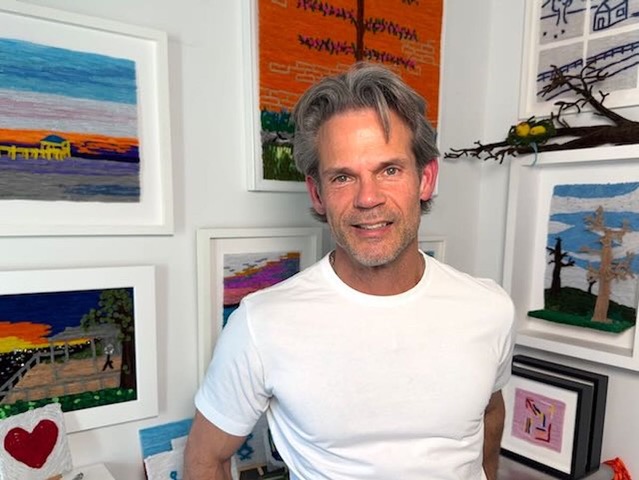
What happens when a pile of leftover corporate event supplies falls into the hands of a natural problem-solver? For artist Greg Domres, it sparked an entirely new creative chapter.
Combining a background in marketing and interiors with inspiration from icons like Hockney and Picasso, Greg has traded traditional paints and canvases for the tactile, vibrant world of chenille stems – a process he calls “stemming.”
In this interview, we dive into the accidental origins of Greg’s work, the challenge of creating depth with primary colours, and why bringing joy to a collector is the ultimate form of artistic connection.
How did you first discover that pipe cleaners could become an artistic medium, and why “stemming”?
This all happened by accident. I was working with an incentive agency, and after a kickoff event there were pipe cleaners left over. Someone handed me a bundle, and I thought, what am I going to make? I made a cornucopia. Then I kept going. How big can I go? What can I make? Pop art was a big early influence.
At some point I showed some pieces to my friend Jack Pearson, a successful artist. He said they were great, and that I could push them into an art form if I wanted. I took that as a challenge. I wanted to make representational work, so I had to figure out how. That became the fascination: what could this material actually do?
The term stemming came out of that. I wasn’t painting. I wasn’t weaving, or was I? I wasn’t doing anything people think of when they hear “pipe cleaner.” And the material’s technical name is chenille stem (because you’d never clean a pipe with one of these.) So I called it stemming, and it stuck.

What do you enjoy most about the possibilities of working with chenille stems?
The challenge. I have a vision, or something inspires me, and the question is whether I can execute it. Sometimes it’s about scale. Sometimes it’s detail. Or I’ll become mesmerized by the rhythm or ripples the rows of pipe cleaner creates.
The material has real limits. It comes mostly in primary colors, I rarely find in-between hues, so depth is a challenge to create so I lean into what I know. I took one drawing class in college, and it taught me perspective. Everything else I’ve had to figure out myself, and that problem-solving is what I love most.
I also love how tactile it is. And that no one else does it. There’s some pride in that. I created this.
You have a background in marketing, publishing and interiors. Have those experiences influenced the way you approach your artwork?
Yes, both in what I make and in how I bring it to market. Working with John Derian taught me what people are drawn to, and that’s shaped my interest in iconography. I love the power of an icon, and I think all my work carries that. Marketing made me comfortable putting the work out there. Art and interiors share something that doesn’t quite make sense on paper: a piece doesn’t need a purpose; it needs a connection.
So I create and let it land where it lands. I’ve seen the switch flip, when someone loves a piece and has to have it. I’ve also seen people not understand it or try to minimize it. I’m okay with all of that. I’ve created something, I keep creating, and I bring it to market in a way that feels right to me and it’s important that anyone involved have a connection.
Your influences include Picasso, Hockney and Alexander Girard. What is it about their work that speaks to you?
I’m not a trained artist. I have an MBA, not an MFA. A gallerist once explained to me that I’m not an outsider artist either, because I am informed. I go to galleries and museums. I have books. All of it has informed me, and seeing how those artists conveyed their own vision has educated me and has given me permission to do the same in mine. With Picasso it is the way his style evolved. With Girard it is his designs, streamlined iconography which feels very inspired by the folk art collection he built and you can see at the Museum of International Folk Art. That hits home for me. With Hockney, it’s his color. That’s what I thrive on.
Honestly, I’m not sure there’s a representational artist alive who wouldn’t inspire me, because I’m always looking at how their voice comes through.

Do you have a favourite piece you’ve created so far, or one that surprised you once it started taking shape?
Two come to mind. One I just left organically happen called Across the Room and Out the Window. I found it incredibly powerful in its color and simplicity. It sold almost immediately, which I think says something about its originality. Again, it drew on iconography.
And then there is Good Morning LA which is a vibrant landscape. It’s also a nod to tinsel paintings by using tinsel pipe cleaner to make Tinseltown sparkle as morning light is breaking over the Santa Monica Mountains. You don’t think of LA as having a skyline but there is a great deal of deep satisfaction in hearing the astonished recognition of “wait, that’s Los Angeles made out of pipe cleaner!”
You’re now embracing a new creative chapter. What would you love to explore or achieve next?
I want to put a bigger voice behind what I do. There was no MFA and no senior show. I’ve never had a crit to beat me down or build me up. I made this up, and I’ll admit that for a while I wasn’t sure it was worthy as an art form. It is though. Other artists have congratulated me on creating an art form, and I’m confident in that now.
I don’t think my work will change the world with some provocative meaning. But it brings joy. One collector told a gallerist that my work makes her happy. That’s a real connection, and it’s what I’m comfortable striving for.
So the next step is to keep challenging myself with what I can make, but also to speak for the work. I’m drawn to art forms that are misunderstood or underappreciated. So many artists aren’t following a traditional path, they’re following a truly creative voice, and they need a place. I want to be part of creating that place.
Follow Greg on Instagram – @gregdomres





Leave a Reply