
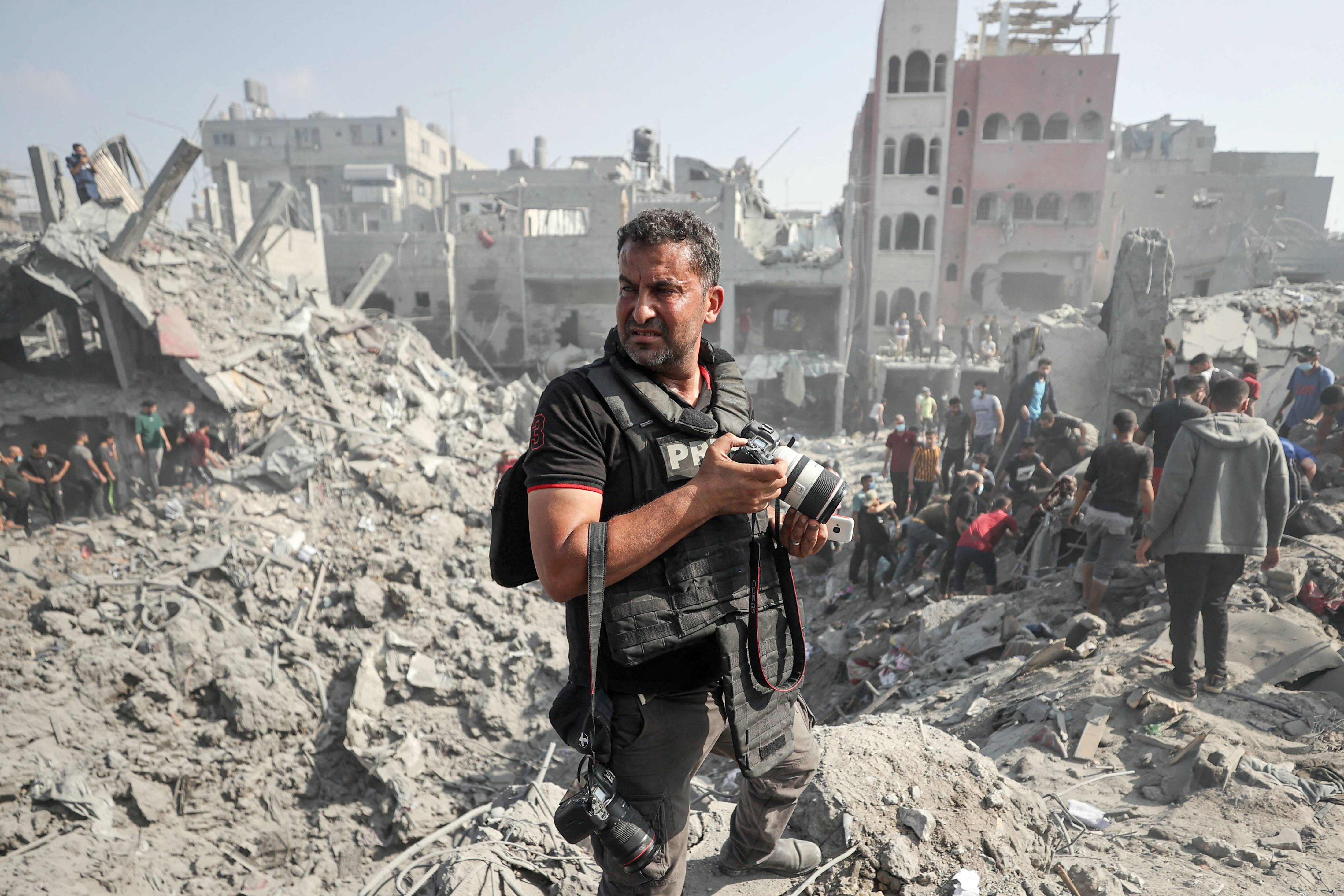
On 2 November, the International Day to End Impunity for Crimes against Journalists, Ciné Lumière hosted a screening of Inside Gaza, a documentary that is poignant in its recognition of those who risk their lives to ensure the world bears witness to events unfolding around them.
Where most documentaries of this nature show conflict from the outside, through a visiting correspondent or an embedded crew, Inside Gaza takes the opposite approach. Directed by Hélène Lam Trong, the film turns its attention to the journalists who continued to document the devastation in Gaza at extraordinary personal cost. For months after 7 October 2023, international press were largely barred from entering the Gaza Strip, so the world’s view of the war came through the few reporters who were already there.
The film follows the Gaza City team of Agence France-Presse (AFP), including reporters Mai Yaghi and Adel Zaanoun and photojournalists Mahmud Hams and Mohammed Abed. They were covering a war while living in it. Their bureau, their homes, and their families were all inside the conflict zone. Lam Trong, who won the Albert Londres Prize for Daesh, the Ghost Children, built the film from the agency’s archive and the journalists’ testimony, covering the period from October 2023 to the Spring of 2024, when many journalists were evacuated out. The footage was shot by the people who appear on screen as interviewees.
It is the journalist’s proximity to their subject matter that gives the film its power. The archive images are never just illustration, because we are also hearing from the person who held the camera. The journalists talk about the strange split of working through grief and about the practical problems of staying alive while trying to report. They also describe the scrutiny their work met, with images challenged by the international community, and verification demanded. One recollection stays with you: a photographer asked to prove that a dead child’s body in his picture was not a doll.

The journalists’ eventual evacuation from Gaza does not bring a straightforward sense of relief. Instead, distance introduces its own particular form of anguish. Speaking after the screening, Mai Yaghi reflected on the difficulty of rebuilding her life in London while remaining emotionally tethered to the place she had been forced to leave. “I still feel like I’m living two lives in parallel.” Yaghi is particularly keen to challenge the way Palestinian journalists’ continued reporting is understood by the outside world. “Those journalists who are still working under those circumstances are not necessarily resilient, but they are doing what they have to do. It’s not an option for them,” she explained. Her words are an important reminder that the extraordinary circumstances under which these journalists work should never become normalised.
For producer Yanni Ollivier, the impetus behind the documentary came following the destruction of AFP’s Gaza office in November 2023. Having previously worked as a journalist himself, Ollivier recognised that the experiences of his former colleagues warranted a story of their own. Amid accusations questioning their credibility and the increasingly difficult circumstances in which they were working, he felt it was essential to ensure their experiences were heard. “We needed to tell their story. We needed to give them their voice,” he explained during the post-screening discussion.
The film also has a clear sense of its limits. It doesn’t try to explain the conflict or hand viewers a political thesis. Its subject is smaller and more focussed: what it costs to bear witness, and what we owe the people who do it. At a time when journalists are among those killed in the conflict (with this being the deadliest conflict for journalists ever recorded) that question feels urgent as well as professional.
Speaking after the screening, Ollivier described the film as being about “the human costs of bearing witness”. He also stressed that “good journalism has a price, and it’s not free”, arguing that audiences must recognise the resources and protections necessary to allow journalists to continue reporting from conflict zones. It is a sentiment that sits at the very heart of Inside Gaza: the images that reach us, and the stories we are able to hear come at a very real human cost.
Inside Gaza is sombre and unshowy, and it stays close to its subjects. It works as a record of a war and as a tribute to the craft of reporting, but its importance extends beyond the stories it documents. At a time when it is so easy to scroll past uncomfortable images, turn away from difficult realities, or allow the relentless news cycle to diminish our attention, this is a film that demands we stop and look. It reminds us that behind every photograph and every news report there are people risking their lives to ensure the world does not look away. This is not simply a documentary worth watching; it is one that deserves to be seen, discussed and remembered. It deserves a wide audience, and it will remain worth watching long after the headlines have moved on.






Leave a Reply