
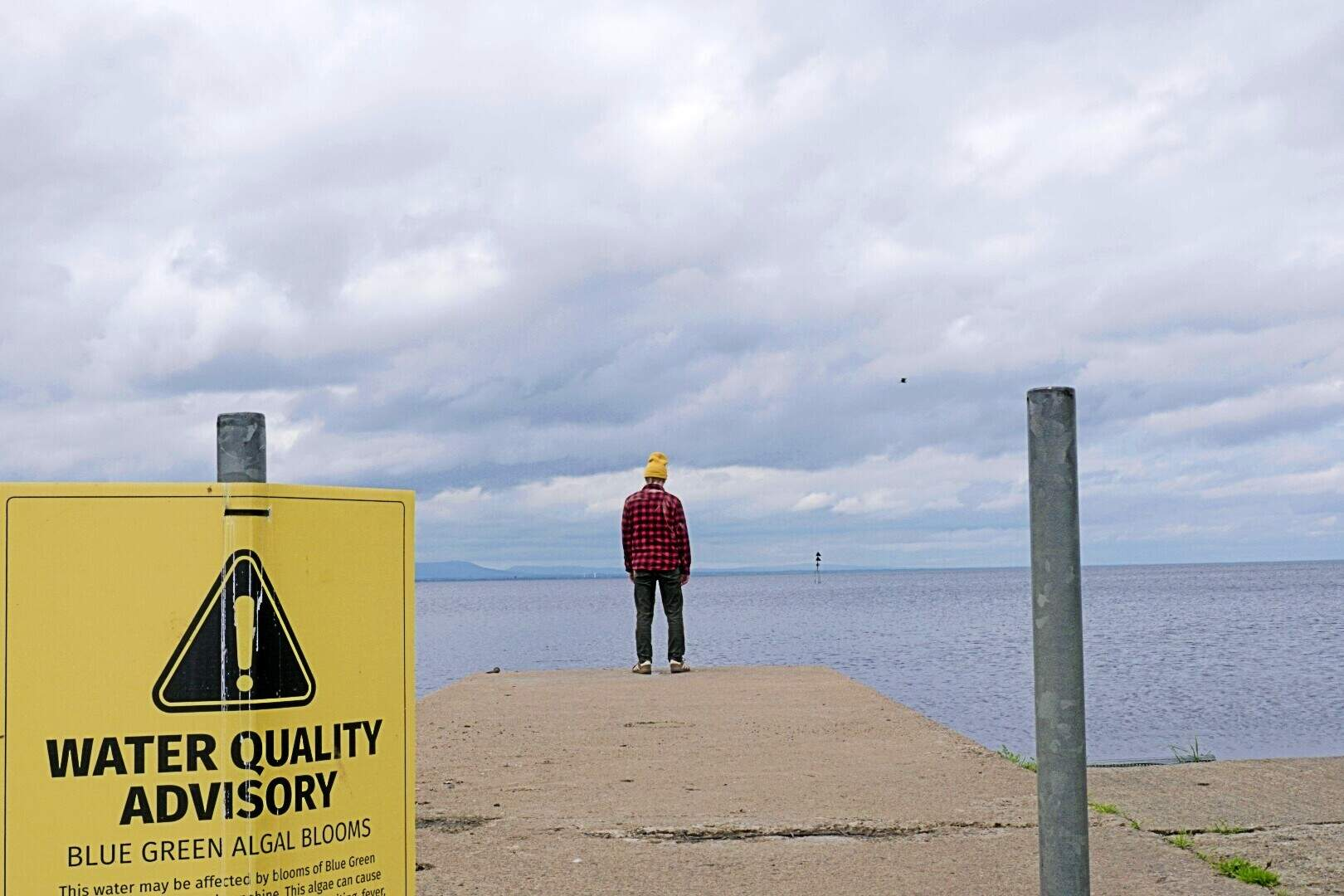
In an era where a few clicks can trick the mind into a false sense of absolute expertise, filmmaker Dominic Curran arrives at the Belfast Film Festival with a timely, unsettling psychological portrait. Produced by Soil Engineers Productions, his debut feature film, A Little Learning Is A Dangerous Thing, follows Michael, a young man recovering from a car accident who quickly spirals down a dizzying internet rabbit hole of corporate greed and conspiracy theories.
We spoke to Dominic to find out more…
This is your debut feature, and it follows Michael as he falls down an internet rabbit hole while recovering from a car accident. What first sparked the idea, and why did you want to explore this kind of obsession through film?
I have always been interested in the internet as a psychological phenomenon. Much of it completely confounds me, but the appeal of knowledge and the feeling of enlightenment, coupled with a righteous anger, is something I can completely sympathise with. It is all too easy to feel superior, even if you haven’t truly put in the work.
During lockdown, those close to me and I definitely fell foul of this, spending far too much time online, with any anger or disagreement amplified tenfold by text. As we emerged, it became an object of enormous fascination to me: why had I, and others, believed we had become so knowledgeable with virtually no effort?
Then, while watching Under the Skin for probably the tenth time, one sequence where the crowds of faces blend together stood out to me. It created a sensation remarkably similar to that of overindulging in the internet. I began playing with different edits of the footage from my last two shorts to try and replicate this effect.
This style and concept eventually coalesced into the character of Michael, whose misfortune causes a sudden emergence into the cold world from a benign youth, driving him to desperately seek knowledge and understanding as fast as he can. Unfortunately, my personal realisation – which is fundamental to understanding the whole movie – is that knowledge is hard-fought for and shared. There are no shortcuts.
The film seems to sit in an interesting space between genuine concern about a local business and the more dangerous pull of conspiracy thinking. How did you approach keeping that line blurred without making Michael’s perspective too easy to dismiss?
I think Michael’s knowledge is fundamentally grounded in truth, even if it’s a truth that hasn’t been explored in enough detail. If you were to broadly research everything he mentions in the movie, none of it is false. It is his reductionism and hypocrisy that ultimately make all the knowledge he has gained useless. He is fundamentally just angry and looking for easy answers – the same scapegoat everyone wants. He could accept himself as a smaller part of the world, someone who simply does what they can to help, but he is not willing to accept that. He has to be massive.
So, I think that is why you go along with the character and agree with his intentions, yet you can ultimately see his mistake. He is abusing his minimal knowledge for his own imagined rationale.

The press release describes the film as a portrait of a young mind unravelling. What were some of the visual or sound choices you used to put the audience inside Michael’s experience, particularly as the online world starts to overwhelm him?
The collaboration with Liam ‘Son Zept’ McCartan on the score was fundamental to this part of the project from the very start. His unique sound is so integral to creating the sensation that Michael is collapsing. He was privy to very early cuts of the movie and began writing based on the overall tone, rarely directly scoring actual scenes. We would then ping-pong off each other, re-editing until it worked perfectly.
Throughout the film, I also made use of montage and a general degradation of the film quality to convey his collapse. I would render sections of the movie out repeatedly until the digital file began to break down in interesting ways, and then I increasingly incorporated those corrupted textures into the final image.
There’s a real anger in the film’s description of corporate greed and the disaffection that can feed these obsessions. Was that frustration something you brought into the story from the beginning, or did it become clearer as you developed the film?
That’s definitely one of the most sympathetic aspects of his character to me. I completely understand the sense of hopelessness that comes with trying to gain any real understanding of how the world has functioned over the last 75 years. Any attempt to understand things on this scale can cause despair, especially relative to our actual ability to affect change.
That was in the story from the start; it was the lough that came later as a focal point for that idea. Originally, Michael worked as event catering staff and was obsessed with a specific businessman. As my regular co-writer and co-producer, Will, and I were working, the lough loomed large in our minds. It reached a point where we couldn’t ignore it as a symptom of every problem this character was obsessed with – from post-colonialism through to market fundamentalism.
The title, A Little Learning Is A Dangerous Thing, feels especially relevant in an age where a few searches can make someone feel like an expert. What do you think the film says about the difference between being informed and becoming consumed by what you find online?
I think the difference lies in the gratification you gain from it. Seeking knowledge is deeply satisfying and an incredibly good instinct, but it is all too easy to create a veneer of intellect, even to yourself. People spend their entire lives specialising and training on one fraction of a percentage of life. If we are honest, there is no single person who knows everything, or even a lot. We are a sort of hive mind of intellect passed down through generations- it is our greatest strength, no contest – and yet we deny it and pretend we know everything, largely in the name of ego. I don’t think this behaviour is unique to our age, but it is much more easily done now, and it is often the inadvertent result of an algorithm.
Now that A Little Learning Is A Dangerous Thing is heading out into the world, what do you hope audiences take away from Michael’s story?
Firstly, I hope they have a thrilling experience watching the film. Despite the low budget, it is a movie I designed to take maximum advantage of every artistic opportunity film as a medium offers. I think it will be a unique experience to watch in a theatre, at home, or even on your phone, because of how the text connects directly to our modern modes of consumption. It won’t be something everyone can handle, but those who are looking for something stimulating and engrossing will definitely take something away from it.
Ultimately, I hope it speaks somewhat to the disaffection of my generation, and those like-minded from other generations. I don’t feel there are many movies out there at the minute that genuinely do, despite plenty of weak attempts to monetise that feeling.




Leave a Reply