
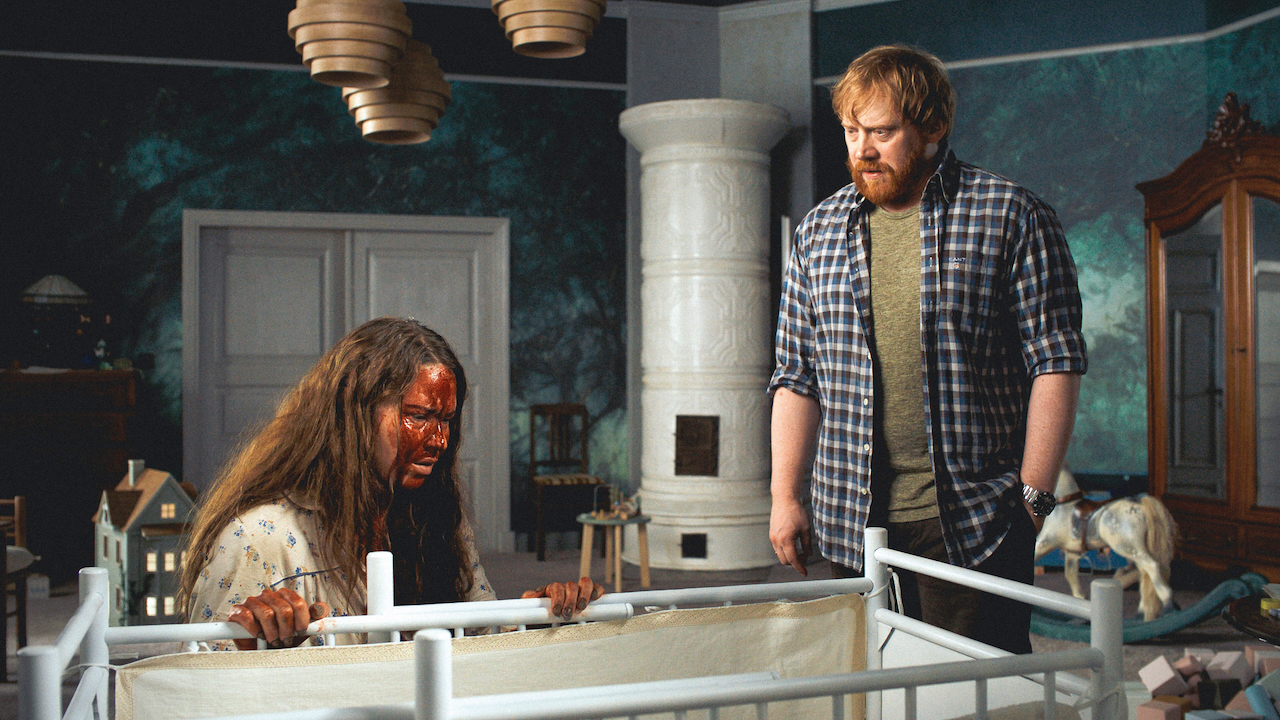
It is natural for any first-time parent to have anxieties about the transition to parenthood. In her latest film, Nightborn, Finnish filmmaker Hanna Bergholm takes these fears and transforms them into an unsettling exercise in body horror, anxiety, and the mental spiral that can accompany the early days of becoming a parent.
The film follows Saga (Seidi Haarla) and her British husband Jon (Rupert Grint), who move into Saga’s childhood home in the Finnish forest, hoping to begin their family somewhere familiar. They conceive their son in a forest with trees that look suspiciously human, and as soon as their son Kuura arrives, their domestic idyll quickly deteriorates. As Saga becomes convinced that something is very wrong with her baby, the couple find themselves caught between the expectations of parenthood and a more disturbing reality.
In Nightborn, Bergholm explores the exhaustion and psychological disorientation that accompany the arrival of a child but pushes these experiences to grotesque extremes. She twists breastfeeding, sleepless nights, and the demands of a newborn into visceral horror, while the expectation that a mother should instinctively adore her child hangs over the film like a threat in itself.
Is Saga uncovering something genuinely monstrous, or is she experiencing a psychological crisis that those around her cannot recognise? The film plays with the distance between a mother’s instincts and the judgements of those who believe they know what is best for her. In doing so, it raises uncomfortable questions about how readily women’s fears are dismissed when they fail to conform to society’s expectations of motherhood.

Bergholm is no stranger to this territory. Her previous feature, Hatching, similarly explored the darker implications of femininity, familial pressure, and bodily transformation. With Nightborn, she again demonstrates an eye for the grotesque, using the body as a site of horror rather than something to be hidden from view. The film’s more graphic imagery will not be for everyone, but the confrontation of the physical realities of reproduction gives its horror a particular potency.
The setting adds to the suspense. Surrounded by dense Finnish woodland, the couple’s childhood-home-turned-family-haven feels is removed from the reassuring structures of modern life. The forest is beautiful but threatening, and the house carries the weight of inherited expectations. This distinctly folkloric atmosphere gives the film an identity beyond that of a conventional psychological thriller, suggesting that the horrors confronting Saga may be rooted in something far older than her immediate circumstances – something that is heavily alluded to but not confirmed until the final scenes.
Haarla anchors the film with a haunting performance that captures the volatility of a woman pushed to the edge of her endurance. Her Saga is frightened, exhausted, and isolated, yet never reduced to a straightforward portrait of maternal instability. Rupert Grint provides an excellent contrast as Jon, whose desire to maintain a recognisable family life becomes irreconcilable with his wife’s experience.
The film’s appetite for grotesque imagery occasionally overwhelms, and the shifts between dark comedy, folk horror and domestic drama do not always sit comfortably together. However, for viewers drawn to horror that challenges social conventions as much as it unsettles the stomach, Nightborn offers plenty to engage with. Bergholm’s vision is distinctive, the central performances are compelling, and its treatment of maternal anxiety genuinely provocative. This is motherhood stripped of its comforting mythology – and, in Bergholm’s hands, that is a frightening prospect indeed.





Leave a Reply