
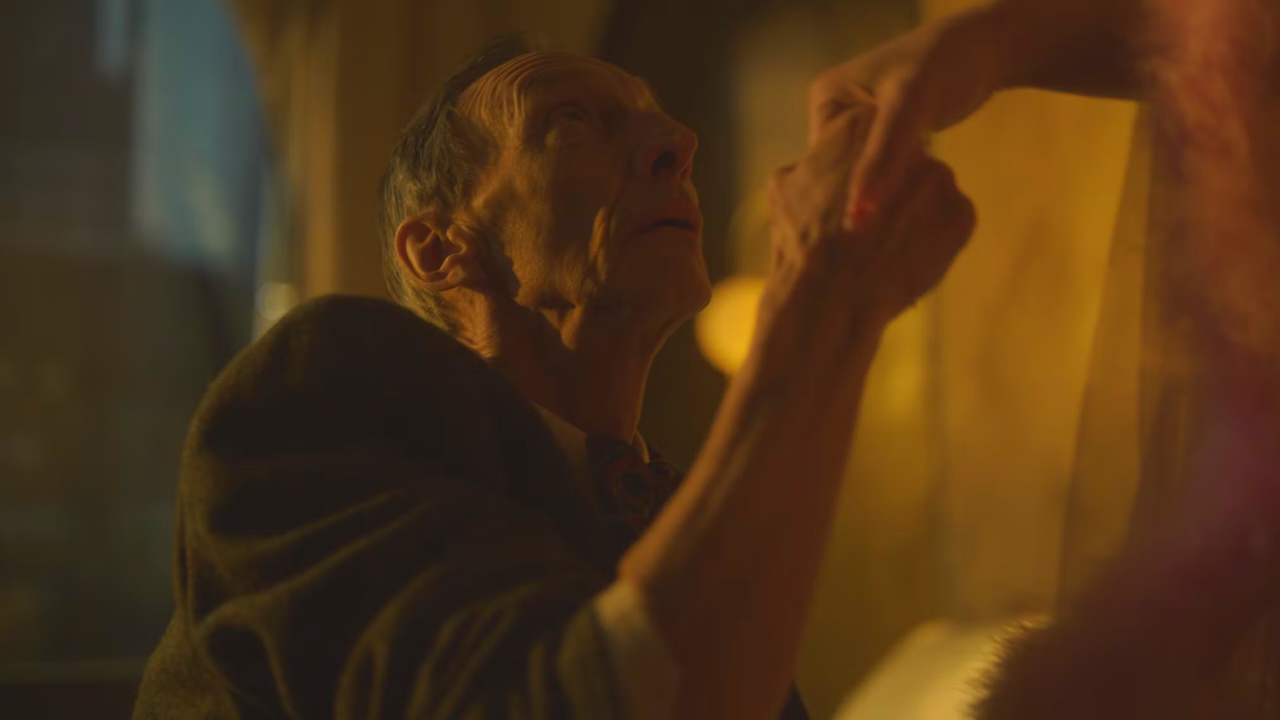
Emily “Lee” Lawson is a Toronto-based filmmaker whose work explores experiences at the intersection of trauma and transformation. Her short film, Man Eating Pussy, was a hit at London Film Festival, telling the story of a dying man who seeks comfort in a mysterious sex worker.
We spoke to Lee to find out more about this brilliant project.
There’s an interesting tension in Man Eating Pussy between the body as something that can be feared or objectified and the body as a source of intimacy and connection. Was that tension central to what you wanted to explore, or did it emerge as the story took shape?
Lee Lawson: Wow, I mean, I think it was central from the moment Kitty became a character.
She’s the literal personification of pussy – a person transformed into an object. And then the challenge is helping you see her as a person again. That might seem lofty or overly arty but, in a strange way, I think film asks us to do this with a lot of actresses. To see them and value them for their beauty… as commodifiable objects (because it’s a draw, and it’s pleasurable), and then over the course of a film to identify and empathise with them. It’s a bit of a brain tickle, but actually a really common shift. Just part of how we’re asked to interact with representations of women.
There’s something really interesting that happens with her face. Your brain wants to map a person onto it, so her “clit” becomes an eye landmark. But then you see the anatomy again… It keeps flickering between being an inhuman orifice and being somebody’s face. I love that you can experience both, sometimes almost simultaneously.
And that happens emotionally too. You’re confronted with this image that might feel grotesque or sexual or threatening, but then she becomes someone you’re getting to know. I think that tension is at the heart of it… What happens when something you’ve been looking at becomes someone who can look back?
You’re both an actor and a filmmaker. Has being on the other side of the camera changed the way you direct performers, particularly when a role asks them to do something physically or emotionally unusual?
Lee Lawson: I hope it has! I certainly wouldn’t ask anyone to do something I wasn’t willing to do myself. And regardless of the ask, I think it’s my responsibility to make sure everyone is comfortable and informed. Acting is so vulnerable. It’s difficult to do your best work when you’re treated like a machine that simply has to deliver.
Forget the physically or emotionally unusual stuff… Just knowing what’s going on can be a rare commodity! As an actor you get very used to being the last to know: put in holding, left to wait, then suddenly summoned. Can I eat a sandwich? Do I have time to prepare? Am I about to cry on camera in 30 seconds? It’s a stressful state to create from.
I try to treat actors like collaborators – the way they’d be treated if they were A-list stars (and I don’t mean fetching coffees). I mean communicating with them, including them, treating them as the artists they are. Good actors are smart and hyper aware, so giving them that trust and information makes all the difference. That’s generally how I like to be treated as well.
With a premise this extreme, there must be a temptation to keep escalating it. How did you decide what belonged in a 12-minute film and what would have tipped it into something else entirely?
Lee Lawson: I’ve had people say this to me before, and I find myself wondering: Escalate to where?! Horror fans especially have told me it could’ve been way more hardcore… I guess I’m just a romantic, well, and aware of the limits of the prosthetics. Creating the illusion of a very slow… engulfing… involved four different prosthetic, puppet and animatronic stages. Something more extreme? I can’t even imagine how we’d do that!
But really, I followed my instincts and tied all of the fantastical, bodily elements to character choices and impulses. Freddie and Kitty are sensitive people, approaching each other’s bodies through exploration, care and, I suppose, deliverance of sorts. That gave me a way to decide what belonged. Does this come from something they want or need from each other? All of the action stems from that… And their encounter felt complete to me without needing to go “harder.”
Freddie comes to Kitty with a very specific final wish. What did you need to understand about Freddie as a person to make his request feel like more than just a provocative plot device?
Lee Lawson: I needed to understand what he was asking for emotionally. Beneath the unusual nature of his desire, there’s this very human need to feel safe and held. To be cared for at a moment when he’s frightened and vulnerable. Despite his age, there’s a little boy in there.
That informed the little things: he’s gentle, he’s put effort into the occasion, he wants to be respectful of Kitty… He’s asking another person to meet him in a very vulnerable place, and how he treats her matters. Both to him and to her.
Julian Richings is what makes this possible. I think his performance is the difference between seeing Freddie as a “creepy old man” and as this flawed but comprehensible human being whose desires are unusual but not “wrong.” I will forever be grateful to him.
I don’t think the audience has to understand Freddie completely, but I’d like them to care for him… To see him as a person worthy of gentleness.
The film has played to audiences at festivals ranging from SXSW to Fantasia. Have you encountered reactions that surprised you, particularly moments when audiences respond with laughter, discomfort or emotion in ways you didn’t anticipate?
Lee Lawson: The first time I heard an audience laugh their way through the film, I was in a spin. I knew there was humour in it, but I hadn’t anticipated quite that much laughter! I’d been so focused on the tenderness of the encounter… So hearing it play that differently took a moment to get used to.
Over time I’ve come to really appreciate and enjoy the varied responses. One room will be laughing, another will be so quiet, and afterwards someone will tell me it made them cry. Or that it reminded them of when they took care of their ailing parent. My intentions matter to me, but people bring their own feelings to it.
So, YES! Laugh! Cry! Scream! I kept coming back to this idea because it made me feel so many different things… I’m glad audiences can too.
Getting a film this unconventional made requires people to take a chance on it. What was the hardest part of convincing others that this story was worth backing, and did you have to change how you pitched it to different people?
Lee Lawson: I mean, it took five years to get this project made! Six if you count production and post. It wasn’t so difficult to get other artists on board, at least the ones I approached. They seemed excited to take a big swing. The hardest part was convincing funders that we could actually pull it off.
I’m so lucky that Canada has public arts funding. I wouldn’t have a career without Canada Council, Ontario Arts Council, Toronto Arts Council and the NFB. But it’s a slow and demanding process, and you really have to demonstrate that you can deliver what you’re promising.
I applied for production funding for two years before realizing I needed to take a step back and PROVE we could do this. That meant getting research funding and testing with Monica Pavez from Black Spot FX and Grace Glowicki. Actually building Kitty’s face, putting it on and seeing what happened!
Even with that test footage, the project was rejected for two more funding cycles. But the tests helped me bring the team together and move forward with a confidence I hadn’t had before. I needed convincing too. That’s the beauty of research: you get a chance to surprise yourself, and suddenly this thing you’ve been trying to explain to everyone is there in front of you.
Your upcoming projects include Polycepolis, which explores neurodivergence and coupledom through movement, and Self Portrait: Skin, Bone, Subdermis, about the DIY plastic surgery community. What connects these subjects for you, and what are you trying to understand about people through their relationships with their bodies?
Lee Lawson: I am fascinated by the interplay between our physical selves and our inner worlds. Between the people we understand ourselves to be and how the world reads us.
With Polycepolis, I’m making the negotiation of coupledom physical… Two people sharing a suit, trying to move through the world together whilst still having distinct needs. How do you make room for another person without losing yourself?
With Self Portrait: Skin, Bone, Subdermis, that negotiation turns towards the body itself. I’m interested in what someone hopes changing their body will make possible. What they’re trying to bring into alignment, or take control of, or finally have someone else see. The idea of plastic surgery being… social surgery I guess…
I think what connects them is this question of how we make our inner lives legible… To ourselves and to other people.


Leave a Reply