
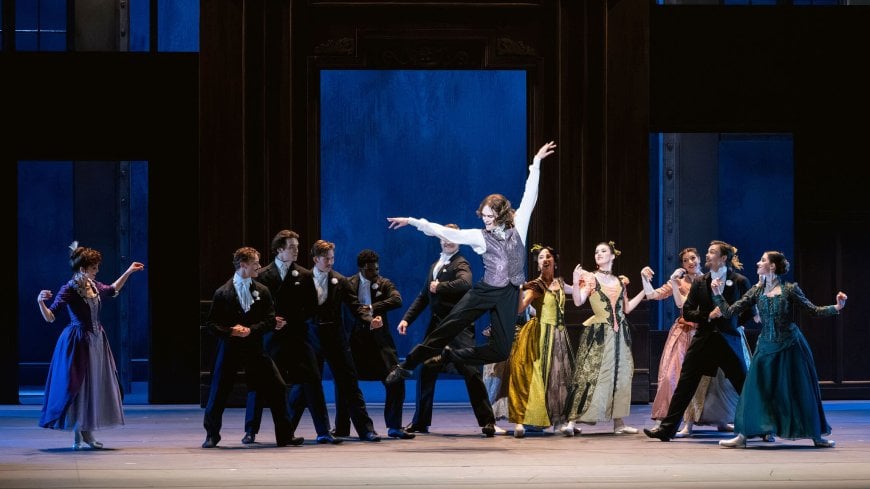
Translating the life of Oscar Wilde into ballet is no small undertaking. One of literature’s most celebrated wordsmiths, Wilde built his reputation on the precision of his language, the brilliance of his wit, and his ability to expose the hypocrisies of Victorian society. To tell his story without words, therefore, is an ambitious proposition. Yet Christopher Wheeldon’s Oscar, performed by the Australian Ballet, rises to the challenge with extraordinary confidence, delivering a production that is as technically accomplished as it is emotionally enriching.
The opening-night performance by The Australian Ballet at the New York City Center was a testament to the power of ballet as a form of theatrical storytelling. From meticulously constructed staging to beautifully paced choreography, every element felt purposeful. The result was a production that captured both the grandeur of Wilde’s public persona and the devastating consequences of a society that refused to accept him.
The Picture of Dorian Gray and The Nightingale and the Rose emerge as extensions of the emotional and psychological landscape surrounding Wilde. As the Nightingale, Grace Carroll is mesmerising. There is a moment during her performance when the audience seems to collectively catch its breath, gasping at the sight of her dancing. With her delicate lines, fluid movements, and extraordinary lightness, Carroll seems to transcend the human form, embodying the bird with a beauty that is both ethereal and convincing. Adam Elmes’s Dorian Gray provides a darker counterpoint, performed with technical skill and a sinister undertone that equally captures the audience’s attention. Joseph Caley as Robbie Ross, Elijah Trevitt as Lord Alfred “Bosie” Douglas, and Sharni Spencer as Constance Wilde bring grace and emotional nuance to their respective roles as those who were closest to OscarWilde, demonstrating their deep affection for him, and the complexities of his relationships.
At the centre of the production is Callum Linnane as Oscar Wilde. He captures Wilde’s larger than life presence with remarkable sensitivity, balancing the flamboyance and confidence with vulnerable introspection. Linnane’s acting is beautiful in its subtlety; through the smallest gestures, shifts in expression and nuances of movement, he conveys an extraordinary depth of feeling. His portrayal never feels like a mere imitation of a literary icon, but rather an intimate exploration of the man beneath the public persona. It is a beautifully realised performance that gives the ballet its emotional anchor and showcases the benefits from the close attention of Artistic Director David Hallberg, himself a famed dancer of the American Ballet Theatre and the Bolshoi Ballet.
The transitions between biography and fiction provide opportunities for the production’s staging and choreography to flourish. The theatrical transitions are handled with elegance, allowing the production to move between the external world and the imaginative spaces associated with Wilde’s literary creations.

Throughout, Wheeldon demonstrates an exceptional command of classical technique while using contemporary movement to communicate emotional complexity. Joby Talbot’s score, conducted by Jonathan Lo, provides a beautiful foundation for this exploration. Rich and evocative, the music gives the choreography both momentum and emotional depth. The relationship between music and movement is satisfying, with neither competing for attention; instead, they work in tandem to create something greater than the sum of their parts.
There is something particularly moving about seeing Wilde’s life expressed through an art form that depends so profoundly on the body. His story was shaped by a society determined to regulate how certain people could love, behave and exist. The ballet’s achievement lies not simply in commemorating a remarkable artist, but in restoring a measure of dignity to a life that was publicly disgraced.
For a story so profoundly concerned with the relationship between artistic expression and personal freedom, ballet proves an unexpectedly powerful medium. In Oscar, Wheeldon and The Australian Ballet honour Wilde’s legacy through a production of extraordinary beauty and precision, celebrating an artist whose enduring literary brilliance stands in stark contrast to the prejudice and persecution he endured in life.
The Australian Ballet, touring the US for the first time in 15 years, has shown that it is a force on the world stage of ballet. The company dances as well as any in the world andhas been bold enough to commission a work that is different and looks to the future of an art form increasingly challenged by rising costs and an ageing audience.
I daresay Oscar Wilde would have been proud of this production, and Wheeldon, Hallberg, and The Australian Ballet are to be commended for boldly striking a new path.
Genevieve Dammery attended two performances of Oscar as a guest of The Australian Ballet.





Leave a Reply