
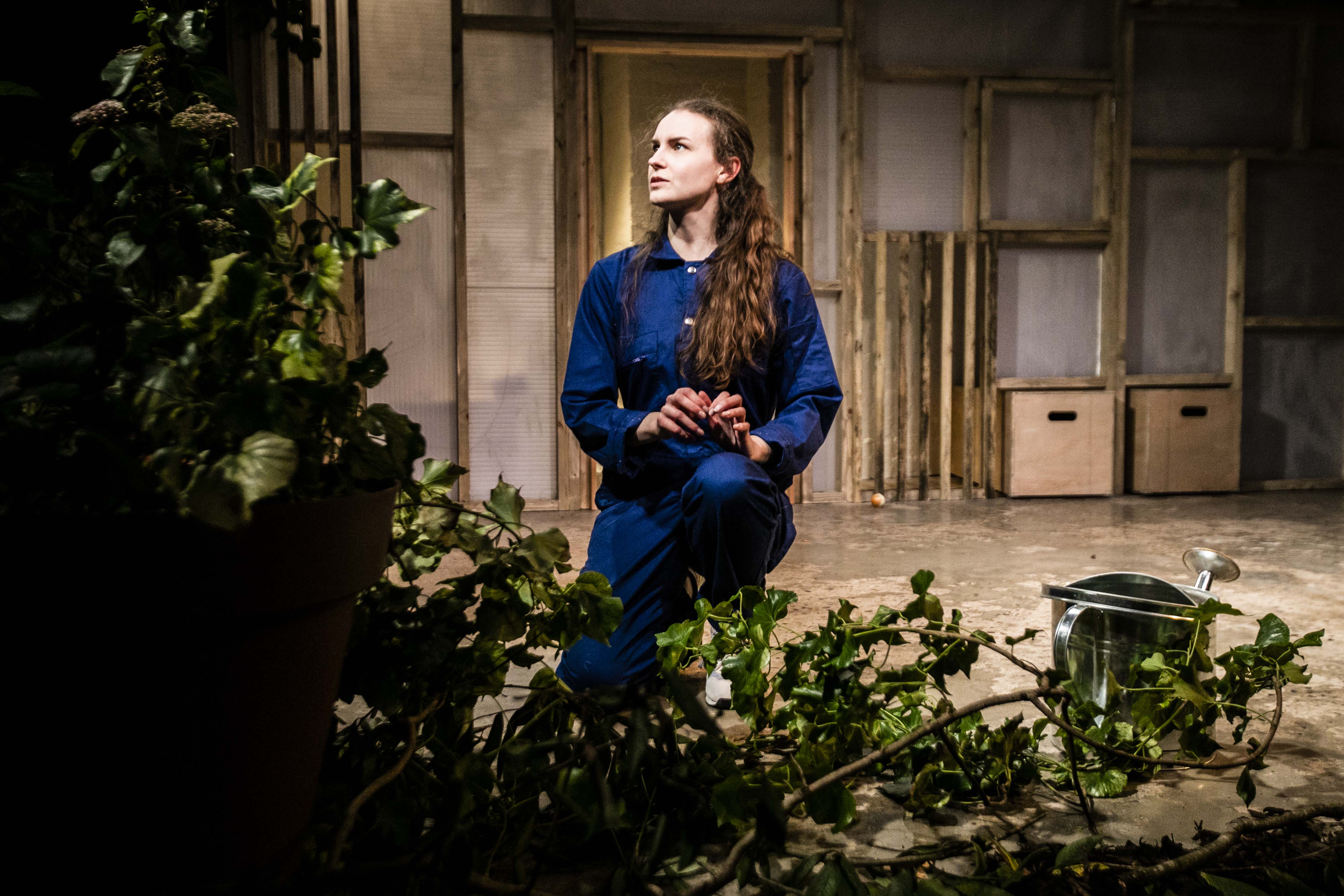
Allison Davies’s play, Tiny Fragments of Beautiful Light, is a warm, compassionate and playful love story based on her own experience of autism. It was first seen in Newcastle in 2023, and Birmingham is the last stop on this 2025 tour.
Allison joins us on Close-Up Culture to tell us more…
Hi, it’s lovely to be chatting with you! Please could you tell us about Tiny Fragments of Beautiful Light?
Tiny Fragments is a play that began as a monologue, written during the spring/summer of 2020, so it’s had rather a long gestation. At its heart the show is a love story, both in terms of two people falling for one another, but also in terms of a woman’s growing self-acceptance.
What inspired you to write the show?
The inspiration came from a growing awareness that I might be neurodiverse and then one day switching the radio on and hearing an interview with Katherine May. So much of what she said about being an autistic woman resonated with me, so I began writing as a way of processing my thoughts and feelings, alongside going through the diagnostic process. I did a lot of reading too, as I always feel better when armed with information.
This story must be quite personal to you. What was it like to write something so close to the heart?
Writing something so close to the heart and seeing it on stage is scary, like being naked in Fenwicks’ window, so in all honesty part of me wants to run off and hide under a nice, cool rock.
But I’m also incredibly grateful that writing the play means I’ve had the joy of working with some brilliantly creative and genuinely wonderful people.

How important do you think it is to share the female experience of autism diagnoses?
Until relatively recently, there was an assumption that the vast majority of autistic people were men and boys, but we now know this is wrong. Neurodiversity occurs throughout human populations, and women, girls and non-binary people are just as likely to be on the spectrum. I think it’s important to set the record straight, especially in light of the outdated assumptions and stereotypes that still persist. Women and girls still face barriers to getting diagnosis and support. I don’t want to load too much onto Tiny Fragments, but if the play helps even one woman feel seen, then that’s a positive.
You offer audiences the option to wear headphones during the performance. Do you think accessibility like this in art should be more widespread?
Absolutely. Art should be made accessible and enjoyable to everyone, and as an autistic person I feel a sense of responsibility to try to get things right for anyone coming to see the show, because I want them to feel safe and to have a great time. I know what it’s like to feel ‘trapped’ by an experience or in a space and I’d hate to put anyone in that position. It’s about respect, and perhaps even kindness, which has been reduced to a bit of a cliché these days but which I think we need more and more in these ‘interesting’ times. There’s a definitely a growing narrative around accessibility, which can only be a positive.
What do you find is the biggest misconception with autism in the arts?
There’s a persistent myth that autistic people lack imagination, can’t handle abstract thought and therefore aren’t really cut out for a career in the arts. When I’m put on the spot my brain freezes and I’m sure many other autistic artists respond in a similar way, leading to us being underestimated by people who only see our masked selves. Throw social anxiety into the mix and certain situations can be excruciating, and I get upset at how difficult it is to be ‘heard’ sometimes.
If you could collaborate with any actor/writer/director, who would you choose and why?
What a great question! I’d love to work with Vici Wreford-Sinnott, an incredible write/director and passionate campaigner for cultural equality for disabled people in the arts. We were blessed to have Vici as our access consultant on Tiny Fragments, but I’d love to work with her in creating work too. I’d also love to work with Kiran Rao, writer/director of my favourite film, Dhobi Ghat, a visual love poem to Mumbai, a city close to my heart.
Title image by Victoria Wai



Leave a Reply