
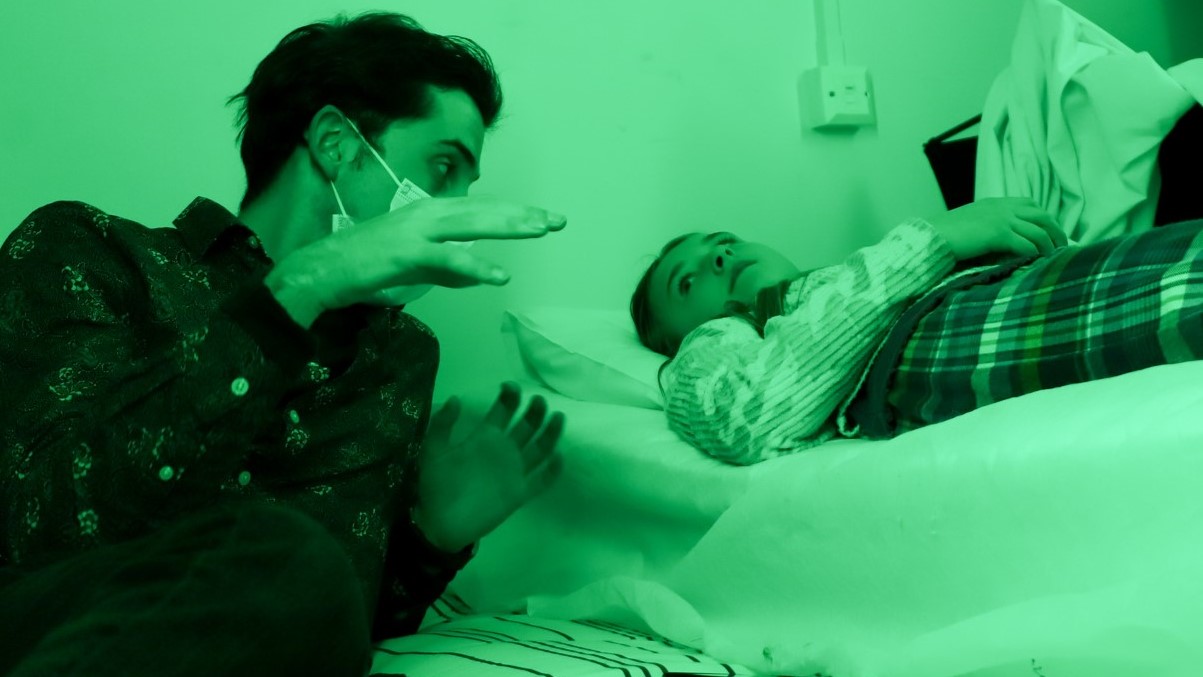
Available to watch from today, In a House, At Night follows 7-year-old Lynn who leaves her mother after a tantrum and wanders the corridors of the women’s shelter where they’re living, coming face to face with the residents’ nightmares. After reviewing the short, Anna was able to ask writer & director Tomás Ferreira more about his creative process.
Hi Tomás, thanks for joining us on Close-Up Culture! Your short film In a House, At Night is great at exploring our fears and what can come out at night. What is your process as a director when you first get an idea that you want to tell?
Hello, Anna. Thank you for having me. It’s a pleasure to be here. Isn’t that the ultimate question. What’s that first click? When is an idea the one? Well, often with me ideas tend to come when I least expect as I walk about and just observe things. I see a situation in real life, a place, an interaction between two strangers, for instance, and it’s really my mind playing with the possibilities of what that means that spurs the imagination and builds a story.
If the concept stays for me for weeks, that’s when I know I have something cooking, though it’s not as entirely magical as it seems. On the one hand, there’s a work of intuition, the creative side of your brain that works almost without you noticing, adding different textures to the story as the days pass and you come in and out of it like in a dream. That’s a beautiful part of the process, when the world of the story, the characters, speaks to you softly and sure of itself, only coming in moments of true inspiration. It’s a rare thing.
Thus, on the other hand, sometimes the process isn’t as effortless. I may feel strongly about an idea, but I need to sit down and write about it very early on to try and decode what my interest in it actually is, what is the main point of view, where do I want to take my characters and why? The closer you feel your idea is reflecting the Truth of real life in a way that excites you, the better! if it holds contradictions that thrill you regarding the human condition, the better! This more rational part of the early creative process may enlighten the path further when one feels ready to start an outline and so on, but it’s really like Hemingway says: sometimes “All you do is sit down at a typewriter and bleed”.

The setting for the film is a women’s shelter and we get to see some of the nightmares the people living in these places can go through. Why did you want to tell this story, and why now?
There is a house near where I live, here in Portugal, which is a shelter for victims of domestic abuse. At night, I was walking, as I did a lot during the pandemic in 2020, and I came across the image of this house, which from the outside looks like something innocent, white and pink, but at the same time retains something frightening, horrific within it. It had this great wall surrounding it, these bars on the windows. Suddenly, I saw a mother and a child watching television, illuminated by that light [from the screen] and I thought ‘what a fragile image in such a heavy world’.
The memory of this mysterious house, pretending to be a home for strangers, these different families, bonded by an unwanted shared trauma painted a very interesting uncharted territory for me to explore. I knew there was a story there and furthermore, an incredibly original one, since shelter life isn’t often portrayed on film. Now or whenever, I thought it was a timeless experience to show on screen, a living world that was proof of the terrible scars that human beings leave on one another.
The actors in your film are brilliant, especially Honor Davis-Pye who plays 7-year-old Lynn. How did you find your cast and make sure they were prepared for the story you wanted to tell?
Well, I used a platform called Star Now through which I found Moa Myerson who plays Alice, the mother, and in the case of Honor, who plays her daughter, her father reached out to me over email with an interest in the short after seeing a casting call on social media.
Both of them were great actresses to work with, enthusiastic about the work and always asking questions about their characters and the evolution of the narrative. I couldn’t have asked for better collaborators. After casting, we rehearsed in preparation for the shooting. employed theatre games to build a sense of trust between them and really tried to spur their imagination concerning the world of the story. For instance, one of the exercises was just Alice and Lynn going through their morning routine at the shelter with their eyes closed. I think this really allowed them as actors to find another space of being beyond the script itself and make them at ease with the characters. It was very moving to see the two of them as mother and daughter come together in that exercise with their eyes closed.
Then of course, we analysed the script, in particular the dialogue, discussed the dramatic beats and what would each character be looking for at each step of this battle concerning returning home.
You shot the film whilst studying at the University of South Wales. Do you have any funny behind the scenes stories you can share with us?
Our set was this student apartment at a university campus. Now, this campus was located on a mountain hillside and our location was at the very top of it, ah ah. So, every morning, me and my sound director, Gerardo, who was staying with me for the duration of the shoot, had to go up there on foot while carrying equipment and cursing the heavens every day of production ah ah. I remember Gerry making jokes the whole way, venting his frustration at the mountain.
I don’t think we can talk about the film without going into detail on the visuals. Lighting plays such an important part, especially the colours. Can you tell us why you chose certain ones?
Yes, of course. Tom Barker was the director of photography and he was a master at realising all those tonalities that you see in the film as I envisioned them. The light work really shifted according to the emotional progression of the characters. I discussed it at length with Tom for each scene we embarked on. At first, the fluorescent green and purple lights in their bedroom created this lively, warm and imaginary bubble soon to be popped by the sickness of successive colours in the film: predominantly yellow, the colour of fear, the menacing exterior of the street, and blue, a sad colour of longing, a calling to the past.
Another element I want to know more about is the music and soundscape. Sound is so important in horror films; how did you work with your team to build your final product?
The music was very much inspired by the score in the films of David Lynch and subsequent filmmakers influenced by him, since from a very early stage I knew that only the ethereal sounds of synth guitar, piano and all encompassing electronic atmosphere could smoothly convey the intimacy between the characters, a sense of fantasy while contrasting it with the greatest moments of terror in Lynn’s journey. I have Sean Spiteri, our composer, to thank for his dedication and enthusiasm for creating the music in the film.
Likewise Alex Newman and Gerardo Ruiz, the sound designers, were very sensitive in crafting the soundscape as a key part of the magical realism perception from which we view the grounded aspects of the story. In discussing with them what the sound would be like, we tried to incorporate as many textures as possible searching for realism against the surreal visuals, which in turn would give the ordinary of everyday life an alienated sense. One of the contributing factors is that many of the sounds we hear suggesting other presences in the house are played off-screen, never fully knowing what or who it is we are listening to.

You’re a co-host on the Royale Without Cheese podcast and a big watcher of films. What have you seen recently that you’ve been inspired by?
Good question. Thank you for mentioning the podcast. Yes, indeed. It has been quite a journey with that project as well, having not only reviewed many films, varied in style and period, but also interviewed all kinds of filmmakers. Being three friends from the Film School days, we really started the podcast out of this belief that talking about cinema is as much part of filmmaking as the very act of making it. The exchange of different perceptions and thoughts is also part of that gesture of being “inspired” by others that you speak of.
Now, if I had to pick a movie that impressed recently, it would definitely be Alice Rohrwacher’s “La Chimera”. That was outside of the podcast programme so to speak, but it was an amazing watch. Surprisingly, it isn’t often that a movie really touches you both intellectually and emotionally so when a movie comes along and grabs you like that by surprise, it’s an amazing hug ah ah. I love the ideas of spirituality and love in the film and the way the director expresses herself, reminding me of the narrative fluidity and magic of Fellini.
Now, within the Royale Without Cheese reviews, I would say that “Anatomy of a Fall” was a film that impressed me for sure. For the reader at home, feel free to check out the podcast on Spotify, YouTube or apple podcasts ah ah, wink, wink.
Now that the film has worked around the festival circuit, what are you working on next?
I am finishing the first draft of a feature film idea. There is also another short film project that has been developing in the back of my mind recently, much like in that dream logic that I spoke of earlier and that excites me. I enjoy my intimacy with the world of the stories, so can’t really go deeper in revealing either ah ah.
The short film “In a House, At Night” is now available to the public on Vimeo. Check it out here. Feel free to comment, share or simply give a like.




Leave a Reply