
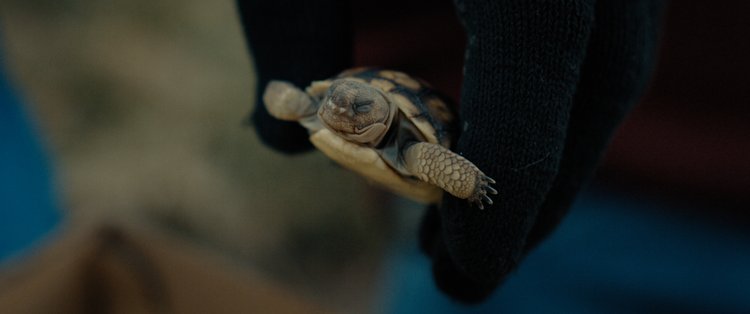
Directors Brett Marty and Josh Izenberg join us on Close-Up Culture to discuss Eco-Hack!
The short film follows Tim Shields down an unconventional route to save the Desert Tortoise. Educating and entertaining, we watch Tim turn away from traditional conservation biology to tackle the ballooning Raven population brought on by increased human activity. Eco-Hack has qualified to be considered for a 2024 Academy Award after winning Best Documentary Short at the Palm Springs International ShortFest and HotDocs International in Toronto.
ECO-HACK! is the perfect name for this film; it’s entertaining – the idea of hacking nature – yet is exactly what Tim Shields is doing with his work. How did you brainstorm the name for this docu-short and were there any other contenders?
Thanks! We like it a lot, too. Felt like it just really encapsulated the spirit of what Tim is doing. And that exclamation point gets a lot of credit, too.
There wasn’t a brainstorm, actually. It was the first idea (I think it was Josh’s) — and we never looked back.
What drew you into covering Tim Shield’s work?
As of late, we’ve felt a strong pull to tell environmental stories. To us, climate change feels like the most profoundly important problem right now — and we’ll be dealing with the fallout for decades to come. But, so often, films about climate change are incredibly sad and depressing. And rightfully so! But, as Josh likes to say, they can sometimes feel like an “eat your vegetables” approach. And those are important films, too! …but our theory of the case is: despair isn’t the best motivator. If you want to make an impact with a documentary, inspiration is — and if you can do that while also entertaining people and making them laugh, all the better.
And that’s what drew us to Tim’s work. Not only was it a solution-based approach to an urgent problem, it was pretty madcap, both incredibly fun and funny. Tim, Frank, and their team were — and continue to — invent and adapt any high-tech tool they could get their hands on, implementing them in fascinating and quirky new ways. Watching them, they’re like kids in a candy store. (They let us try out the laser to shoo away ravens, and it was like playing a video game…)
Not only is it hilarious, it’s working!
What I love most about this short is it makes science fun, entertaining and lighthearted – not just numbers and statistics. Was this something you feel Tim brought through his work, or was it brought in through the process of documenting his work into a short film?
Both! Tim is exactly who he seems to be on screen. Always a funny turn of phrase, endless optimism, and a deep love for animals and the natural world.
Not to mention, the raven — being such an incredibly intelligent animal — made for a pretty comedic foe. It was like Tom and Jerry out in the desert… And the raven was Jerry.
And it was exactly the kind of story we were looking for… someone using technology in a novel way to solve an important environmental problem. From there, we just looked for every opportunity for irony and the natural humor in a tough situation — and hope that it made for an enchanting and inspirational watch.
What was working with Tim Shields like?
In documentary, we’ve always felt like the character or subject is the most important element. No matter how thrilling or interesting the story is, you still need a captivating character to hold the audience’s attention.
And Tim did a lot of the hard work for us. It’s wild. He has this delightful ability to be totally himself in front of the camera. He doesn’t hold anything back — or get guarded or uncomfortable when the red light comes on — nor does he feel like he has to put on any kind of show for you. He’s just himself…

Would you consider ever doing a feature length documentary on his work?
We’ve talked a lot about it, actually. It’s a no-brainer in a lot of ways. We’re just waiting for the right moment to turn the cameras back on, til the story develops enough to sustain a feature-length.
Originally, Eco-Hack! was conceived of as a docuseries — each episode about a different scientist out in the field, using technology in novel ways to help an ecosystem or endangered species or in the fight against climate change. We still love that idea…
Do we know if there have been any updates in Tim’s work since ECO-HACK! was made?
Loads! They’ve gotten grants from the National Science Foundation, won a massive Roosevelt Genius Prize, and are leading a $2M project for the state of California to try all their tools at once, on a big scale, throughout the Mojave.
Are there any other projects the two of you have worked together on? And what drew you to co-direct this short?
We’ve been collaborating and co-directing on short docs for about 8 years. Most recently, we did another outdoor film about a falconer up in the Eastern Sierras for Patagonia Films last year. And we’re currently in production on another film in the same vein as Eco-Hack! about some plant geneticists.
Joshua, I believe you have a lot of experience in cinematography – do you feel you have a certain style to the way you work, and – if so – how did this influence the making of the film?
Yes, I’m spending a lot more time behind the camera now. I’m looking for intimacy in camerawork — it’s all about connection to the subjects and the landscape. That means different things for different projects, but it’s all about building a sense of place and character. I love how it’s possible to bring the tools of narrative cinematography to docs now. With Eco-Hack! we wanted to celebrate the Mojave — hot, dry, magical — and Phil Briggs, our DP, did a wonderful job inhabiting that world with us.

Brett, similar question for you regarding directing style, what is it like co-directing a short with someone and what do you think you have learnt from working alongside Joshua?
Co-directing with Josh feels pretty natural. Our skill sets and tastes are pretty complementary. If there’s something we disagree on, we just hash it out until we find something we both like — and usually without fail, that new solution ends up being better. Ultimately, I think it makes our films better than they otherwise would’ve been. And it’s also a lot more fun. We’ve developed a lot of trust over the years and have gotten pretty good at communicating. And I know it’s not only made me a better filmmaker but also a better person.
And of course, Joshua, what do you think you have taken away from working alongside Brett?
Filmmaking is hard, but Brett has a nothing-is-impossible attitude that has shepherded along so many of our projects even when the going gets rough. Which it usually does. He is incredibly thorough and believes in getting things right, which has been a good push I’ve often needed.
For both of you, if you could choose one director to work with – living or dead – who would you choose?
Werner Herzog! …is there another choice?
You have qualified to be considered for a 2024 Academy-Award! Congratulations! What was this process like?
It was a lot of fun. This one really made the rounds at film festivals, and the reactions were really great… Really feel like we hit the sweet spot with Eco-Hack! …a lot of that is luck, a lot is having a fun subject and subject matter, and the rest is just getting out of the way.
Is there anywhere people can view this incredibly entertaining (and educational!) short film?
If you’re in North America, you can view it at The New Yorker. If you’re international, you can also find it on Vimeo Staff Picks.
And where can people follow your film’s Oscar progress?
On Instagram at @brettmarty @onlyhumanfilm and @speculativefilms


Leave a Reply